Pearson+ LogoPearson+ Logo
Ch. 52 - An Introduction to Ecology and the Biosphere
Campbell - Campbell Biology 12th Edition
Urry12th EditionCampbell BiologyISBN: 9785794169850Not the one you use?Change textbook
Chapter 52, Problem 4

The oceans affect the biosphere by
a. Absorbing a substantial amount of the biosphere's oxygen
b. Regulating the pH of freshwater biomes and terrestrial groundwater
c. Decreasing winter temperatures of coastal terrestrial biomes
d. Removing carbon dioxide from the atmosphere

Verified step by step guidance
1
Understand the role of oceans in the global carbon cycle. Oceans act as a major carbon sink, meaning they absorb carbon dioxide (CO2) from the atmosphere, which helps regulate atmospheric CO2 levels.
Consider the process of photosynthesis in marine environments. Phytoplankton, which are microscopic marine plants, use sunlight to convert CO2 and water into oxygen and glucose, thus contributing to oxygen production rather than absorption.
Evaluate the impact of oceans on climate regulation. Oceans have a high heat capacity, which allows them to store and distribute heat, influencing climate and weather patterns, including moderating temperatures in coastal regions.
Examine the role of oceans in regulating pH levels. While oceans do not directly regulate the pH of freshwater biomes or terrestrial groundwater, they do play a role in the global carbon cycle, which can indirectly affect pH levels through the carbonic acid equilibrium.
Identify the correct statement based on the above analysis. The oceans primarily affect the biosphere by removing carbon dioxide from the atmosphere, which aligns with option (D).

Verified video answer for a similar problem:

This video solution was recommended by our tutors as helpful for the problem above.
Video duration:
2m
Was this helpful?

Key Concepts

Here are the essential concepts you must grasp in order to answer the question correctly.

Ocean's Role in Carbon Dioxide Removal

Oceans play a crucial role in the global carbon cycle by absorbing carbon dioxide from the atmosphere. This process helps mitigate climate change by reducing greenhouse gas levels. Marine organisms, such as phytoplankton, use CO2 for photosynthesis, and some carbon is stored in ocean sediments, contributing to long-term carbon sequestration.
Recommended video:

Ocean's Influence on Coastal Climate

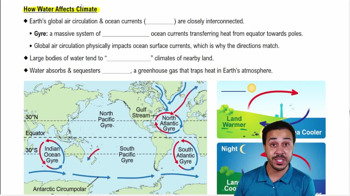
Oceans have a significant impact on coastal climates, particularly in moderating temperatures. Water has a high heat capacity, meaning it can absorb and store large amounts of heat. This property allows oceans to buffer temperature extremes, leading to milder winters and cooler summers in coastal regions compared to inland areas.
Recommended video:
Guided course
04:08
How Water Affects Climate

Ocean's Effect on Global Oxygen Levels

While oceans do not absorb a substantial amount of the biosphere's oxygen, they are vital in oxygen production. Phytoplankton, microscopic marine plants, contribute significantly to global oxygen levels through photosynthesis. This process not only supports marine life but also impacts atmospheric oxygen, highlighting the ocean's role in sustaining life on Earth.
Recommended video:
03:29
Permian Extinction
Related Practice
Textbook Question

Which of the following areas of study focuses on the exchange of energy, organisms, and materials between ecosystems?

a. Organismal ecology

b. Landscape ecology

c. Ecosystem ecology

d. Community ecology

828
views
Textbook Question

Which lake zone would be absent in a very shallow lake?

a. Benthic zone

b. Aphotic zone

c. Pelagic zone

d. Littoral zone

1698
views
Textbook Question

Which of the following is characteristic of most terrestrial biomes?

a. A distribution predicted almost entirely by rock and soil patterns

b. Clear boundaries between adjacent biomes

c. Vegetation demonstrating vertical layering

d. Cold winter months

1097
views
Textbook Question

Which statement about dispersal is true?

a. Dispersal is not a component of the life cycles of most plants and animals.

b. Dispersal occurs only on an evolutionary time scale.

c. Colonization of devastated areas after floods or volcanic eruptions depends on dispersal.

d. The ability to disperse does not affect the geographic distribution of a species.

1072
views
Textbook Question

When climbing a mountain, we can observe transitions in biological communities that are analogous to the changes

a. In biomes at different latitudes

b. In different depths in the ocean

c. In a community through different seasons

d. In an ecosystem as it evolves over time

928
views
Textbook Question

Suppose that the number of bird species is determined mainly by the number of vertical strata found in the environment. If so, in which of the following biomes would you find the greatest number of bird species?

a. Tropical rain forest

b. Savanna

c. Desert

d. Temperate broadleaf forest

1369
views