Ch. 24 - Speciation
Freeman - Biological Science 8th Edition
Freeman8th EditionBiological ScienceISBN: 9780138276263Not the one you use?Change textbook
Chapter 24, Problem 10

All over the world, natural habitats are being fragmented into tiny islands by suburbs, ranches, farms, and roads. If asked to join a science panel to speak to Congress, could you explain how this fragmentation process could lead to extinction? How it could lead to speciation?

Verified step by step guidance
1
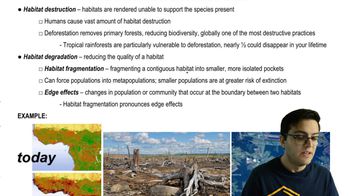
Explain the concept of habitat fragmentation: Habitat fragmentation occurs when large, continuous areas of habitat are divided into smaller, isolated patches due to human activities such as urban development, agriculture, and road construction.
Discuss the impact on species and genetic diversity: Fragmentation reduces the size of habitat patches and isolates populations, limiting the movement of individuals between patches. This isolation can lead to reduced genetic diversity as smaller populations have fewer mating options and are more susceptible to inbreeding.
Describe how fragmentation can lead to extinction: Smaller, isolated populations are more vulnerable to environmental fluctuations, diseases, and demographic changes. With limited genetic diversity and fewer individuals, the probability of extinction increases as populations are less able to adapt to new challenges or changes in their environment.
Explain how fragmentation could lead to speciation: Over time, isolated populations may undergo genetic drift or adapt to their specific local environments, leading to genetic differences significant enough to result in speciation. This process, known as allopatric speciation, occurs when populations of the same species become geographically isolated from each other and evolve independently.
Highlight the importance of addressing habitat fragmentation: Emphasize to Congress the need for conservation strategies that maintain or restore connectivity between habitat patches, such as wildlife corridors, to support biodiversity, reduce the risk of extinction, and potentially facilitate natural processes of speciation.

Verified video answer for a similar problem:

This video solution was recommended by our tutors as helpful for the problem above.
Video duration:
2m
Was this helpful?

Key Concepts

Here are the essential concepts you must grasp in order to answer the question correctly.

Habitat Fragmentation

Habitat fragmentation refers to the process where large, continuous habitats are divided into smaller, isolated patches due to human activities like urban development and agriculture. This division can disrupt ecosystems, making it difficult for species to find mates, food, and migrate, ultimately leading to population declines and increased extinction risk.
Recommended video:
Guided course
03:23
Habitat Destruction and Degradation

Extinction Vortex

The extinction vortex is a phenomenon where small populations become increasingly vulnerable to extinction due to inbreeding, genetic drift, and environmental changes. As populations shrink, their genetic diversity decreases, reducing their ability to adapt to changing conditions, which can accelerate their decline toward extinction.
Recommended video:
04:48
Extinctions

Speciation

Speciation is the evolutionary process by which new biological species arise. In fragmented habitats, isolated populations may experience different selective pressures, leading to divergent evolution. Over time, these populations can accumulate genetic differences, potentially resulting in the emergence of new species, especially if they adapt to their unique environments.
Recommended video:
Guided course
02:53
Allopatric Speciation
Related Practice
Textbook Question

If one species (2n = 10) crosses with another species (2n = 18), producing an allopolyploid offspring, what is the ploidy of the offspring?

a. 2n = 10

b. 2n = 18

c. 2n = 10+18 = 28

d. 4n = 36 +20 = 56

1111
views
Textbook Question

True or false? Speciation is a slow process. Justify your answer.

1321
views
Textbook Question

Three-spine sticklebacks are small fish that originated in the ocean and continue to exist there, but then some took up residence in hundreds of streams and freshwater lakes in the Northern Hemisphere. Predict whether you would expect to find different species in lakes today.

774
views
Textbook Question

A revolution in the study of human evolution is under way thanks to the invention of techniques that enable DNA sequencing of not only modern humans, but also ancient humans. Human populations today are not considered separate species under the biological species, morphospecies, and phylogenetic concepts. Explain what kind of evidence supports this statement.

844
views
Textbook Question

A revolution in the study of human evolution is under way thanks to the invention of techniques that enable DNA sequencing of not only modern humans, but also ancient humans. Before the application of DNA sequencing to fossils, which species concept was most useful for distinguishing human fossils? What is one disadvantage of this approach?

770
views
Textbook Question

A revolution in the study of human evolution is under way thanks to the invention of techniques that enable DNA sequencing of not only modern humans, but also ancient humans. Modern humans (Homo sapiens) and archaic humans called Neanderthals (H. neanderthalensis) shared a common ancestor in Africa but diverged in different geographic areas. When modern humans migrated out of Africa and dispersed around the world starting about 100,000 years ago, they overlapped with Neanderthals in Europe. This scenario is best described as

a. Species living in sympatry following allopatric speciation

b. Species living in sympatry following sympatric speciation

c. Species living in allopatry following allopatric speciation

d. Species living in allopatry following sympatric speciation

1017
views