Pearson+ LogoPearson+ Logo
Ch. 24 - Speciation
Freeman - Biological Science 8th Edition
Freeman8th EditionBiological ScienceISBN: 9780138276263Not the one you use?Change textbook
Chapter 24, Problem 9

Three-spine sticklebacks are small fish that originated in the ocean and continue to exist there, but then some took up residence in hundreds of streams and freshwater lakes in the Northern Hemisphere. Predict whether you would expect to find different species in lakes today.

Verified step by step guidance
1
Identify the key concept: Understand that the three-spine sticklebacks have adapted to different environments (oceanic and freshwater).
Consider genetic drift and natural selection: Recognize that populations in different environments may experience different selective pressures and random genetic changes over time.
Analyze isolation: Acknowledge that populations in separate lakes are geographically isolated from each other, which can lead to reproductive isolation.
Predict speciation: Infer that due to different selective pressures, genetic drift, and reproductive isolation, it is likely that different species of three-spine sticklebacks could have evolved in separate lakes.
Conclude based on evolutionary biology principles: Given the factors of different environments, isolation, and time, it is reasonable to expect that different species of three-spine sticklebacks might be found in various lakes today.

Verified video answer for a similar problem:

This video solution was recommended by our tutors as helpful for the problem above.
Video duration:
3m
Was this helpful?

Key Concepts

Here are the essential concepts you must grasp in order to answer the question correctly.

Speciation

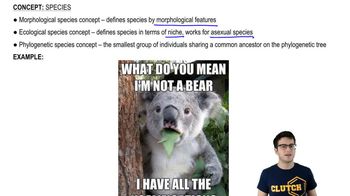
Speciation is the evolutionary process by which populations evolve to become distinct species. This often occurs when populations are geographically isolated, leading to genetic divergence due to different environmental pressures and selective forces. In the case of three-spine sticklebacks, those that moved from ocean to freshwater environments may have adapted to their new habitats, potentially resulting in the emergence of new species.
Recommended video:
Guided course
02:53
Allopatric Speciation

Adaptive Radiation

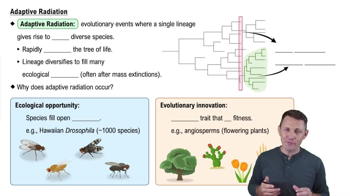
Adaptive radiation is a process in which organisms rapidly diversify into a variety of forms to adapt to different environments. This phenomenon often follows the colonization of new habitats, where species exploit various ecological niches. For three-spine sticklebacks, the transition from marine to freshwater environments could lead to adaptive radiation, resulting in different species adapted to specific lake conditions.
Recommended video:
05:24
Adaptive Radiation

Ecological Niche

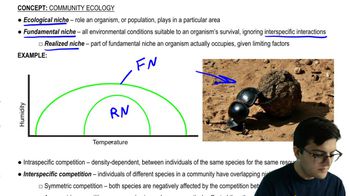
An ecological niche refers to the role and position a species has in its environment, encompassing its habitat, resource use, and interactions with other organisms. Different species can occupy different niches, which reduces competition and allows for coexistence. In lakes, three-spine sticklebacks may evolve distinct niches based on factors like food availability and predation, leading to the development of different species.
Recommended video:
Guided course
02:48
Ecological Niches and Competition
Related Practice
Textbook Question

Sexual selection favors individuals with traits that increase their ability to obtain mates, such as mating calls in crickets. Using this example, propose a scenario where sexual selection could contribute to divergence in sympatric speciation.

839
views
Textbook Question

If one species (2n = 10) crosses with another species (2n = 18), producing an allopolyploid offspring, what is the ploidy of the offspring?

a. 2n = 10

b. 2n = 18

c. 2n = 10+18 = 28

d. 4n = 36 +20 = 56

1131
views
Textbook Question

True or false? Speciation is a slow process. Justify your answer.

1336
views
Textbook Question

All over the world, natural habitats are being fragmented into tiny islands by suburbs, ranches, farms, and roads. If asked to join a science panel to speak to Congress, could you explain how this fragmentation process could lead to extinction? How it could lead to speciation?

614
views
Textbook Question

A revolution in the study of human evolution is under way thanks to the invention of techniques that enable DNA sequencing of not only modern humans, but also ancient humans. Human populations today are not considered separate species under the biological species, morphospecies, and phylogenetic concepts. Explain what kind of evidence supports this statement.

866
views
Textbook Question

A revolution in the study of human evolution is under way thanks to the invention of techniques that enable DNA sequencing of not only modern humans, but also ancient humans. Before the application of DNA sequencing to fossils, which species concept was most useful for distinguishing human fossils? What is one disadvantage of this approach?

795
views