
Pearson+ LogoPearson+ Logo
Ch. 24 - Speciation
Freeman - Biological Science 8th Edition
Freeman8th EditionBiological ScienceISBN: 9780138276263Not the one you use?Change textbook
Chapter 24, Problem 7

If one species (2n = 10) crosses with another species (2n = 18), producing an allopolyploid offspring, what is the ploidy of the offspring?
a. 2n = 10
b. 2n = 18
c. 2n = 10+18 = 28
d. 4n = 36 +20 = 56

Verified step by step guidance
1
Understand the concept of allopolyploidy: Allopolyploidy occurs when two different species interbreed, resulting in offspring with a combination of the parental species' chromosome sets.
Identify the chromosome numbers of the parent species: The first species has a diploid number of 2n=10, and the second species has a diploid number of 2n=18.
Determine the chromosome contribution from each parent: In an allopolyploid, the offspring typically receives one complete set of chromosomes from each parent species.
Calculate the total chromosome number in the offspring: Add the chromosome numbers from both parent species to find the total chromosome number in the offspring.
Consider the ploidy level: Since the offspring is an allopolyploid, it will have a ploidy level that is the sum of the chromosome sets from both parents, resulting in a new diploid number.

Verified video answer for a similar problem:

This video solution was recommended by our tutors as helpful for the problem above.
Video duration:
3m
Was this helpful?

Key Concepts

Here are the essential concepts you must grasp in order to answer the question correctly.

Allopolyploidy

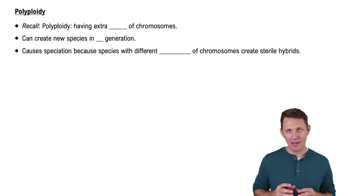
Allopolyploidy refers to the formation of a polyploid organism through the hybridization of two different species. This process involves the combination of the complete sets of chromosomes from each parent species, resulting in offspring with a higher chromosome number than either parent. It is a common mechanism in plant evolution, leading to new species with unique genetic combinations.
Recommended video:
05:53
Polyploidy

Chromosome Number

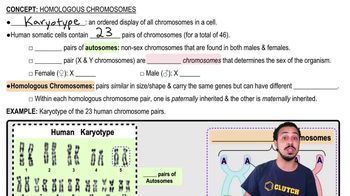
Chromosome number is the total count of chromosomes present in the nucleus of a cell. In diploid organisms, represented as 2n, chromosomes exist in pairs. When two species with different chromosome numbers cross, the resulting offspring's chromosome number is typically the sum of the two parent species' chromosome numbers, especially in cases of allopolyploidy.
Recommended video:
Guided course
08:09
Homologous Chromosomes

Hybridization

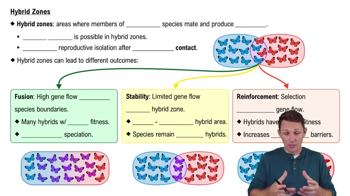
Hybridization is the process of crossing two genetically distinct species or varieties to produce offspring with traits from both parents. In the context of allopolyploidy, hybridization leads to the combination of different sets of chromosomes, creating a new organism with genetic material from both parent species. This can result in increased genetic diversity and novel characteristics in the offspring.
Recommended video:
04:38
Hybrid Zones
Related Practice
Textbook Question

Evaluate this statement: Gene flow increases the genetic divergence of populations.

1138
views
Textbook Question

When the ranges of two different species meet, a stable 'hybrid zone' occupied by hybrid individuals may form. How is this possible?

a. Two diverged populations are capable of mating and producing viable and fertile offspring.

b. Hybrid individuals are always allopolyploid and are thus unable to mate with either of the original species.

c. Hybrid individuals may have reduced fitness and thus be strongly selected against.

d. One species has a selective advantage, so as hybridization continues, the other species will go extinct.

738
views
Textbook Question

Sexual selection favors individuals with traits that increase their ability to obtain mates, such as mating calls in crickets. Using this example, propose a scenario where sexual selection could contribute to divergence in sympatric speciation.

839
views
Textbook Question

True or false? Speciation is a slow process. Justify your answer.

1336
views
Textbook Question

Three-spine sticklebacks are small fish that originated in the ocean and continue to exist there, but then some took up residence in hundreds of streams and freshwater lakes in the Northern Hemisphere. Predict whether you would expect to find different species in lakes today.

785
views
Textbook Question

All over the world, natural habitats are being fragmented into tiny islands by suburbs, ranches, farms, and roads. If asked to join a science panel to speak to Congress, could you explain how this fragmentation process could lead to extinction? How it could lead to speciation?

614
views