


Pearson+ LogoPearson+ Logo
Ch. 31 - Protostome Animals
Freeman - Biological Science 8th Edition
Freeman8th EditionBiological ScienceISBN: 9780138276263Not the one you use?Change textbook
Chapter 31, Problem 16f

A team of 102 scientists spent a year surveying a small area of the San Lorenzo rain forest in Panama to count the number of species of arthropods living there. After collecting 129,494 specimens—using nets, traps, shovels, tree-climbing harnesses, helium balloons, and other creative gear—it took the team eight years to sort and identify the arthropods. The researchers observed a strong correlation between the number of arthropod species and the number of plant species in the San Lorenzo forest.
Pose an evolutionary hypothesis to explain this correlation.

Verified step by step guidance
1
Step 1: Begin by understanding the relationship between arthropods and plants. Arthropods often rely on plants for food, shelter, and reproduction. Plants, in turn, may depend on arthropods for pollination, seed dispersal, or protection from herbivores. This mutualistic relationship can drive co-evolution.
Step 2: Consider the concept of co-evolution. Co-evolution occurs when two or more species influence each other's evolutionary trajectory. In this case, the diversity of plant species may create a variety of ecological niches, which can lead to the diversification of arthropod species.
Step 3: Reflect on the role of ecological niches. Each plant species may provide unique resources or habitats, such as specific types of leaves, flowers, or bark. Arthropods that specialize in utilizing these resources may evolve distinct adaptations, leading to speciation and increased arthropod diversity.
Step 4: Think about the evolutionary pressures involved. Plants may evolve traits to attract specific arthropods (e.g., flower shape, nectar composition), while arthropods may evolve traits to exploit specific plants (e.g., specialized mouthparts or behaviors). This reciprocal adaptation can enhance species diversity in both groups.
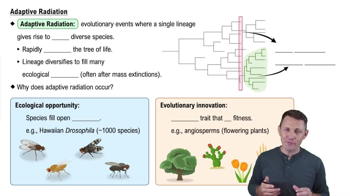
Step 5: Formulate the hypothesis: The observed correlation between arthropod and plant species diversity in the San Lorenzo forest can be explained by co-evolutionary processes. The diversification of plant species creates a variety of ecological niches, driving the adaptive radiation and speciation of arthropods over evolutionary time.

Verified video answer for a similar problem:

This video solution was recommended by our tutors as helpful for the problem above.
Video duration:
1m
Was this helpful?

Key Concepts

Here are the essential concepts you must grasp in order to answer the question correctly.

Biodiversity and Ecosystem Interdependence

Biodiversity refers to the variety of life in a particular habitat or ecosystem, including the number of species, genetic diversity, and ecosystem diversity. In ecosystems, different species often rely on one another for survival, forming complex interdependencies. A rich diversity of plant species can provide various habitats and resources, which in turn supports a greater diversity of arthropods, as these organisms often depend on plants for food and shelter.
Recommended video:
Guided course
04:07
Introduction to Ecosystems

Evolutionary Adaptation

Evolutionary adaptation is the process through which species undergo changes over generations to better fit their environment. This can involve physical changes, behavioral shifts, or changes in reproductive strategies. In the context of the San Lorenzo forest, arthropods may have evolved specific adaptations that allow them to exploit the diverse plant species, leading to a higher number of arthropod species in areas with rich plant diversity.
Recommended video:
05:24
Adaptive Radiation

Mutualism

Mutualism is a type of symbiotic relationship where two different species benefit from each other. In ecosystems, many arthropods play crucial roles in pollination and seed dispersal for plants, while plants provide food and habitat for arthropods. This mutualistic relationship can enhance species richness, as the presence of diverse plant species can attract a wider variety of arthropods, creating a feedback loop that promotes biodiversity.
Recommended video:
Guided course
02:56
Positive Interactions
Related Practice
Textbook Question

A team of 102 scientists spent a year surveying a small area of the San Lorenzo rain forest in Panama to count the number of species of arthropods living there. After collecting 129,494 specimens—using nets, traps, shovels, tree-climbing harnesses, helium balloons, and other creative gear—it took the team eight years to sort and identify the arthropods. The graph below shows some of the data for the major arthropod groups collected. Notice that the scale on the y-axis is logarithmic to make both small and large numbers legible on the same graph. For example, there are about 400 species of spiders but only 40 species of bees.

About how many arthropods were found in total?

About what percentage of these were beetles?

661
views
Textbook Question

A team of 102 scientists spent a year surveying a small area of the San Lorenzo rain forest in Panama to count the number of species of arthropods living there. After collecting 129,494 specimens—using nets, traps, shovels, tree-climbing harnesses, helium balloons, and other creative gear—it took the team eight years to sort and identify the arthropods. A team of 102 scientists spent a year surveying a small area of the San Lorenzo rain forest in Panama to count the number of species of arthropods living there. After collecting 129,494 specimens—using nets, traps, shovels, tree-climbing harnesses, helium balloons, and other creative gear—it took the team eight years to sort and identify the arthropods. Use the data in the graph to analyze the following statements.

Select True or False for each statement, then correct any false statements to make them true.

T/FAll taxa shown in the graph are insects.

T/FAll taxa shown in the graph have segmented bodies and limbs.

T/FAll taxa shown in the graph are terrestrial.

T/FIf the researchers had sampled for mollusks, they probably would have found almost as many species as they did for arthropods.

769
views
Textbook Question

A team of 102 scientists spent a year surveying a small area of the San Lorenzo rain forest in Panama to count the number of species of arthropods living there. After collecting 129,494 specimens—using nets, traps, shovels, tree-climbing harnesses, helium balloons, and other creative gear—it took the team eight years to sort and identify the arthropods. By comparing the number of arthropod species that were common among the 12 plots sampled, the researchers estimated that the total number of arthropods in the whole San Lorenzo forest is 25,000 species.

To come up with this estimate, what's one assumption the researchers had to make about the forest?

754
views