
Ch. 43 - Animal Nervous Systems
Chapter 43, Problem 6

Describe the role of summation in postsynaptic cells.

Verified step by step guidance
1
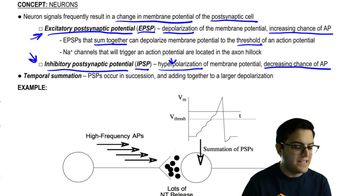
Summation in postsynaptic cells refers to the process by which multiple synaptic inputs combine their effects on a postsynaptic neuron to influence its overall level of activity.
There are two types of summation: temporal summation and spatial summation. Temporal summation occurs when a single presynaptic neuron fires action potentials so rapidly that the postsynaptic neuron does not have time to return to its resting potential between stimuli, leading to a cumulative effect.
Spatial summation occurs when multiple presynaptic neurons fire at the same time, but at different locations on the postsynaptic neuron. The combined input can have a greater effect than any single input alone, potentially bringing the postsynaptic cell to threshold and triggering an action potential.
Summation is crucial for neural integration, which is the process by which the nervous system processes all the incoming synaptic inputs to produce an appropriate output. This allows the nervous system to make complex decisions and responses.
The overall effect of summation can either be excitatory or inhibitory, depending on the nature of the neurotransmitters released by the presynaptic neurons and the types of receptors present on the postsynaptic neuron.

Verified video answer for a similar problem:

This video solution was recommended by our tutors as helpful for the problem above.
Video duration:
1m
Was this helpful?

Key Concepts

Here are the essential concepts you must grasp in order to answer the question correctly.

Postsynaptic Potential

Postsynaptic potentials are changes in the membrane potential of a postsynaptic neuron that occur when neurotransmitters bind to receptors. These potentials can be excitatory (EPSPs) or inhibitory (IPSPs), influencing whether the neuron will fire an action potential. Understanding these potentials is crucial for grasping how signals are transmitted across synapses.
Recommended video:
Guided course
05:33
Postsynaptic Potentials and Summation

Summation

Summation refers to the process by which multiple postsynaptic potentials combine to determine the overall change in membrane potential of a neuron. There are two types of summation: temporal, where multiple signals occur in quick succession, and spatial, where signals from different synapses converge. This process is essential for integrating signals and deciding whether to initiate an action potential.
Recommended video:
Guided course
05:33
Postsynaptic Potentials and Summation

Action Potential Threshold

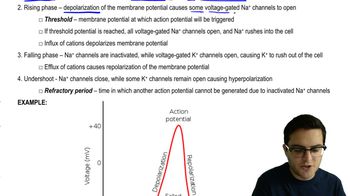
The action potential threshold is the critical level of depolarization that must be reached for a neuron to fire an action potential. If the summed postsynaptic potentials exceed this threshold, voltage-gated sodium channels open, leading to a rapid influx of sodium ions and the generation of an action potential. Understanding this threshold is key to comprehending how neurons communicate and process information.
Recommended video:
Guided course
09:55
Action Potential