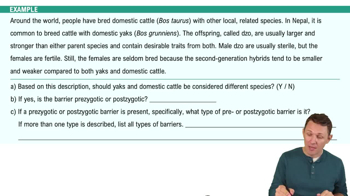
What is a disturbance? Consider the role of fire in a forest. Compare the consequences of high-frequency versus low-frequency fire, and high severity versus low severity of fire.
Suppose that a two-acre lawn on your college's campus is allowed to undergo succession. Describe how species traits, species interactions, and the site's history might affect the community that develops.
Verified step by step guidance
Verified video answer for a similar problem:
Key Concepts
Species Traits
Species Interactions
Site History
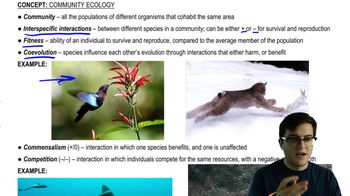
Draw a vertical food chain (part of a food web) showing that sea urchins eat kelp and that sea otters eat sea urchins.
Use this model to (1) show or explain how a trophic cascade works; and (2) offer an explanation for why otters are considered a keystone species.
In some circumstances, the use of probiotics, which stimulate the rapid growth of bacteria that are mutualistic or commensal with humans, can eliminate the need to use antibiotics, which can wipe out helpful bacteria along with harmful bacteria. The use of probiotics is an example of which process?
a. Succession
b. Competitive exclusion
c. Parasitism
d. Niche differentiation
Lyme disease is caused by infections of the bacterium Borrelia burgdorferi (stained blue in the inset, among red blood cells), which is transferred to humans via blood-sucking bites from the tick Ixodes scapularis. Lyme disease can cause flu-like symptoms in the short term and more serious illnesses in the long term if not treated.
Why is Lyme disease on the rise in eastern North America?
In relation to humans, B. burgdorferi is a/an ____________ and the tick is a/an _____________.
a. endoparasite/ectoparasite
b. endoparasite/host
c. parasitoid/host
d. parasite/predator
The carnivorous plant Nepenthes bicalcarata ('fanged pitcher plant') has a unique relationship with a species of ant—Camponotus schmitzi ('diving ant'). The diving ants are not digested by the pitcher plants but instead live on the plants and consume nectar. Diving ants also dive into the digestive juices in the pitcher, swim to the bottom, and capture and consume trapped insects, leaving uneaten body parts and ant feces behind.
What nutritional impact do the ants have on fanged pitcher plants?
Do the pitcher plants derive any nutritional benefit from this relationship?
Researchers tested the hypothesis that the relationship between diving ants and pitcher plants is mutualistic (i.e., both species derive a nutritional benefit). To do so, they compared leaf surface area (as a measure of overall growth) in two sets of pitcher plants: plants with diving ants and plants without. The results are shown in the graph. The P values indicate whether there is a significant relationship between the size of the host plants and the surface area of the host plants' leaves. Based on this graph, what conclusions can be drawn about the impact of diving ants on overall plant growth?
Lyme disease is caused by infections of the bacterium Borrelia burgdorferi (stained blue in the inset, among red blood cells), which is transferred to humans via blood-sucking bites from the tick, Ixodes scapularis. Lyme disease can cause flu-like symptoms in the short term and more serious illnesses in the long term if not treated.
Why is Lyme disease on the rise in eastern North America?
Newly hatched ticks do not harbor B. burgdorferi. Rather, they pick it up from certain hosts that are reservoirs of the bacterium. When a larval tick crawls onto a host, it may get groomed off and killed by the host, or it may feed successfully, in which case it may or may not then become infected with B. burgdorferi. Felicia Keesing and others measured the rate of tick feeding and infection on different hosts.
What percentage of ticks on mice were infected with B. burgdorferi? What percentage of ticks on opossums were groomed off and killed?