In Exercises 19–20, a few steps in the process of simplifying the given matrix to row-echelon form, with 1s down the diagonal from upper left to lower right, and 0s below the 1s, are shown. Fill in the missing numbers in the steps that are shown.
Table of contents
- 0. Review of Algebra4h 18m
- 1. Equations & Inequalities3h 18m
- 2. Graphs of Equations1h 43m
- 3. Functions2h 17m
- 4. Polynomial Functions1h 44m
- 5. Rational Functions1h 23m
- 6. Exponential & Logarithmic Functions2h 28m
- 7. Systems of Equations & Matrices4h 5m
- 8. Conic Sections2h 23m
- 9. Sequences, Series, & Induction1h 22m
- 10. Combinatorics & Probability1h 45m
7. Systems of Equations & Matrices
Introduction to Matrices
Problem 21
Textbook Question
Use the Gauss-Jordan method to solve each system of equations. For systems in two variables with infinitely many solutions, write the solution with y arbitrary. For systems in three variables with infinitely many solutions, write the solution set with z arbitrary.
x + y = 5
x - y = -1
Verified step by step guidance1
Write the system of equations as an augmented matrix. For the system \( \begin{cases} x + y = 5 \\ x - y = -1 \end{cases} \), the augmented matrix is:
\[\left[\begin{array}{cc|c} 1 & 1 & 5 \\ 1 & -1 & -1 \end{array}\right]\]
Use row operations to create a leading 1 in the first row, first column (which is already 1), and then eliminate the \( x \)-term in the second row by subtracting the first row from the second row. This means:
\[ R_2 \leftarrow R_2 - R_1 \]
After the row operation, the matrix will look like:
\[\left[\begin{array}{cc|c} 1 & 1 & 5 \\ 0 & -2 & -6 \end{array}\right]\]
Next, make the leading coefficient in the second row a 1 by dividing the entire second row by \(-2\):
\[ R_2 \leftarrow \frac{1}{-2} R_2 \]
Now, use the second row to eliminate the \( y \)-term in the first row by performing the operation:
\[ R_1 \leftarrow R_1 - (1) \times R_2 \]
This will give the matrix in reduced row echelon form, where you can read off the values of \( x \) and \( y \).
Translate the final matrix back into equations to find the solution for \( x \) and \( y \). Since this is a system of two equations with two variables, the solution will be a unique ordered pair \( (x, y) \).
Verified video answer for a similar problem:This video solution was recommended by our tutors as helpful for the problem above
Video duration:
5mPlay a video:
Was this helpful?
Key Concepts
Here are the essential concepts you must grasp in order to answer the question correctly.
Gauss-Jordan Elimination Method
Gauss-Jordan elimination is a systematic procedure to solve systems of linear equations by transforming the augmented matrix into reduced row-echelon form. This method uses row operations to simplify the matrix, making it easier to find the values of variables directly. It extends Gaussian elimination by continuing until each leading coefficient is 1 and all other entries in the column are zero.
Recommended video:
Guided course
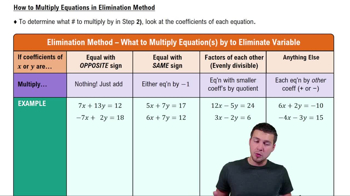
How to Multiply Equations in Elimination Method
Systems of Linear Equations
A system of linear equations consists of two or more linear equations with the same variables. Solutions are the values of variables that satisfy all equations simultaneously. Systems can have a unique solution, infinitely many solutions, or no solution, depending on the relationships between the equations.
Recommended video:
Guided course
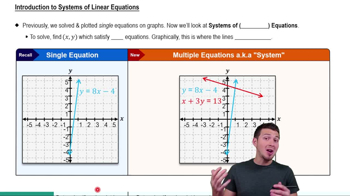
Introduction to Systems of Linear Equations
Parametric Solutions for Infinite Solutions
When a system has infinitely many solutions, some variables are expressed in terms of arbitrary parameters to describe the solution set. For two-variable systems, one variable (like y) is set as arbitrary; for three-variable systems, another variable (like z) is chosen. This approach clearly represents all possible solutions.
Recommended video:
Categorizing Linear Equations
Watch next
Master Introduction to Matrices with a bite sized video explanation from Patrick
Start learningRelated Videos
Related Practice
Textbook Question
931
views