Solve each system in Exercises 5–18. ⎩⎨⎧3(2x+y)+5z=−12(x−3y+4z)=−94(1+x)=−3(z−3y)
Verified step by step guidance
1
First, write down the given system of equations clearly:
\$3(2x + y) + 5z = -1$
\$2(x - 3y + 4z) = -9$
\$4(1 + x) = -3(z - 3y)$
Next, simplify each equation by distributing the constants inside the parentheses:
For the first equation: \$3 \times 2x + 3 \times y + 5z = -1\( which simplifies to \)6x + 3y + 5z = -1\(.
For the second equation: \)2 \times x - 2 \times 3y + 2 \times 4z = -9\( which simplifies to \)2x - 6y + 8z = -9\(.
For the third equation: \)4 \times 1 + 4 \times x = -3 \times z + 3 \times 3y\( which simplifies to \)4 + 4x = -3z + 9y$.
Rearrange the third equation to bring all terms to one side, making it consistent with the others:
\$4x - 9y + 3z = -4$
Now, write the simplified system of linear equations:
\$6x + 3y + 5z = -1$
\$2x - 6y + 8z = -9$
\$4x - 9y + 3z = -4$
To solve the system, choose a method such as substitution, elimination, or matrix methods (like Gaussian elimination). For example, you can:
- Use elimination to eliminate one variable between two equations,
- Then solve the resulting two-variable system,
- Substitute back to find the third variable.
Verified video answer for a similar problem:
This video solution was recommended by our tutors as helpful for the problem above
Video duration:
9m
Play a video:
Was this helpful?
Key Concepts
Here are the essential concepts you must grasp in order to answer the question correctly.
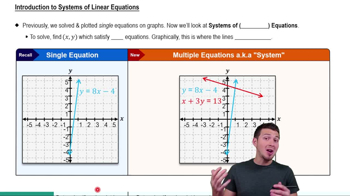
Systems of Linear Equations
A system of linear equations consists of two or more linear equations with the same variables. The goal is to find values for the variables that satisfy all equations simultaneously. Understanding how to interpret and set up these systems is essential for solving them.
Before solving, equations often need to be simplified by distributing constants and combining like terms. Rewriting the system in standard form (Ax + By + Cz = D) makes it easier to apply solution methods such as substitution or elimination.
Adding & Subtracting Unlike Radicals by Simplifying
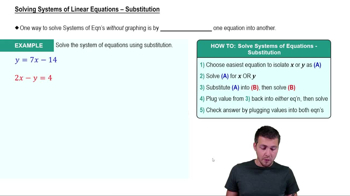
Methods for Solving Systems of Equations
Common methods include substitution, elimination, and using matrices. These techniques help find the values of variables that satisfy all equations. Choosing the appropriate method depends on the system's complexity and the number of variables.