6. Exponential & Logarithmic Functions
The Number e


Multiple Choice
Graph the given function.
A
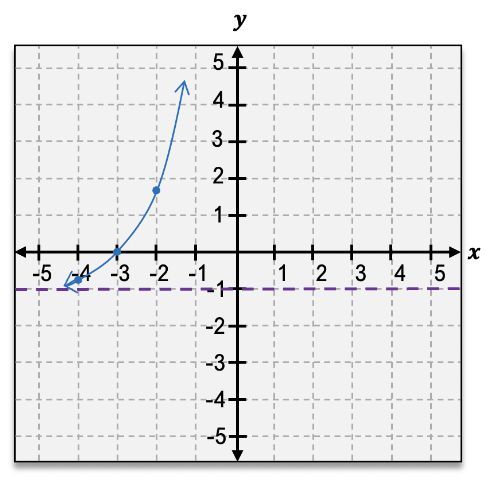
B

C

D

 Verified step by step guidance
1
Identify the function given: \( g(x) = e^{x+3} - 1 \). This is an exponential function with a horizontal shift and a vertical shift.
Recognize the transformations: The term \( x+3 \) indicates a horizontal shift to the left by 3 units, and the \( -1 \) indicates a vertical shift downward by 1 unit.
Determine the asymptote: The horizontal asymptote of the basic exponential function \( e^x \) is \( y = 0 \). After the vertical shift, the new asymptote is \( y = -1 \).
Plot key points: Calculate a few values of \( g(x) \) for different \( x \) values to help plot the graph. For example, when \( x = -3 \), \( g(-3) = e^{0} - 1 = 0 \). When \( x = -2 \), \( g(-2) = e^{1} - 1 \).
Sketch the graph: Start from the asymptote \( y = -1 \), plot the calculated points, and draw the curve showing exponential growth as \( x \) increases, ensuring the curve approaches the asymptote as \( x \) decreases.




