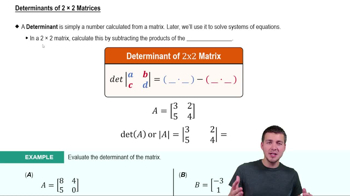
Identify the size of the matrix for which you need to evaluate the determinant (e.g., 2x2, 3x3, etc.).
For a 2x2 matrix \( \begin{bmatrix} a & b \\ c & d \end{bmatrix} \), use the formula for the determinant: \( \det = ad - bc \).
For a 3x3 matrix \( \begin{bmatrix} a & b & c \\ d & e & f \\ g & h & i \end{bmatrix} \), apply the rule of Sarrus or cofactor expansion to find the determinant.
If using cofactor expansion, select a row or column (usually one with zeros to simplify calculations), then calculate the minors and cofactors for each element in that row or column.
Sum the products of each element and its corresponding cofactor to get the determinant: \( \det = a_{ij} C_{ij} + a_{ik} C_{ik} + \ldots \), where \( C_{ij} \) are cofactors.
Verified video answer for a similar problem:
This video solution was recommended by our tutors as helpful for the problem above
Video duration:
2m
Play a video:
Was this helpful?
Key Concepts
Here are the essential concepts you must grasp in order to answer the question correctly.
Determinant of a Matrix
The determinant is a scalar value computed from a square matrix that provides important properties about the matrix, such as invertibility. It is calculated using specific rules depending on the matrix size, like expansion by minors or row operations.
Common methods to evaluate determinants include expansion by minors (cofactor expansion), using row reduction to echelon form, and applying properties of determinants to simplify calculations. Choosing an efficient method depends on the matrix size and structure.
Determinants have key properties such as: swapping two rows changes the sign, multiplying a row by a scalar multiplies the determinant by that scalar, and adding a multiple of one row to another does not change the determinant. These properties help simplify determinant evaluation.