Write each decimal as a fraction. (Do not write in lowest terms.) 0.087
Table of contents
- 0. Review of Algebra4h 18m
- 1. Equations & Inequalities3h 18m
- 2. Graphs of Equations1h 43m
- 3. Functions2h 17m
- 4. Polynomial Functions1h 44m
- 5. Rational Functions1h 23m
- 6. Exponential & Logarithmic Functions2h 28m
- 7. Systems of Equations & Matrices4h 5m
- 8. Conic Sections2h 23m
- 9. Sequences, Series, & Induction1h 22m
- 10. Combinatorics & Probability1h 45m
0. Review of Algebra
Exponents
Problem 91
Textbook Question
Perform the indicated computations. Write the answers in scientific notation. If necessary, round the decimal factor in your scientific notation answer to two decimal places.
Verified step by step guidance1
Identify the problem as multiplying two numbers expressed in scientific notation: \((6.1 \times 10^{-8})\) and \((2 \times 10^{-4})\).
Recall the rule for multiplying numbers in scientific notation: multiply the decimal factors and add the exponents of 10. That is, \((a \times 10^m)(b \times 10^n) = (a \times b) \times 10^{m+n}\).
Multiply the decimal factors: \$6.1 \times 2$.
Add the exponents of 10: \(-8 + (-4)\).
Combine the results to write the product in scientific notation as \((6.1 \times 2) \times 10^{-8 + (-4)}\), then if necessary, adjust the decimal factor to be between 1 and 10 and round to two decimal places.
Verified video answer for a similar problem:This video solution was recommended by our tutors as helpful for the problem above
Video duration:
1mPlay a video:
Was this helpful?
Key Concepts
Here are the essential concepts you must grasp in order to answer the question correctly.
Scientific Notation
Scientific notation expresses numbers as a product of a decimal factor and a power of ten, typically in the form a × 10^n, where 1 ≤ a < 10 and n is an integer. It simplifies working with very large or very small numbers, making calculations and comparisons easier.
Recommended video:
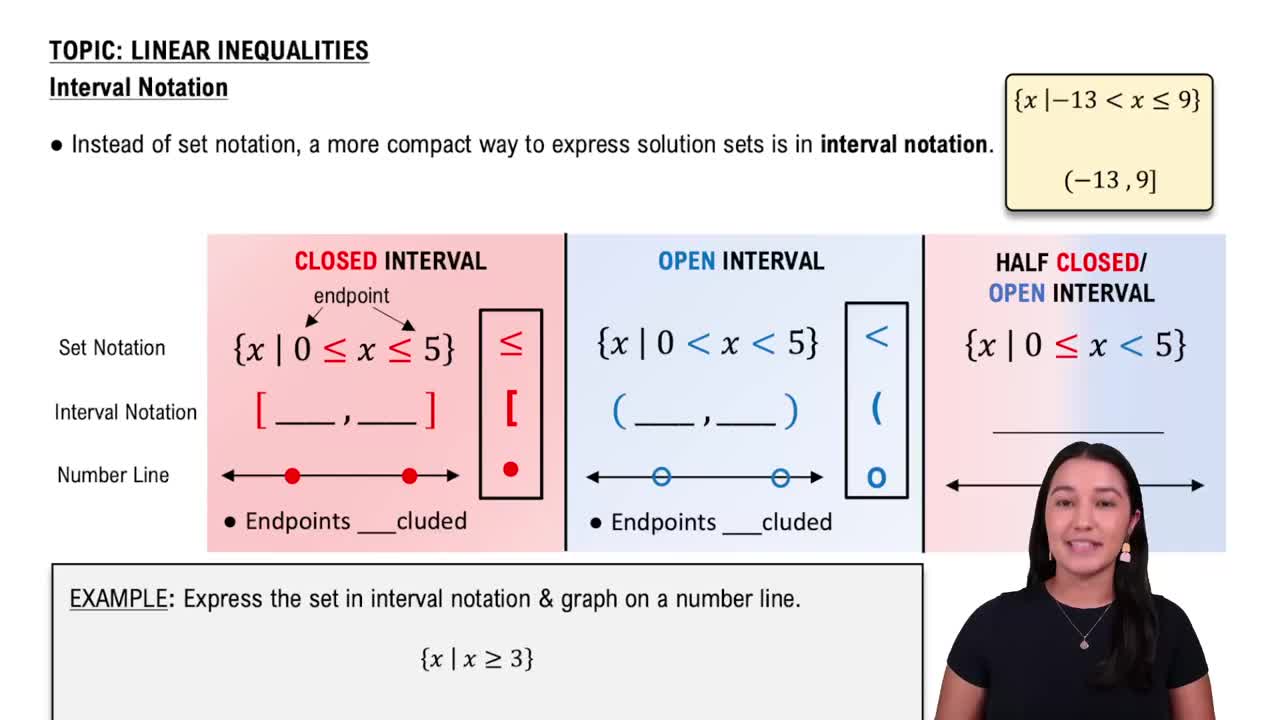
Interval Notation
Multiplication of Numbers in Scientific Notation
To multiply numbers in scientific notation, multiply their decimal factors and add their exponents. For example, (a × 10^m)(b × 10^n) = (a × b) × 10^(m+n). After multiplication, adjust the decimal factor to be between 1 and 10 if necessary.
Recommended video:
The Number e
Rounding Decimal Factors
Rounding the decimal factor involves limiting the number of decimal places to a specified precision, here two decimal places. This ensures the answer is concise and meets the problem's requirements, while maintaining reasonable accuracy.
Recommended video:
Guided course
Factor by Grouping
Watch next
Master Introduction to Exponent Rules with a bite sized video explanation from Patrick
Start learningRelated Videos
Related Practice
Textbook Question
802
views