Perform the indicated operations. Assume all variables represent positive real numbers. (√2 + 3) (√2 - 3)
Verified step by step guidance
1
Recognize that the expression \((\sqrt{2} + 3)(\sqrt{2} - 3)\) is a difference of squares.
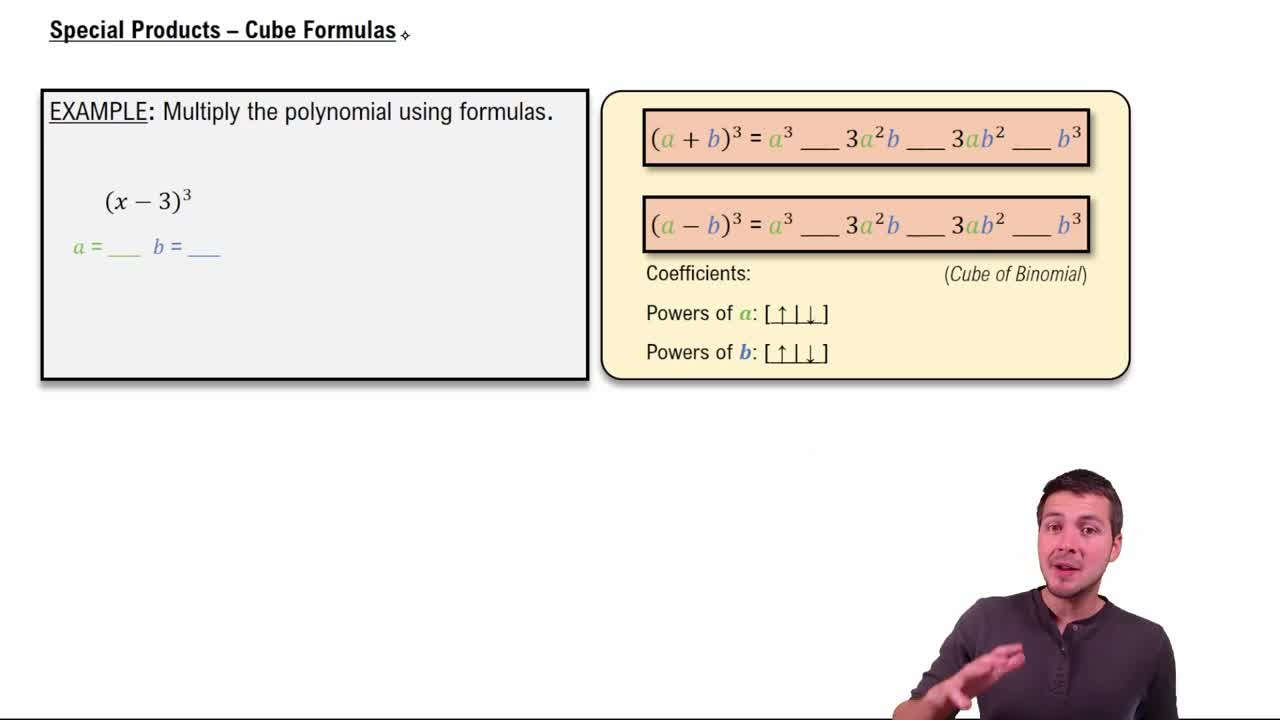
Recall the formula for the difference of squares: \((a + b)(a - b) = a^2 - b^2\).
Identify \(a = \sqrt{2}\) and \(b = 3\) in the expression.
Apply the difference of squares formula: \((\sqrt{2})^2 - 3^2\).
Calculate each square: \((\sqrt{2})^2 = 2\) and \(3^2 = 9\), then subtract the results.
Verified video answer for a similar problem:
This video solution was recommended by our tutors as helpful for the problem above
Video duration:
1m
Play a video:
Was this helpful?
Key Concepts
Here are the essential concepts you must grasp in order to answer the question correctly.
Difference of Squares
The difference of squares is a fundamental algebraic identity that states that the product of two binomials, where one is the sum and the other is the difference of the same two terms, can be expressed as the difference of their squares. Specifically, (a + b)(a - b) = a² - b². In this case, applying this identity to (√2 + 3)(√2 - 3) simplifies the expression significantly.
Solving Quadratic Equations by Completing the Square
Radicals
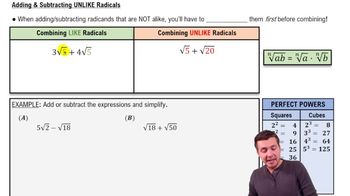
Radicals are expressions that involve roots, such as square roots, cube roots, etc. In this problem, √2 is a radical expression representing the positive square root of 2. Understanding how to manipulate radicals, including simplifying them and performing operations with them, is essential for solving problems that involve square roots.
Algebraic operations include addition, subtraction, multiplication, and division of algebraic expressions. In this question, performing the indicated operations requires knowledge of how to multiply binomials and apply the distributive property. Mastery of these operations is crucial for simplifying expressions and solving algebraic equations effectively.