Identify the terms given: \(\sqrt{3}\) and \(\sqrt[3]{15}\). Notice that \(\sqrt{3}\) is a square root (second root) and \(\sqrt[3]{15}\) is a cube root (third root).
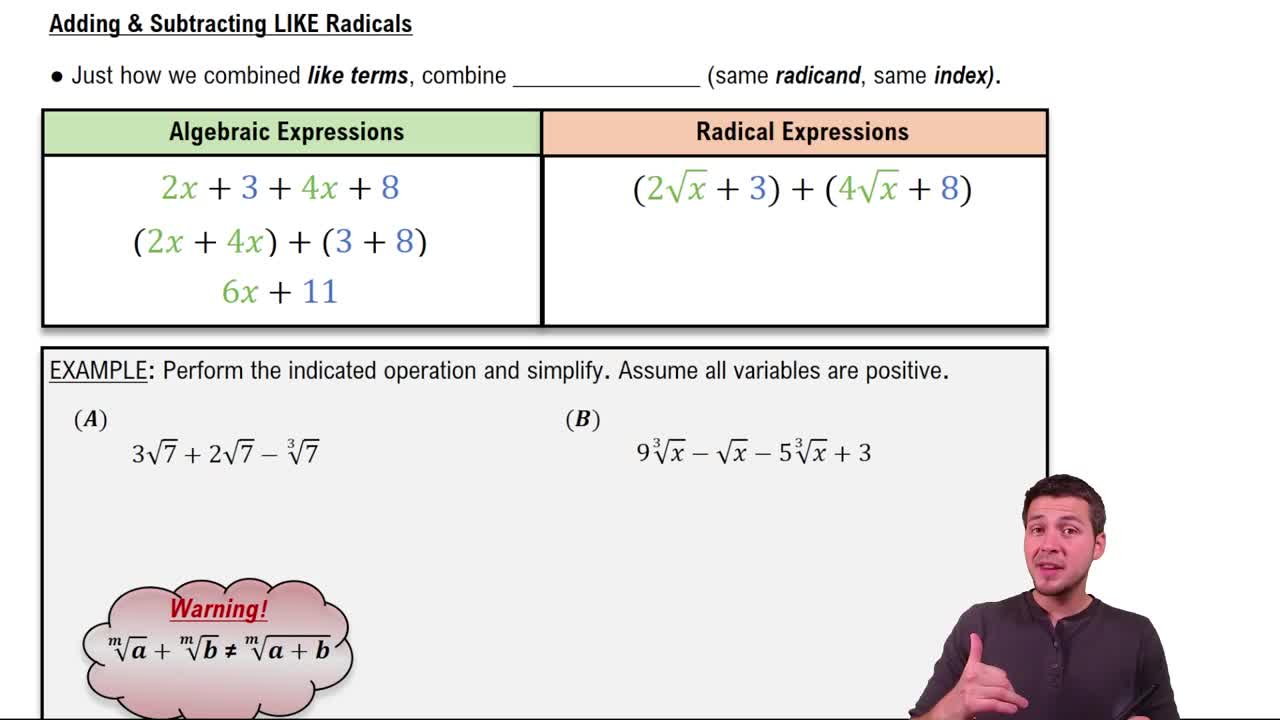
Recall that to add or subtract radical terms, the radicals must be like terms, meaning they have the same index (root) and the same radicand (the number inside the root).
Since \(\sqrt{3}\) and \(\sqrt[3]{15}\) have different indices (2 and 3 respectively), they are not like terms and cannot be combined by addition or subtraction.
Check if either radical can be simplified to have the same index and radicand, for example by factoring inside the root, but in this case, \(\sqrt{3}\) is already simplified and \(\sqrt[3]{15}\) cannot be simplified to a square root or to \(\sqrt{3}\).
Conclude that the expression \(\sqrt{3} + \sqrt[3]{15}\) cannot be simplified further by addition or subtraction because the terms are unlike radicals.
Verified video answer for a similar problem:
This video solution was recommended by our tutors as helpful for the problem above
Video duration:
2m
Play a video:
Was this helpful?
Key Concepts
Here are the essential concepts you must grasp in order to answer the question correctly.
Simplifying Radicals
Simplifying radicals involves expressing the radicand (the number inside the root) as a product of perfect squares or cubes to rewrite the radical in simpler terms. This process helps in combining like terms and making calculations easier.
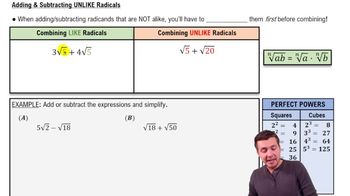
Adding & Subtracting Unlike Radicals by Simplifying
Like Radicals
Like radicals have the same index and radicand, allowing them to be added or subtracted by combining their coefficients. For example, √3 and √3 are like radicals, but √3 and ³√15 are not, so they cannot be directly combined.
To add or subtract radicals, first simplify them and then combine only like radicals by adding or subtracting their coefficients. If radicals are unlike, they remain separate terms in the expression.