Use the compound interest formulas to solve Exercises 10–11. Suppose that you have \$5000 to invest. Which investment yields the greater return over 5 years: 1.5% compounded semiannually or 1.45% compounded monthly?
Table of contents
- 0. Review of Algebra4h 18m
- 1. Equations & Inequalities3h 18m
- 2. Graphs of Equations1h 43m
- 3. Functions2h 17m
- 4. Polynomial Functions1h 44m
- 5. Rational Functions1h 23m
- 6. Exponential & Logarithmic Functions2h 28m
- 7. Systems of Equations & Matrices4h 5m
- 8. Conic Sections2h 23m
- 9. Sequences, Series, & Induction1h 22m
- 10. Combinatorics & Probability1h 45m
6. Exponential & Logarithmic Functions
Introduction to Exponential Functions
Problem 17
Textbook Question
Graph each function by making a table of coordinates. If applicable, use a graphing utility to confirm your hand-drawn graph. f(x) = (0.6)x
Verified step by step guidance1
Identify the function given: \(f(x) = (0.6)^x\). This is an exponential function where the base is 0.6, which is between 0 and 1, indicating exponential decay.
Choose a set of x-values to evaluate the function. Typically, select integer values around zero, such as \(x = -2, -1, 0, 1, 2\), to get a good range of points.
Calculate the corresponding y-values by substituting each chosen x-value into the function: \(f(x) = (0.6)^x\). For example, for \(x=1\), compute \(f(1) = (0.6)^1\); for \(x=-1\), compute \(f(-1) = (0.6)^{-1}\), and so on.
Create a table of coordinates with your x-values and their corresponding y-values. This table will help you plot points accurately on the graph.
Plot the points from your table on a coordinate plane and connect them smoothly to reflect the exponential decay shape. Optionally, use a graphing utility to confirm the accuracy of your hand-drawn graph.
Verified video answer for a similar problem:This video solution was recommended by our tutors as helpful for the problem above
Video duration:
2mPlay a video:
Was this helpful?
Key Concepts
Here are the essential concepts you must grasp in order to answer the question correctly.
Exponential Functions
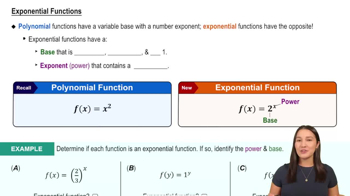
An exponential function has the form f(x) = a^x, where the base a is a positive constant. The function grows or decays depending on whether a is greater than or less than 1. In this question, f(x) = (0.6)^x represents exponential decay since 0.6 is less than 1.
Recommended video:
Exponential Functions
Creating a Table of Coordinates
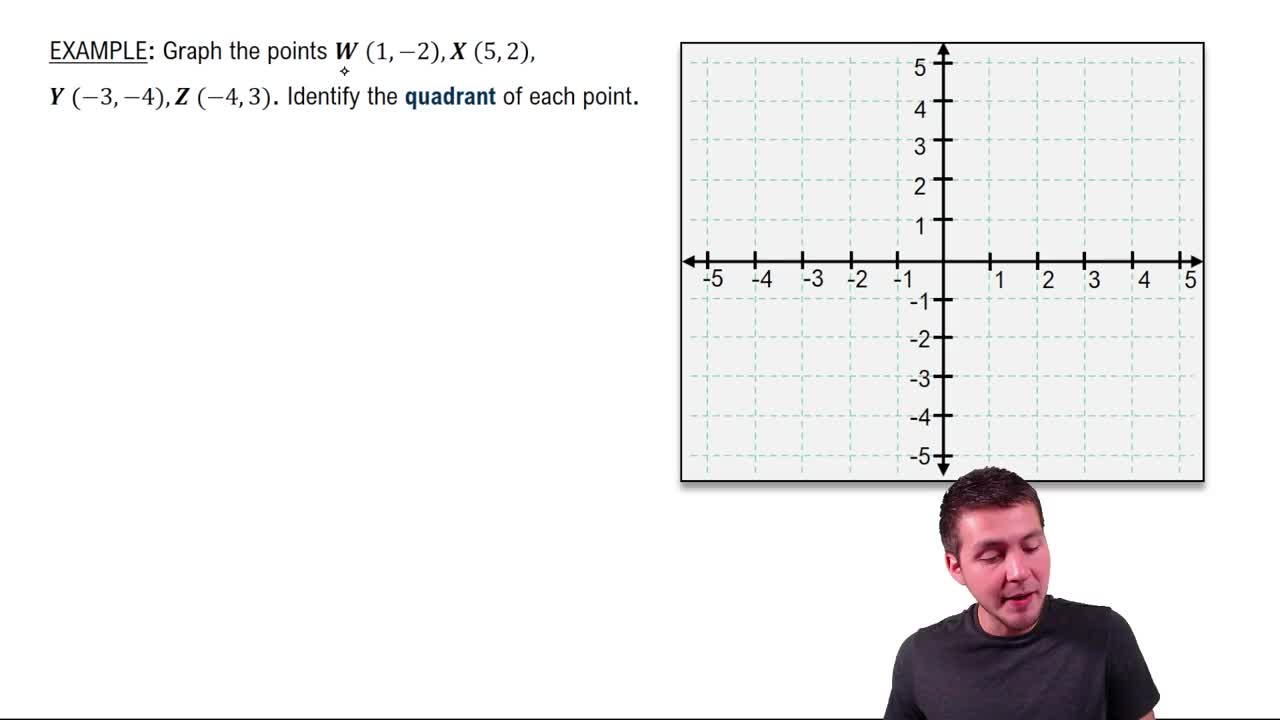
To graph a function by hand, select several x-values and compute their corresponding f(x) values. This creates a set of points (x, f(x)) that can be plotted on the coordinate plane. For f(x) = (0.6)^x, choosing integer x-values helps visualize the decay pattern.
Recommended video:
Guided course
Graphs and Coordinates - Example
Using Graphing Utilities
Graphing utilities, such as calculators or software, allow you to plot functions quickly and accurately. They help confirm the shape and key features of your hand-drawn graph, ensuring correctness and providing a visual check for exponential behavior.
Recommended video:
Graphing Rational Functions Using Transformations
Watch next
Master Exponential Functions with a bite sized video explanation from Patrick
Start learningRelated Videos
Related Practice
Textbook Question
1100
views