In Exercises 1–6, find all numbers that must be excluded from the domain of each rational expression. (x−1)/(x2+11x+10)
Table of contents
- 0. Review of Algebra4h 18m
- 1. Equations & Inequalities3h 18m
- 2. Graphs of Equations1h 43m
- 3. Functions2h 17m
- 4. Polynomial Functions1h 44m
- 5. Rational Functions1h 23m
- 6. Exponential & Logarithmic Functions2h 28m
- 7. Systems of Equations & Matrices4h 5m
- 8. Conic Sections2h 23m
- 9. Sequences, Series, & Induction1h 22m
- 10. Combinatorics & Probability1h 45m
0. Review of Algebra
Polynomials Intro
Problem 34
Textbook Question
Add or subtract as indicated. (3x+2)/(3x+4) + (3x+6)/(3x+4)
Verified step by step guidance1
Identify that both rational expressions have the same denominator, which is \$3x+4$.
Since the denominators are the same, you can combine the numerators directly by adding them: \((3x+2) + (3x+6)\).
Add the numerators by combining like terms: \$3x + 3x = 6x\( and \)2 + 6 = 8\(, so the numerator becomes \)6x + 8$.
Write the combined expression as a single fraction: \(\frac{6x + 8}{3x + 4}\).
Check if the numerator and denominator can be factored to simplify the expression further.
Verified video answer for a similar problem:This video solution was recommended by our tutors as helpful for the problem above
Video duration:
1mPlay a video:
Was this helpful?
Key Concepts
Here are the essential concepts you must grasp in order to answer the question correctly.
Adding and Subtracting Rational Expressions
To add or subtract rational expressions, they must have a common denominator. Once the denominators are the same, combine the numerators by addition or subtraction while keeping the denominator unchanged.
Recommended video:
Guided course
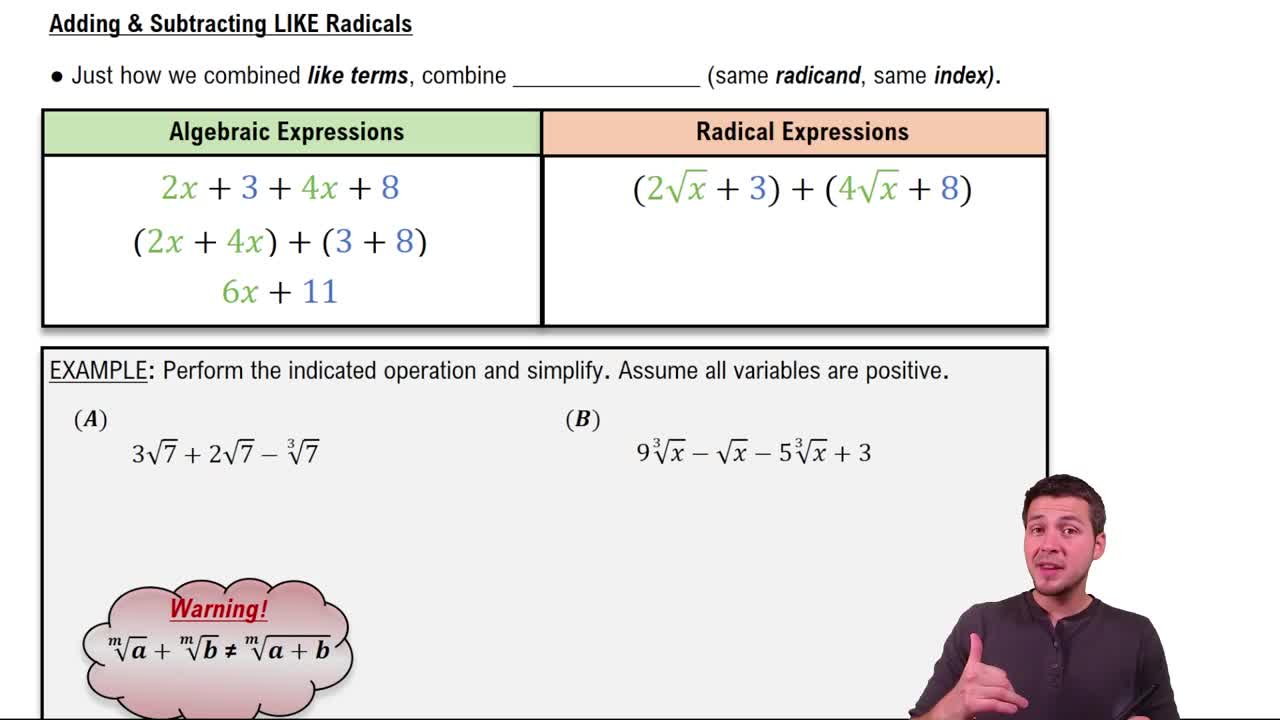
Adding & Subtracting Like Radicals
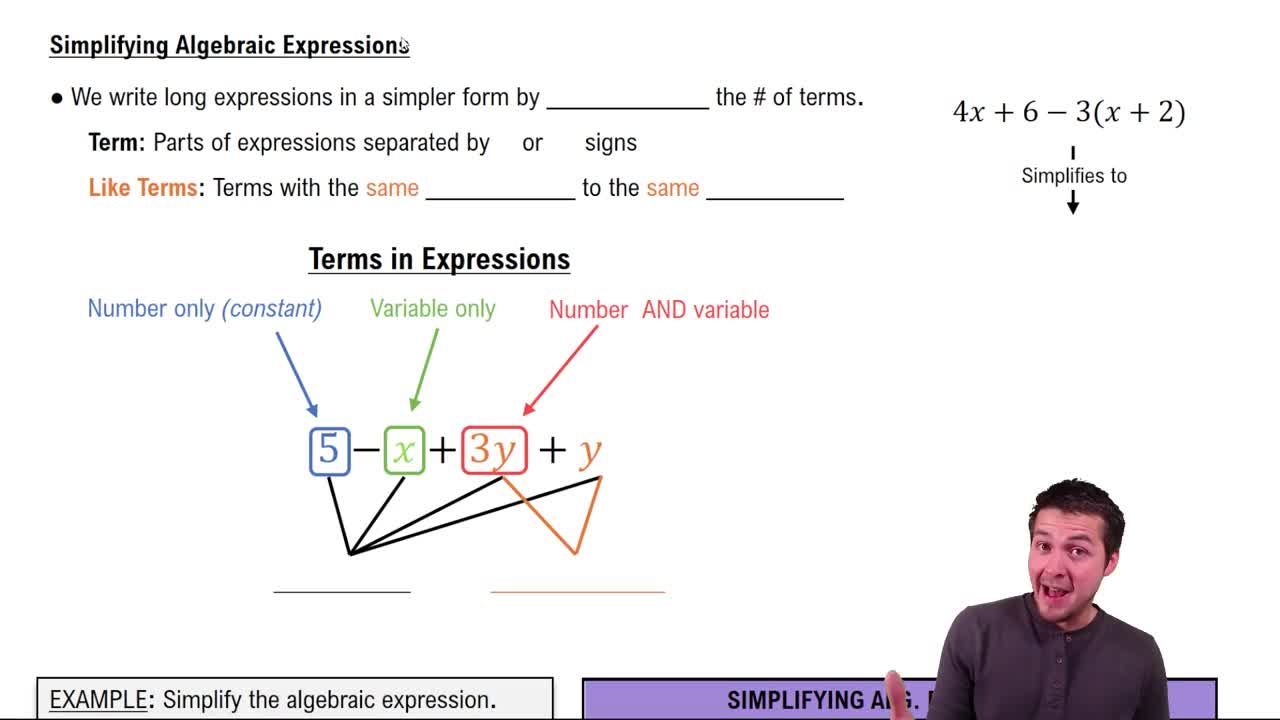
Simplifying Algebraic Expressions
After combining numerators, simplify the resulting expression by combining like terms and factoring if possible. This helps to write the expression in its simplest form for easier interpretation.
Recommended video:
Guided course
Simplifying Algebraic Expressions
Common Denominator Identification
A common denominator is a shared multiple of the denominators of the rational expressions involved. In this problem, both denominators are identical, so the common denominator is simply that expression, allowing direct addition of numerators.
Recommended video:
Guided course
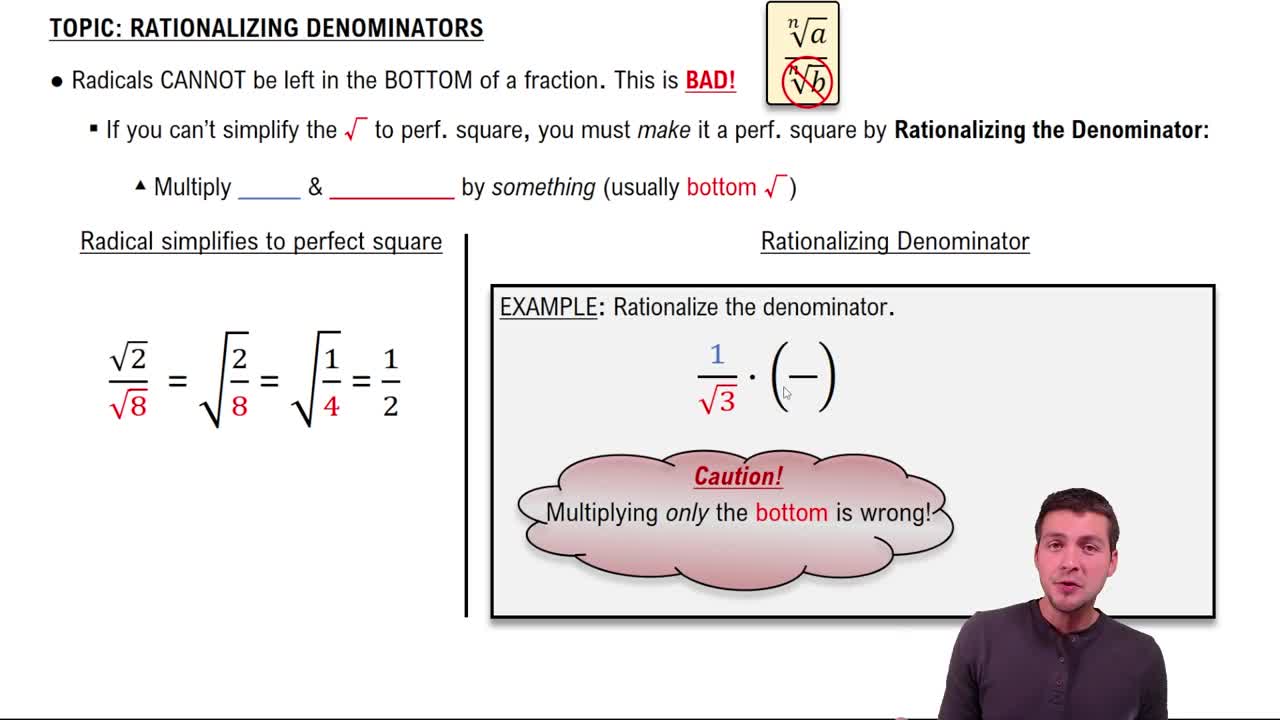
Rationalizing Denominators
Watch next
Master Introduction to Polynomials with a bite sized video explanation from Patrick
Start learningRelated Videos
Related Practice
Textbook Question
799
views