If the expression is in exponential form, write it in radical form and evaluate if possible. If it is in radical form, write it in exponential form. Assume all variables represent posi-tive real numbers. p^5/4
Verified step by step guidance
1
Identify the given expression: \( p^{5/4} \).
Recognize that the expression is in exponential form, where the exponent is a fraction.
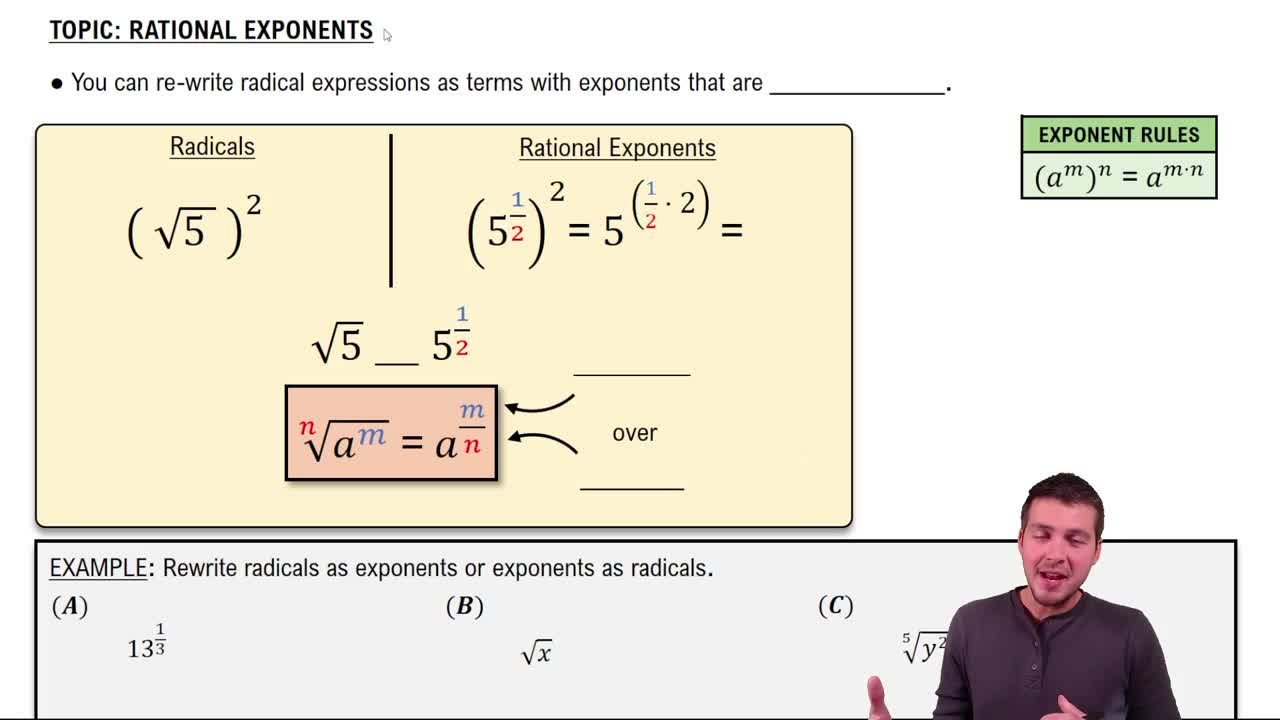
Recall that a fractional exponent \( a/b \) can be rewritten in radical form as \( \sqrt[b]{x^a} \).
Apply this rule to the expression: \( p^{5/4} = \sqrt[4]{p^5} \).
The expression \( \sqrt[4]{p^5} \) is now in radical form.
Verified video answer for a similar problem:
This video solution was recommended by our tutors as helpful for the problem above
Video duration:
1m
Play a video:
Was this helpful?
Key Concepts
Here are the essential concepts you must grasp in order to answer the question correctly.
Exponential Form
Exponential form represents numbers using a base raised to a power, such as p^(5/4). This notation is useful for expressing large numbers compactly and for performing operations like multiplication and division more easily. Understanding how to manipulate exponents is crucial for converting between forms.
Radical form expresses numbers using roots, such as the square root or fourth root. For example, p^(5/4) can be rewritten in radical form as the fourth root of p raised to the fifth power, or √[4]{p^5}. This form is essential for evaluating expressions involving roots and understanding their properties.
Converting between exponential and radical forms involves applying the properties of exponents and roots. The general rule is that a^(m/n) can be expressed as the n-th root of a raised to the m-th power. Mastery of this conversion is vital for solving problems that require switching between these two representations.