Use synthetic division to determine whether the given number k is a zero of the polynomial function. If it is not, give the value of ƒ(k). ƒ(x) = x2 - 2x + 2; k = 1-i
Table of contents
- 0. Review of Algebra4h 18m
- 1. Equations & Inequalities3h 18m
- 2. Graphs of Equations1h 43m
- 3. Functions2h 17m
- 4. Polynomial Functions1h 44m
- 5. Rational Functions1h 23m
- 6. Exponential & Logarithmic Functions2h 28m
- 7. Systems of Equations & Matrices4h 5m
- 8. Conic Sections2h 23m
- 9. Sequences, Series, & Induction1h 22m
- 10. Combinatorics & Probability1h 45m
4. Polynomial Functions
Dividing Polynomials
Problem 85
Textbook Question
Perform each division. See Examples 7 and 8.
Verified step by step guidance1
First, write the division expression clearly as a fraction: \(\frac{-4m^{2}n^{2} - 21mn^{3} + 18mn^{2}}{-14m^{2}n^{3}}\).
Next, separate the fraction into the sum of three fractions by dividing each term in the numerator by the denominator individually: \(\frac{-4m^{2}n^{2}}{-14m^{2}n^{3}} + \frac{-21mn^{3}}{-14m^{2}n^{3}} + \frac{18mn^{2}}{-14m^{2}n^{3}}\).
Simplify each fraction by canceling common factors in the numerator and denominator, such as powers of \(m\) and \(n\), and reduce coefficients by their greatest common divisor.
Rewrite each simplified fraction as a product of constants and variables with their exponents, making sure to handle negative signs carefully.
Finally, combine the simplified terms back into a single expression, if possible, to express the result of the division.
Verified video answer for a similar problem:This video solution was recommended by our tutors as helpful for the problem above
Video duration:
5mPlay a video:
Was this helpful?
Key Concepts
Here are the essential concepts you must grasp in order to answer the question correctly.
Polynomial Division
Polynomial division involves dividing each term of the numerator by the denominator separately when the denominator is a monomial. This simplifies the expression by reducing powers and coefficients, making it easier to work with complex algebraic fractions.
Recommended video:
Guided course
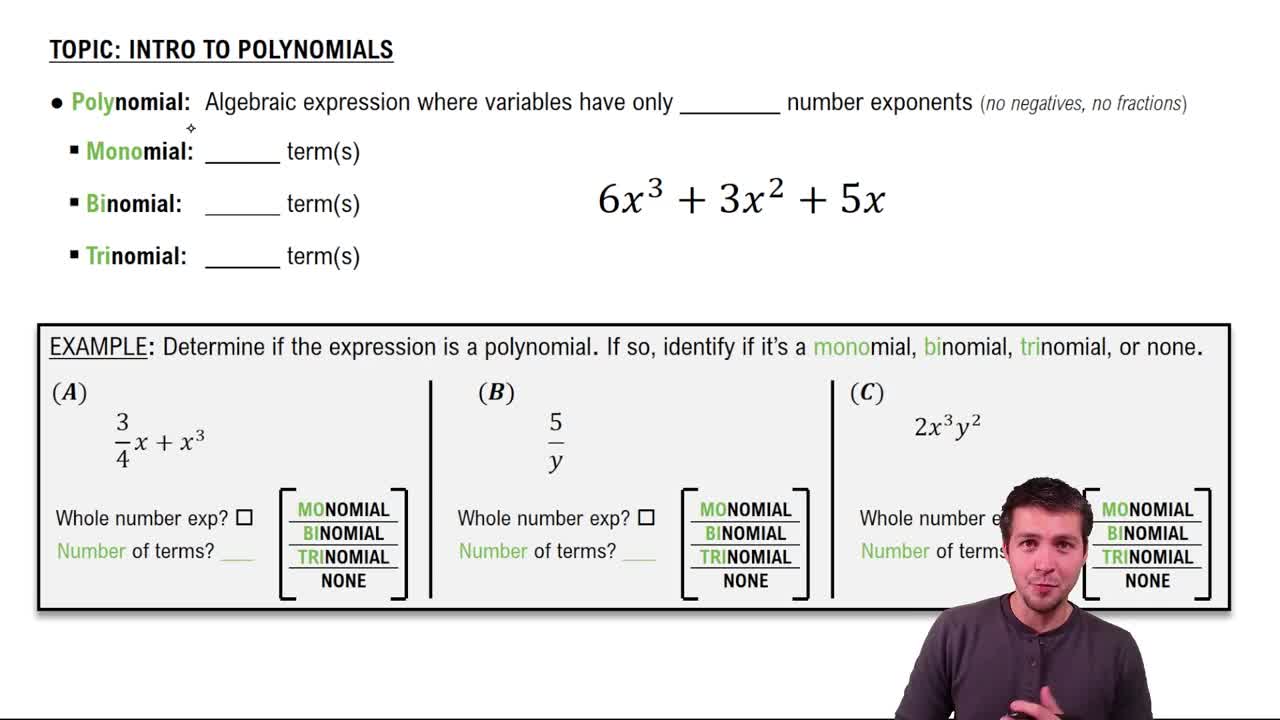
Introduction to Polynomials
Laws of Exponents
When dividing variables with exponents, subtract the exponent in the denominator from the exponent in the numerator for each variable. For example, m^a / m^b = m^(a-b). This rule helps simplify terms during division of algebraic expressions.
Recommended video:
Guided course
Rational Exponents
Simplifying Algebraic Fractions
Simplifying algebraic fractions means reducing the expression to its simplest form by canceling common factors in numerator and denominator. This often involves factoring terms and applying exponent rules to make the expression more manageable.
Recommended video:
Guided course
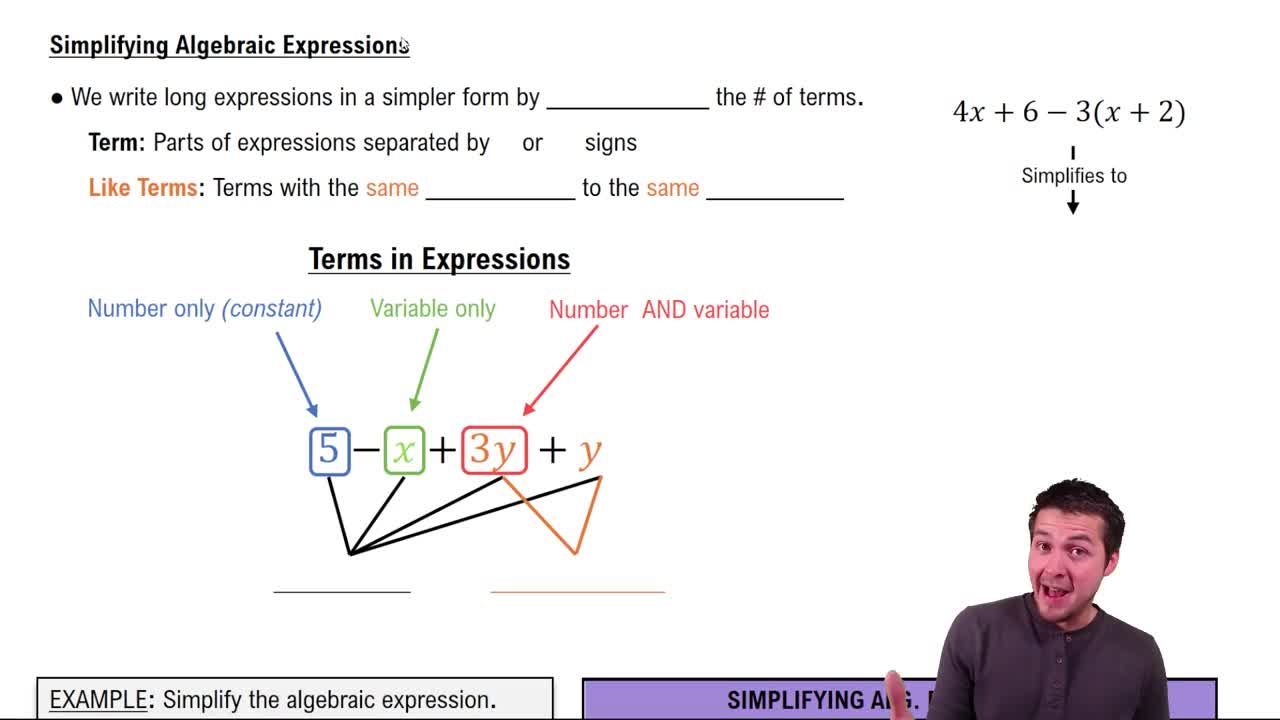
Simplifying Algebraic Expressions
Related Videos
Related Practice
Textbook Question
805
views