Identify the complex fraction: the numerator is \(\frac{y+3}{y} - \frac{4}{y-1}\) and the denominator is \(\frac{y}{y-1} + \frac{1}{y}\).
Find a common denominator for the numerator terms, which are \(\frac{y+3}{y}\) and \(\frac{4}{y-1}\). The common denominator is \(y(y-1)\). Rewrite each fraction with this common denominator:
Cancel the common factors \(y(y-1)\) in numerator and denominator, then simplify the remaining expressions by expanding and combining like terms.
Verified video answer for a similar problem:
This video solution was recommended by our tutors as helpful for the problem above
Video duration:
8m
Play a video:
Was this helpful?
Key Concepts
Here are the essential concepts you must grasp in order to answer the question correctly.
Complex Fractions
A complex fraction is a fraction where the numerator, denominator, or both contain fractions themselves. Simplifying involves rewriting the expression as a single fraction by combining the smaller fractions in the numerator and denominator before dividing.
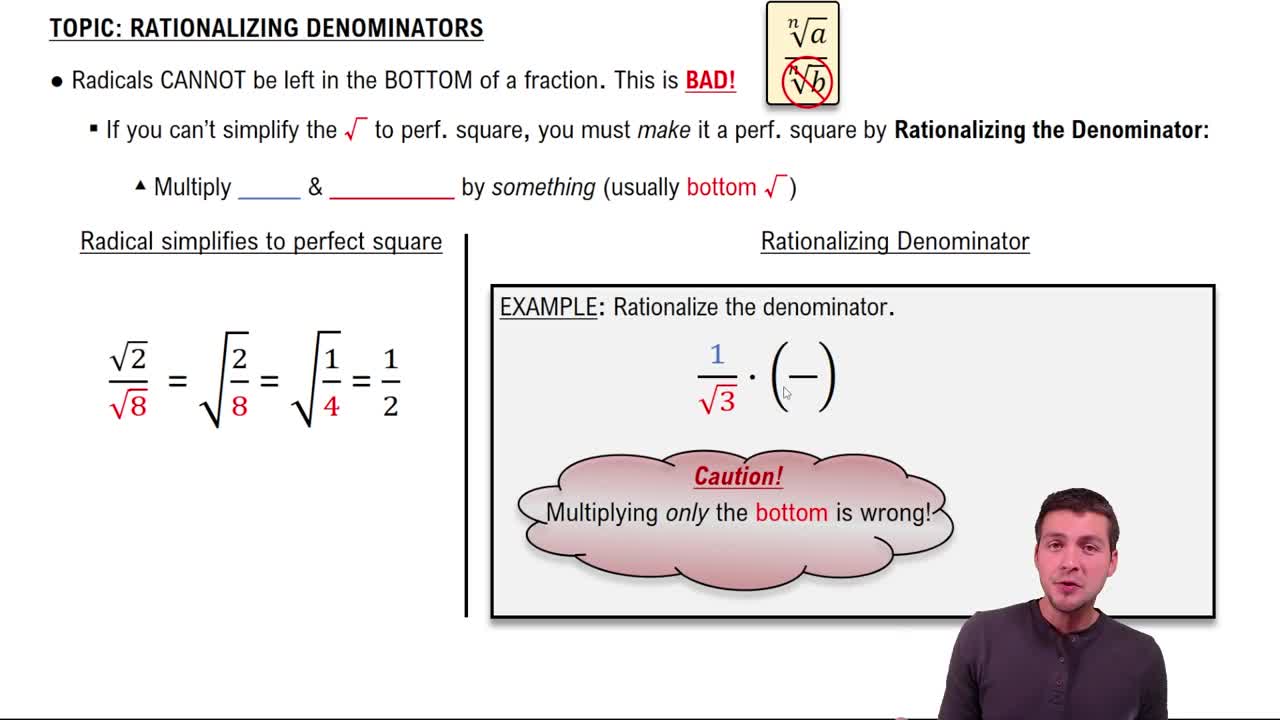
To add or subtract fractions, you must find a common denominator, which is a shared multiple of the denominators involved. This allows you to rewrite each fraction with the same denominator, making it possible to combine them into a single fraction.
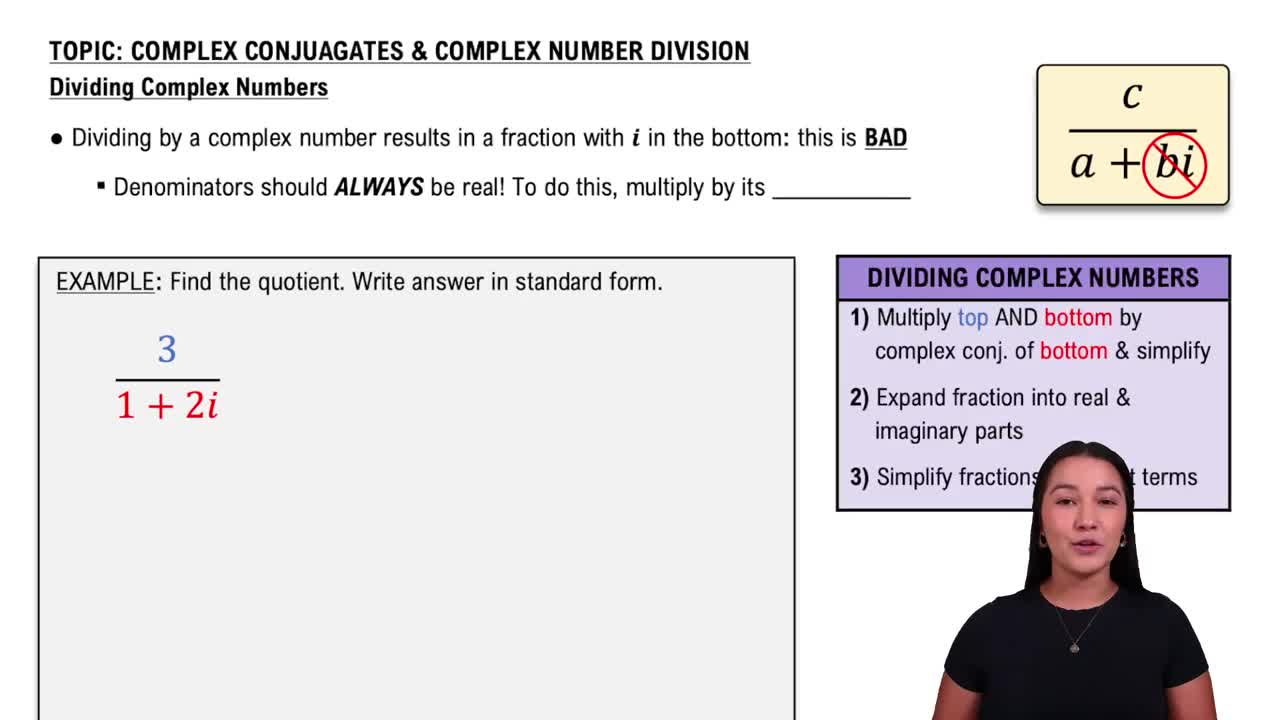
Dividing by a fraction is equivalent to multiplying by its reciprocal. After simplifying the numerator and denominator separately, you divide the two fractions by multiplying the numerator by the reciprocal of the denominator.