Identify the function given: \(f(x) = 2^{-\lvert x \rvert}\), which involves an exponential expression with a negative absolute value in the exponent.
Understand the role of the absolute value: Since \(\lvert x \rvert\) is always non-negative, the exponent \(-\lvert x \rvert\) is always zero or negative, meaning the function will produce values between 0 and 1 inclusive.
Create a table of values by choosing several values of \(x\) (both positive and negative), calculate \(\lvert x \rvert\), then compute \(f(x) = 2^{-\lvert x \rvert}\) for each to get points to plot.
Plot the points on the coordinate plane, noting the symmetry about the y-axis because the function depends on \(\lvert x \rvert\), which is symmetric.
Sketch the graph by connecting the points smoothly, showing that the function has a maximum at \(x=0\) where \(f(0) = 2^0 = 1\), and decreases towards zero as \(x\) moves away from zero in either direction.
Verified video answer for a similar problem:
This video solution was recommended by our tutors as helpful for the problem above
Video duration:
6m
Play a video:
0 Comments
Key Concepts
Here are the essential concepts you must grasp in order to answer the question correctly.
Absolute Value Function
The absolute value of a number represents its distance from zero on the number line, always yielding a non-negative result. In the function f(x) = 2^(-|x|), the absolute value affects the input by making the exponent symmetric about the y-axis, which influences the graph's shape and symmetry.
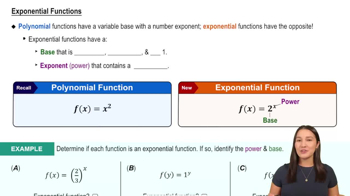
Exponential functions have the form f(x) = a^x, where the base a is positive and not equal to 1. They exhibit rapid growth or decay depending on the exponent's sign. Here, the negative exponent causes the function to decay as |x| increases, producing a graph that approaches zero but never touches the x-axis.
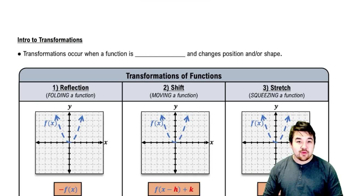
Graphing involves understanding how transformations like reflections, shifts, and stretches affect the base function. Since the exponent includes -|x|, the graph is symmetric about the y-axis and decreases on both sides from a maximum at x=0. Recognizing this symmetry helps in accurately sketching the function.

 6:22 minutes
 Verified step by step guidance
 4:56
4:56