In Exercises 41–70, use properties of logarithms to condense each logarithmic expression. Write the expression as a single logarithm whose coefficient is 1. Where possible, evaluate logarithmic expressions without using a calculator. log x + 3 log y
Table of contents
- 0. Review of Algebra4h 18m
- 1. Equations & Inequalities3h 18m
- 2. Graphs of Equations1h 43m
- 3. Functions2h 17m
- 4. Polynomial Functions1h 44m
- 5. Rational Functions1h 23m
- 6. Exponential & Logarithmic Functions2h 28m
- 7. Systems of Equations & Matrices4h 5m
- 8. Conic Sections2h 23m
- 9. Sequences, Series, & Induction1h 22m
- 10. Combinatorics & Probability1h 45m
6. Exponential & Logarithmic Functions
Properties of Logarithms
Problem 51
Textbook Question
Find each value. If applicable, give an approximation to four decimal places. See Example 5. ln 28
Verified step by step guidance1
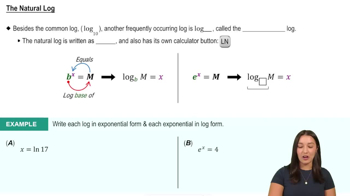
Recognize that 'ln' refers to the natural logarithm, which is the logarithm to the base 'e', where 'e' is approximately 2.71828.
Understand that the problem is asking for the natural logarithm of 28, which can be expressed as \( \ln(28) \).
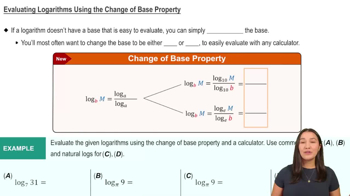
To find \( \ln(28) \), you can use a calculator that has a natural logarithm function, often labeled as 'ln'.
Enter the number 28 into the calculator and press the 'ln' button to compute the natural logarithm.
If an approximation is needed, round the result to four decimal places as specified in the problem.
Verified video answer for a similar problem:This video solution was recommended by our tutors as helpful for the problem above
Video duration:
1mPlay a video:
Was this helpful?
Key Concepts
Here are the essential concepts you must grasp in order to answer the question correctly.
Natural Logarithm (ln)
The natural logarithm, denoted as 'ln', is the logarithm to the base 'e', where 'e' is an irrational constant approximately equal to 2.71828. It is used to solve equations involving exponential growth or decay and is particularly important in calculus and complex analysis. The natural logarithm has unique properties, such as ln(e) = 1 and ln(1) = 0, which are essential for simplifying expressions.
Recommended video:
The Natural Log
Exponential Functions
Exponential functions are mathematical functions of the form f(x) = a * e^(bx), where 'a' and 'b' are constants, and 'e' is the base of natural logarithms. These functions model growth or decay processes, such as population growth or radioactive decay. Understanding how to manipulate and evaluate these functions is crucial for solving problems involving natural logarithms.
Recommended video:
Exponential Functions
Approximation Techniques
Approximation techniques are methods used to estimate values that may not be easily calculable or are irrational, such as logarithms of non-integer values. In the context of logarithms, this often involves using calculators or numerical methods to find values to a specified degree of accuracy, such as four decimal places. Mastery of approximation techniques is essential for practical applications in science and engineering.
Recommended video:
Graph Hyperbolas at the Origin
Watch next
Master Product, Quotient, and Power Rules of Logs with a bite sized video explanation from Patrick
Start learningRelated Videos
Related Practice
Textbook Question
786
views