Determine whether each relation defines y as a function of x. Give the domain and range. See Example 5. y=-6x+4
Table of contents
- 0. Review of Algebra4h 18m
- 1. Equations & Inequalities3h 18m
- 2. Graphs of Equations1h 43m
- 3. Functions2h 17m
- 4. Polynomial Functions1h 44m
- 5. Rational Functions1h 23m
- 6. Exponential & Logarithmic Functions2h 28m
- 7. Systems of Equations & Matrices4h 5m
- 8. Conic Sections2h 23m
- 9. Sequences, Series, & Induction1h 22m
- 10. Combinatorics & Probability1h 45m
3. Functions
Intro to Functions & Their Graphs
Problem 47
Textbook Question
Determine whether each relation defines y as a function of x. Give the domain and range. See Example 5. y=2/(x-3)
Verified step by step guidance1
Identify the given relation: \(y = \frac{2}{x - 3}\). This is a rational function where \(y\) depends on \(x\).
Determine if \(y\) is a function of \(x\): For each value of \(x\) (except where the expression is undefined), there is exactly one value of \(y\). Since the expression gives one output \(y\) for each input \(x\) (except where the denominator is zero), it defines \(y\) as a function of \(x\).
Find the domain: The domain consists of all real numbers \(x\) except where the denominator is zero. Set the denominator equal to zero and solve: \(x - 3 = 0 \implies x = 3\). So, the domain is all real numbers except \(x = 3\).
Find the range: Consider the values that \(y\) can take. Since \(y = \frac{2}{x - 3}\), \(y\) can be any real number except where the function is undefined or cannot reach. To find values \(y\) cannot take, set \(y = 0\) and solve for \(x\): \$0 = \frac{2}{x - 3}\(, which has no solution. So, \)y\( can be any real number except \)0$.
Summarize: The relation defines \(y\) as a function of \(x\) with domain \(\{x \in \mathbb{R} \mid x \neq 3\}\) and range \(\{y \in \mathbb{R} \mid y \neq 0\}\).
Verified video answer for a similar problem:This video solution was recommended by our tutors as helpful for the problem above
Video duration:
5mPlay a video:
Was this helpful?
Key Concepts
Here are the essential concepts you must grasp in order to answer the question correctly.
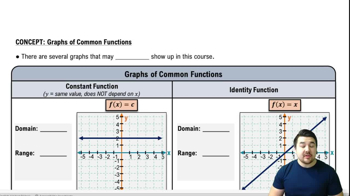
Definition of a Function
A function is a relation where each input x corresponds to exactly one output y. To determine if y is a function of x, check that no x-value maps to multiple y-values. This ensures the relation passes the vertical line test.
Recommended video:
Graphs of Common Functions
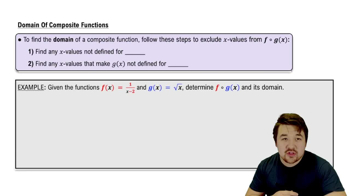
Domain of a Function
The domain is the set of all possible input values (x-values) for which the function is defined. For rational functions like y = 2/(x-3), the domain excludes values that make the denominator zero, since division by zero is undefined.
Recommended video:
Domain Restrictions of Composed Functions
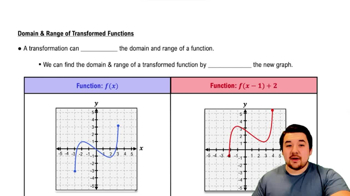
Range of a Function
The range is the set of all possible output values (y-values) the function can produce. For y = 2/(x-3), the range includes all real numbers except the value y cannot take due to the function's behavior, often found by analyzing limits or solving for x.
Recommended video:
Domain & Range of Transformed Functions
Watch next
Master Relations and Functions with a bite sized video explanation from Patrick
Start learningRelated Videos
Related Practice
Textbook Question
588
views