Determine whether each relation defines y as a function of x. Give the domain and range. See Example 5. y=-6x+4
Table of contents
- 0. Review of Algebra4h 18m
- 1. Equations & Inequalities3h 18m
- 2. Graphs of Equations1h 43m
- 3. Functions2h 17m
- 4. Polynomial Functions1h 44m
- 5. Rational Functions1h 23m
- 6. Exponential & Logarithmic Functions2h 28m
- 7. Systems of Equations & Matrices4h 5m
- 8. Conic Sections2h 23m
- 9. Sequences, Series, & Induction1h 22m
- 10. Combinatorics & Probability1h 45m
3. Functions
Intro to Functions & Their Graphs
Problem 47
Textbook Question
Determine whether each relation defines y as a function of x. Give the domain and range. y=2/(x-3)
Verified step by step guidance1
Identify the given relation: \(y = \frac{2}{x - 3}\).
Determine if \(y\) is a function of \(x\): For each value of \(x\) (except where the expression is undefined), there should be exactly one corresponding value of \(y\). Since the expression is a fraction with \(x\) in the denominator, check where the denominator equals zero.
Find the values of \(x\) that make the denominator zero by solving \(x - 3 = 0\), which gives \(x = 3\). This value is excluded from the domain because division by zero is undefined.
State the domain: All real numbers except \(x = 3\), which can be written as \(\{x \in \mathbb{R} \mid x \neq 3\}\).
Determine the range: Since \(y = \frac{2}{x - 3}\) can take any real value except possibly some value that \(y\) cannot equal, analyze if there are any restrictions on \(y\). Because the function is a rational function with a vertical asymptote at \(x=3\) and no horizontal asymptote restricting \(y\), the range is all real numbers except \(y = 0\) (since \(\frac{2}{x-3} = 0\) has no solution).
Verified video answer for a similar problem:This video solution was recommended by our tutors as helpful for the problem above
Video duration:
5mPlay a video:
Was this helpful?
Key Concepts
Here are the essential concepts you must grasp in order to answer the question correctly.
Definition of a Function
A function is a relation where each input x corresponds to exactly one output y. To determine if y is a function of x, check that no x-value maps to multiple y-values. This ensures the relation passes the vertical line test.
Recommended video:
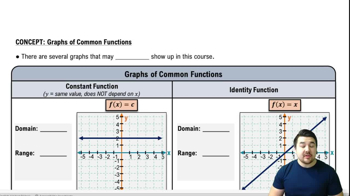
Graphs of Common Functions
Domain of a Function
The domain is the set of all possible input values (x-values) for which the function is defined. For rational functions like y = 2/(x-3), the domain excludes values that make the denominator zero, since division by zero is undefined.
Recommended video:
Domain Restrictions of Composed Functions
Range of a Function
The range is the set of all possible output values (y-values) the function can produce. For y = 2/(x-3), analyze the behavior of the function and any horizontal asymptotes to determine which y-values are attainable.
Recommended video:
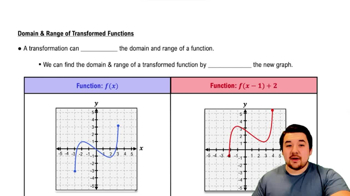
Domain & Range of Transformed Functions
Watch next
Master Relations and Functions with a bite sized video explanation from Patrick
Start learningRelated Videos
Related Practice
Textbook Question
611
views