Without actually graphing, identify the type of graph that each equation has. 4x2−16y2=1
Verified step by step guidance
1
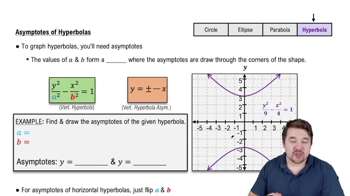
Recognize the given equation: \( \frac{x^2}{4} - \frac{y^2}{16} = 1 \). This is in the standard form of a hyperbola equation, \( \frac{x^2}{a^2} - \frac{y^2}{b^2} = 1 \).
Identify the coefficients of \( x^2 \) and \( y^2 \). Here, \( a^2 = 4 \) and \( b^2 = 16 \).
Determine the orientation of the hyperbola. Since the \( x^2 \) term is positive and comes first, the hyperbola opens horizontally.
Recall that a hyperbola is characterized by two branches that open away from each other, either horizontally or vertically, depending on the equation.
Conclude that the graph of the given equation is a hyperbola that opens horizontally.
Verified video answer for a similar problem:
This video solution was recommended by our tutors as helpful for the problem above
Video duration:
4m
Play a video:
Was this helpful?
Key Concepts
Here are the essential concepts you must grasp in order to answer the question correctly.
Conic Sections
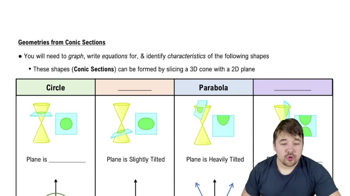
Conic sections are the curves obtained by intersecting a plane with a double-napped cone. The main types include circles, ellipses, parabolas, and hyperbolas. Each type has a distinct equation and geometric properties. Understanding these shapes is crucial for identifying the type of graph represented by a given equation.
The standard form of a hyperbola is given by the equation \\(rac{x^2}{a^2} - rac{y^2}{b^2} = 1\\), where 'a' and 'b' are constants that determine the shape and orientation of the hyperbola. This form indicates that the hyperbola opens horizontally. Recognizing this form helps in identifying hyperbolas from their equations.
To identify the type of graph from an equation, one must analyze its structure and coefficients. For example, if the equation resembles that of a hyperbola, it can be determined by the presence of a subtraction between squared terms. This skill is essential for quickly categorizing equations without graphing them.