Ch. 3 - Polynomial and Rational Functions
Lial - College Algebra 13th Edition
Lial13th EditionCollege AlgebraISBN: 9780136881063Not the one you use?Change textbook
Chapter 4, Problem 26

Graph each quadratic function. Give the (a) vertex, (b) axis, (c) domain, and (d) range. ƒ(x) = (x - 5)2 - 4

Verified step by step guidance
1
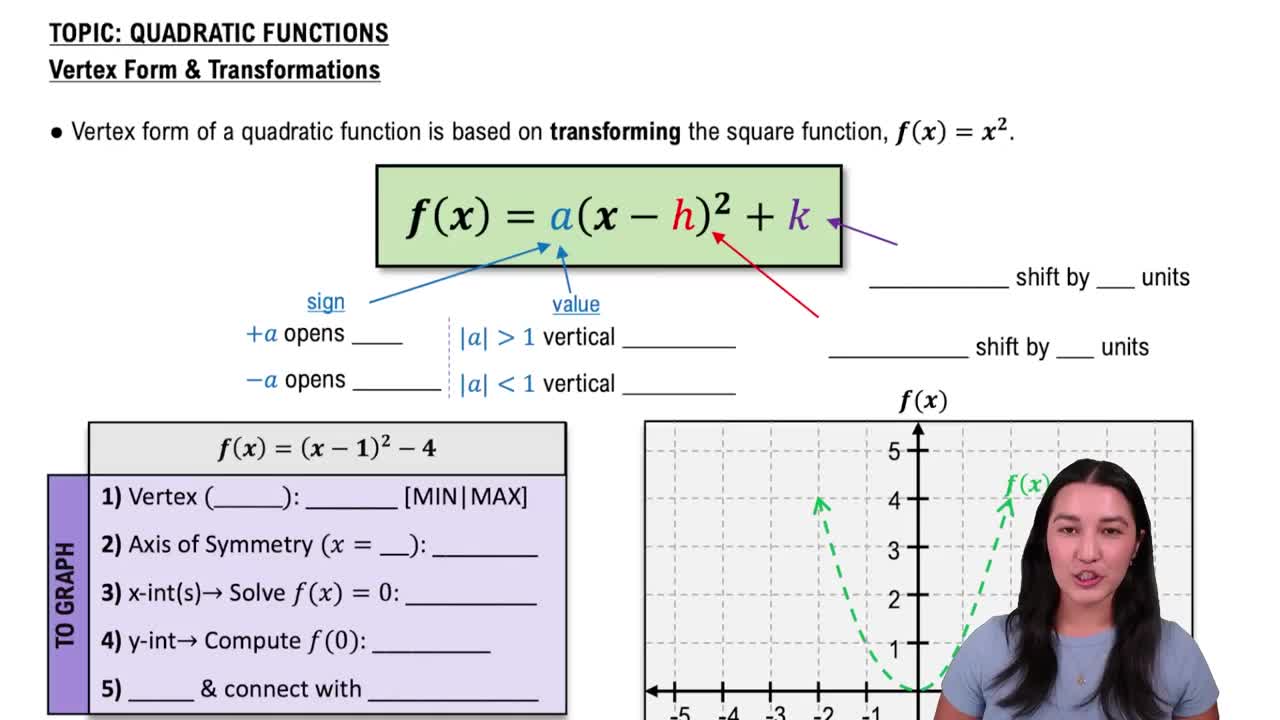
Identify the given quadratic function: \(f(x) = (x - 5)^2 - 4\). This is in vertex form, which is \(f(x) = a(x - h)^2 + k\), where \((h, k)\) is the vertex.
Find the vertex by comparing the given function to the vertex form. Here, \(h = 5\) and \(k = -4\), so the vertex is at the point \((5, -4)\).
Determine the axis of symmetry, which is the vertical line that passes through the vertex. The axis of symmetry is \(x = h\), so here it is \(x = 5\).
State the domain of the function. Since this is a quadratic function, the domain is all real numbers, which can be written as \((-\infty, \infty)\).
Find the range of the function. Because the parabola opens upwards (the coefficient of the squared term is positive), the range starts at the vertex's \(y\)-value and goes to infinity. So, the range is \([-4, \infty)\).

Verified video answer for a similar problem:

This video solution was recommended by our tutors as helpful for the problem above.
Video duration:
5m
Was this helpful?

Key Concepts

Here are the essential concepts you must grasp in order to answer the question correctly.

Vertex of a Quadratic Function

The vertex is the highest or lowest point on the graph of a quadratic function, given in vertex form as f(x) = a(x - h)^2 + k, where (h, k) is the vertex. It represents the point where the parabola changes direction.
Recommended video:
08:07
Vertex Form

Axis of Symmetry

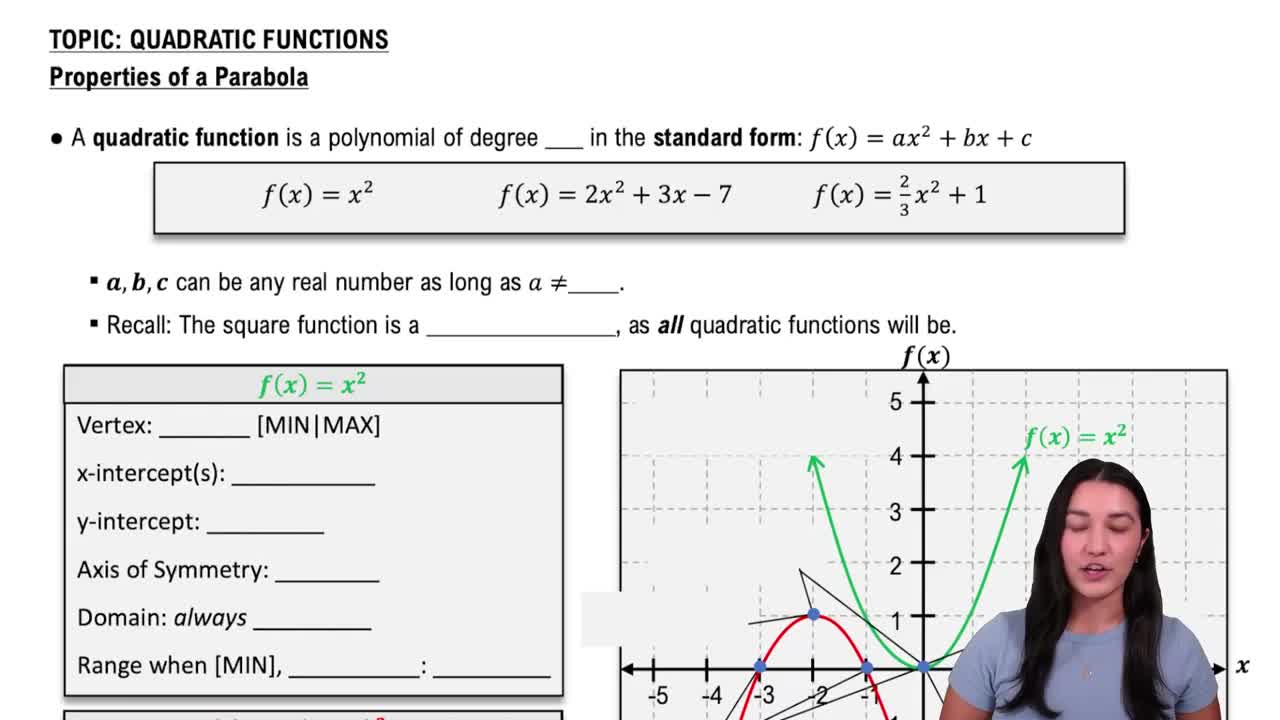
The axis of symmetry is a vertical line that passes through the vertex and divides the parabola into two mirror-image halves. For a quadratic in vertex form, the axis of symmetry is x = h, where h is the x-coordinate of the vertex.
Recommended video:
07:42
Properties of Parabolas

Domain and Range of Quadratic Functions

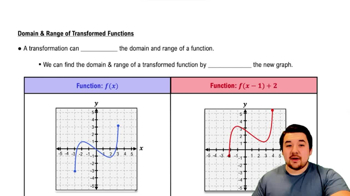
The domain of any quadratic function is all real numbers since x can take any value. The range depends on the vertex and the direction of the parabola (upward if a > 0, downward if a < 0), starting from the vertex's y-value and extending infinitely in one direction.
Recommended video:
4:22
Domain & Range of Transformed Functions