Begin by graphing the cube root function, f(x) = ∛x. Then use transformations of this graph to graph the given function. g(x) = ∛(x-2)
Table of contents
- 0. Review of Algebra4h 18m
- 1. Equations & Inequalities3h 18m
- 2. Graphs of Equations1h 43m
- 3. Functions2h 17m
- 4. Polynomial Functions1h 44m
- 5. Rational Functions1h 23m
- 6. Exponential & Logarithmic Functions2h 28m
- 7. Systems of Equations & Matrices4h 5m
- 8. Conic Sections2h 23m
- 9. Sequences, Series, & Induction1h 22m
- 10. Combinatorics & Probability1h 45m
3. Functions
Transformations
Problem 90
Textbook Question
Begin by graphing the absolute value function, f(x) = |x|. Then use transformations of this graph to graph the given function. g(x) = -|x + 4| +2
Verified step by step guidance1
Start with the base graph of the absolute value function, f(x) = |x|. This graph is a V-shaped graph with its vertex at the origin (0, 0), opening upwards.
Identify the transformation inside the absolute value: x + 4. This represents a horizontal shift. Specifically, the graph of |x| is shifted 4 units to the left because of the +4 inside the absolute value.
Next, consider the negative sign in front of the absolute value, -|x + 4|. This reflects the graph of |x + 4| across the x-axis, causing the V-shape to open downwards instead of upwards.
Now, account for the +2 outside the absolute value. This represents a vertical shift. The entire graph of -|x + 4| is shifted 2 units upward.
Combine all the transformations: Start with the base graph of |x|, shift it 4 units to the left, reflect it across the x-axis, and finally shift it 2 units upward. Plot the resulting graph to visualize g(x) = -|x + 4| + 2.
Verified video answer for a similar problem:This video solution was recommended by our tutors as helpful for the problem above
Video duration:
7mPlay a video:
Was this helpful?
Key Concepts
Here are the essential concepts you must grasp in order to answer the question correctly.
Absolute Value Function
The absolute value function, denoted as f(x) = |x|, outputs the non-negative value of x. This function has a V-shaped graph that opens upwards, with its vertex at the origin (0,0). Understanding this function is crucial as it serves as the foundation for applying transformations to graph other functions.
Recommended video:
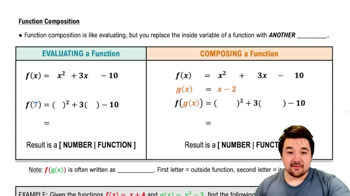
Function Composition
Transformations of Functions
Transformations involve shifting, reflecting, stretching, or compressing the graph of a function. For example, adding a constant inside the absolute value affects horizontal shifts, while adding outside affects vertical shifts. In the function g(x) = -|x + 4| + 2, the transformations include a horizontal shift left by 4 units, a reflection across the x-axis, and a vertical shift up by 2 units.
Recommended video:
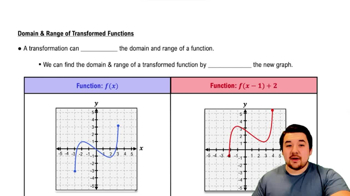
Domain & Range of Transformed Functions
Graphing Techniques
Graphing techniques involve plotting points and understanding how transformations affect the shape and position of a graph. For the function g(x), one must first graph f(x) = |x|, then apply the identified transformations systematically. This process helps visualize the changes and accurately represent the new function on a coordinate plane.
Recommended video:
Guided course
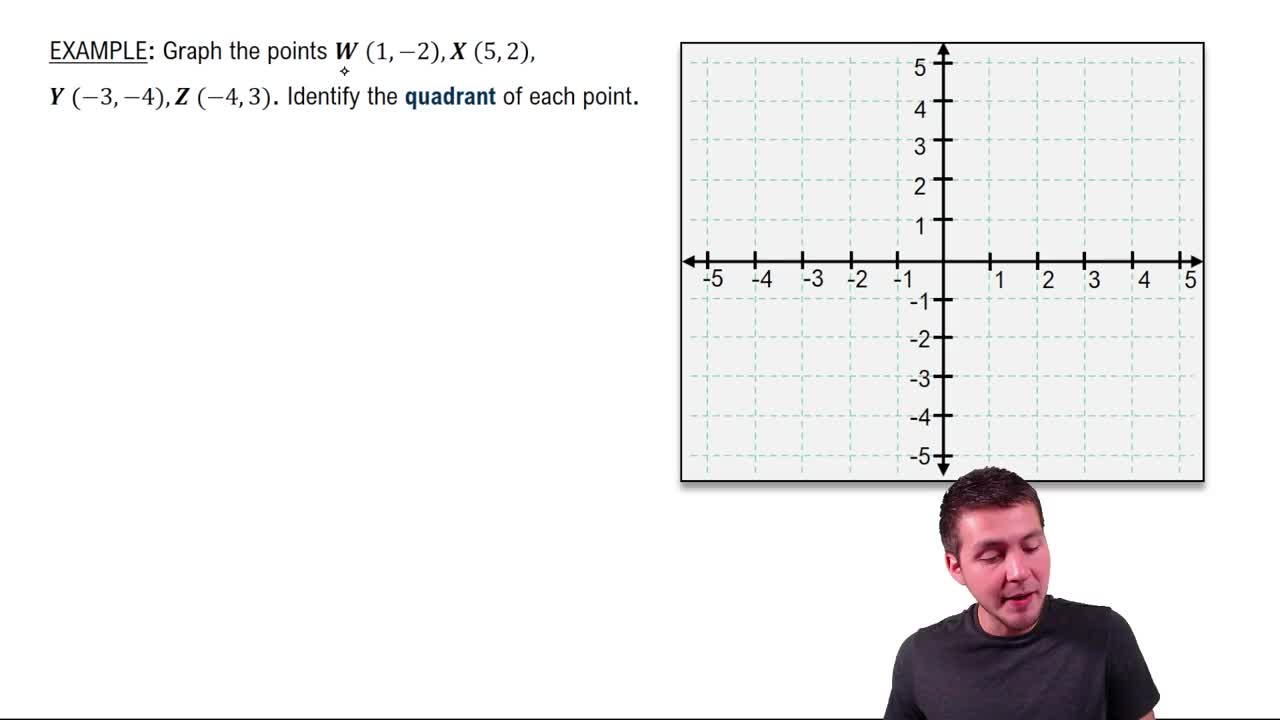
Graphs and Coordinates - Example
Watch next
Master Intro to Transformations with a bite sized video explanation from Patrick
Start learningRelated Videos
Related Practice
Textbook Question
1201
views