Solve each equation. Then state whether the equation is an identity, a conditional equation, or an inconsistent equation. 2x-5 = 7
Table of contents
- 0. Review of Algebra4h 18m
- 1. Equations & Inequalities3h 18m
- 2. Graphs of Equations1h 43m
- 3. Functions2h 17m
- 4. Polynomial Functions1h 44m
- 5. Rational Functions1h 23m
- 6. Exponential & Logarithmic Functions2h 28m
- 7. Systems of Equations & Matrices4h 5m
- 8. Conic Sections2h 23m
- 9. Sequences, Series, & Induction1h 22m
- 10. Combinatorics & Probability1h 45m
1. Equations & Inequalities
Rational Equations
Problem 19
Textbook Question
Solve each equation. Then state whether the equation is an identity, a conditional equation, or an inconsistent equation. 2(x-4)+3(x+5)=2x-2
Verified step by step guidance1
Start by applying the distributive property to both sides of the equation: expand \$2(x-4)\( and \)3(x+5)\( to get \)2 \cdot x - 2 \cdot 4 + 3 \cdot x + 3 \cdot 5$.
Simplify the expressions on the left side by performing the multiplications: this results in \$2x - 8 + 3x + 15$.
Combine like terms on the left side: add \$2x\( and \)3x\( to get \)5x\(, and combine \)-8\( and \)15\( to get \)7\(, so the left side becomes \)5x + 7$.
Rewrite the equation with the simplified left side and the right side as is: \$5x + 7 = 2x - 2$.
To isolate \(x\), subtract \$2x\( from both sides and subtract \)7\( from both sides, resulting in \)5x - 2x = -2 - 7\(, which simplifies to \)3x = -9\(. From here, you can solve for \)x$ by dividing both sides by 3.
Verified video answer for a similar problem:This video solution was recommended by our tutors as helpful for the problem above
Video duration:
2mPlay a video:
Was this helpful?
Key Concepts
Here are the essential concepts you must grasp in order to answer the question correctly.
Solving Linear Equations
Solving linear equations involves isolating the variable on one side of the equation using inverse operations such as addition, subtraction, multiplication, and division. The goal is to find the value of the variable that makes the equation true. For example, simplifying and combining like terms helps to reduce the equation to a simpler form.
Recommended video:
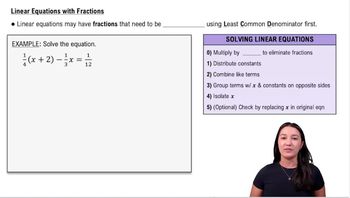
Solving Linear Equations with Fractions
Types of Equations: Identity, Conditional, and Inconsistent
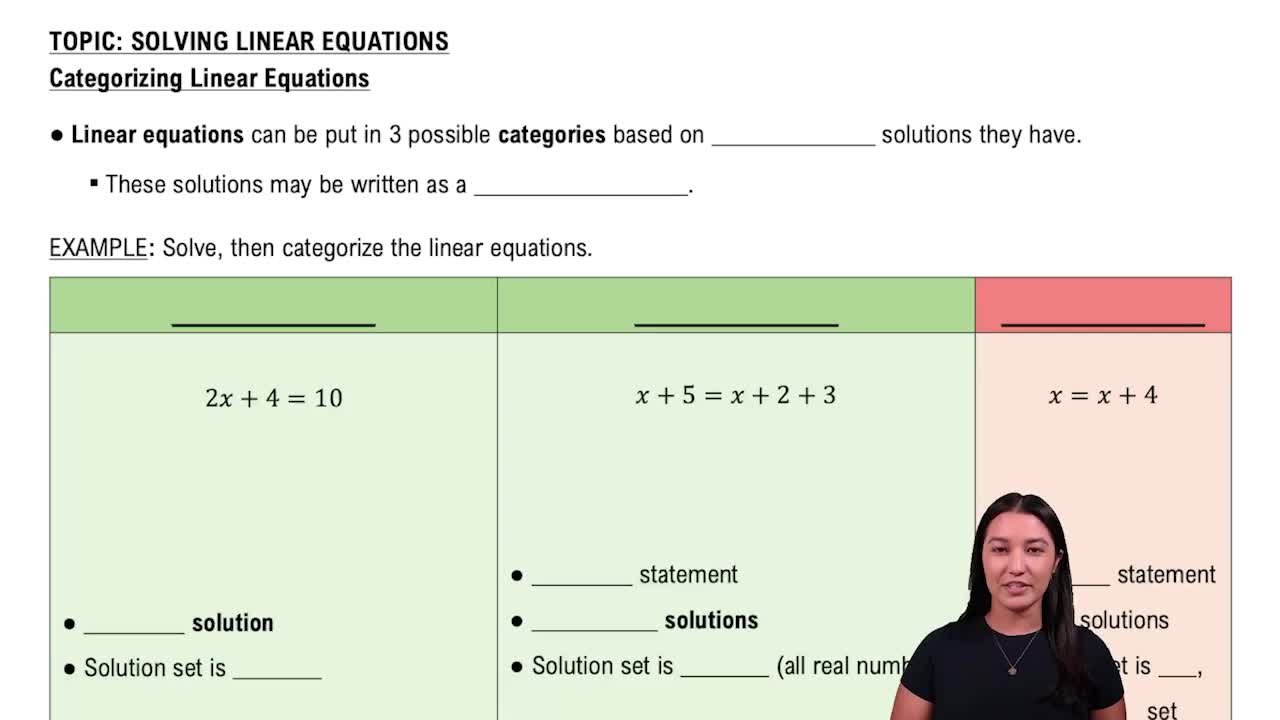
An identity is true for all values of the variable, a conditional equation is true for specific values, and an inconsistent equation has no solution. After solving, if the equation simplifies to a true statement like 0=0, it is an identity; if it results in a false statement like 0=5, it is inconsistent.
Recommended video:
Categorizing Linear Equations
Distributive Property
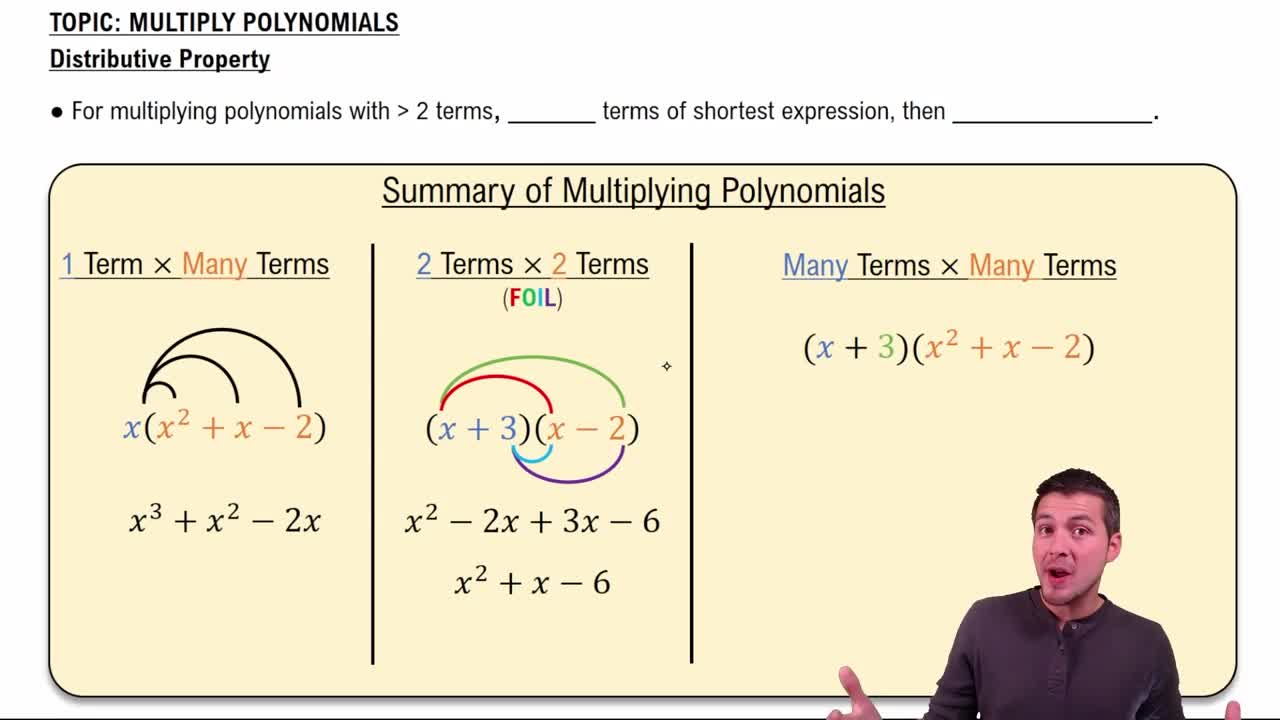
The distributive property allows you to multiply a single term by each term inside parentheses, expressed as a(b + c) = ab + ac. This property is essential for expanding expressions before combining like terms and simplifying equations, as seen in 2(x-4) + 3(x+5).
Recommended video:
Guided course
Multiply Polynomials Using the Distributive Property
Watch next
Master Introduction to Rational Equations with a bite sized video explanation from Patrick
Start learningRelated Videos
Related Practice
Textbook Question
654
views