Identify each set as finite or infinite. Then determine whether 10 is an element of the set. {4, 5, 6,...., 15}
Verified step by step guidance
1
Identify the type of sequence: The set {4, 5, 6, ..., 15} is an arithmetic sequence with a common difference of 1.
Determine the last element: The sequence ends at 15, making it a finite set.
Check if 10 is an element: Since the sequence starts at 4 and increases by 1 each time, check if 10 is between 4 and 15.
Verify inclusion: Since 10 is between 4 and 15 and follows the pattern of the sequence, it is an element of the set.
Conclude: The set is finite, and 10 is an element of the set.
Verified video answer for a similar problem:
This video solution was recommended by our tutors as helpful for the problem above
Video duration:
1m
Play a video:
Was this helpful?
Key Concepts
Here are the essential concepts you must grasp in order to answer the question correctly.
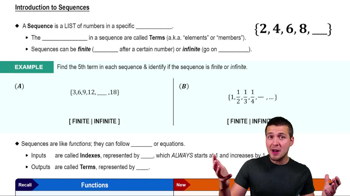
Finite vs. Infinite Sets
A finite set contains a limited number of elements, while an infinite set has no bounds and continues indefinitely. For example, the set of integers is infinite, whereas the set of natural numbers from 1 to 10 is finite. Understanding this distinction is crucial for classifying sets correctly.
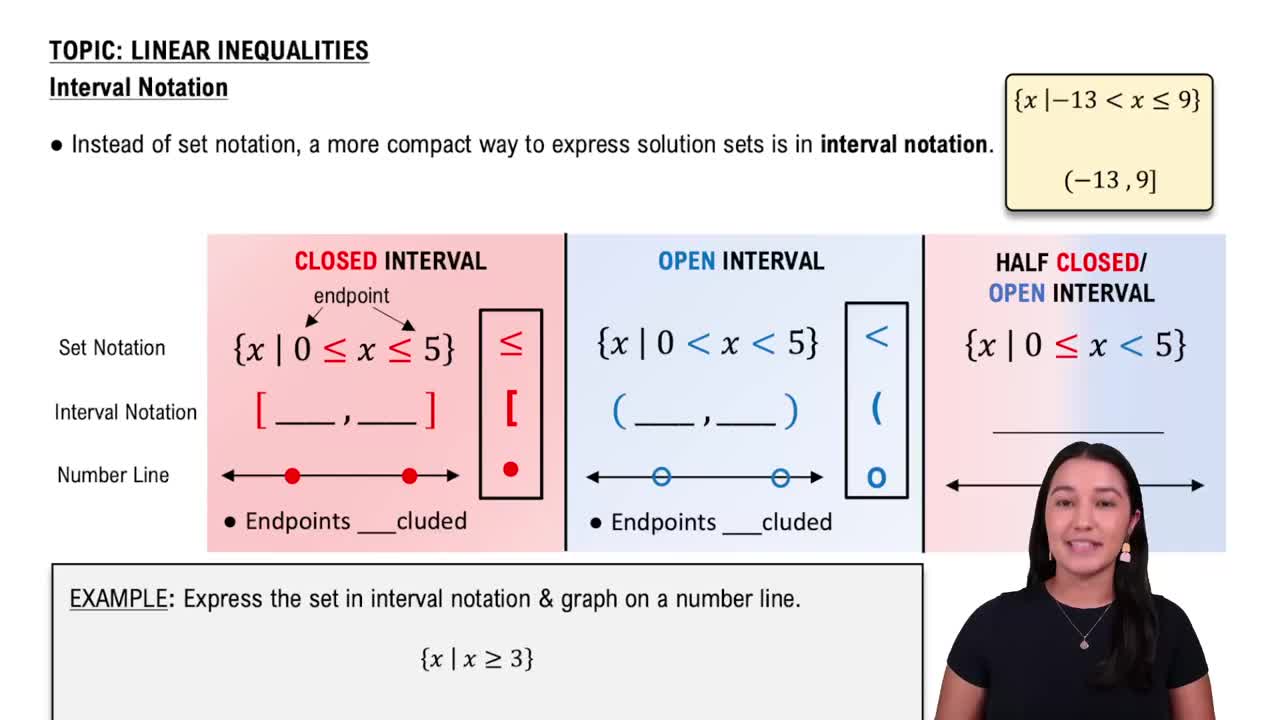
Set notation is a mathematical way to describe a collection of objects, called elements. Curly braces are used to denote sets, and ellipses (....) indicate a continuation of elements in a specific pattern. In the set {4, 5, 6,...., 15}, the notation signifies all integers from 4 to 15, inclusive.
An element of a set is an individual object contained within that set. To determine if a number, such as 10, is an element of a set, one checks if it appears in the collection. In the case of the set {4, 5, 6,...., 15}, since 10 falls within the specified range, it is indeed an element of the set.