In Exercises 105–108, evaluate each expression without using a calculator. log5 (log2 32)
Table of contents
- 0. Review of Algebra4h 18m
- 1. Equations & Inequalities3h 18m
- 2. Graphs of Equations1h 43m
- 3. Functions2h 17m
- 4. Polynomial Functions1h 44m
- 5. Rational Functions1h 23m
- 6. Exponential & Logarithmic Functions2h 28m
- 7. Systems of Equations & Matrices4h 5m
- 8. Conic Sections2h 23m
- 9. Sequences, Series, & Induction1h 22m
- 10. Combinatorics & Probability1h 45m
6. Exponential & Logarithmic Functions
Introduction to Logarithms
Problem 111
Textbook Question
In Exercises 109–112, find the domain of each logarithmic function. f(x) = log[(x+1)/(x-5)]
Verified step by step guidance1
Recall that the domain of a logarithmic function \( f(x) = \log(g(x)) \) consists of all values of \( x \) for which the argument \( g(x) \) is positive, i.e., \( g(x) > 0 \).
Identify the argument of the logarithm in the function: \( \frac{x+1}{x-5} \). We need to find where \( \frac{x+1}{x-5} > 0 \).
Determine the critical points where the numerator or denominator is zero: \( x+1=0 \Rightarrow x=-1 \) and \( x-5=0 \Rightarrow x=5 \). These points divide the number line into intervals to test.
Test the sign of \( \frac{x+1}{x-5} \) in each interval: \( (-\infty, -1) \), \( (-1, 5) \), and \( (5, \infty) \). For each interval, pick a test value and check if the fraction is positive.
Combine the intervals where the fraction is positive, excluding points where the denominator is zero (since division by zero is undefined), to write the domain of \( f(x) \).
Verified video answer for a similar problem:This video solution was recommended by our tutors as helpful for the problem above
Video duration:
3mPlay a video:
Was this helpful?
Key Concepts
Here are the essential concepts you must grasp in order to answer the question correctly.
Domain of a Function
The domain of a function is the set of all input values (x-values) for which the function is defined. For logarithmic functions, the argument inside the log must be positive, so determining the domain involves finding all x-values that make the argument greater than zero.
Recommended video:
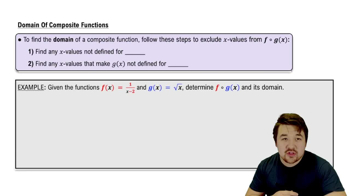
Domain Restrictions of Composed Functions
Properties of Logarithmic Functions
A logarithmic function log_b(A) is defined only when the argument A is positive (A > 0). This means that for f(x) = log[(x+1)/(x-5)], the expression (x+1)/(x-5) must be greater than zero to ensure the function is valid.
Recommended video:
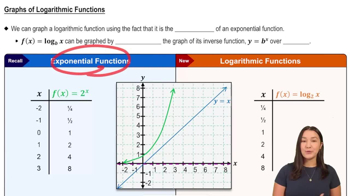
Graphs of Logarithmic Functions
Inequalities Involving Rational Expressions
To find where (x+1)/(x-5) > 0, one must solve a rational inequality. This involves determining the sign of the numerator and denominator, identifying critical points where the expression is zero or undefined, and testing intervals to find where the expression is positive.
Recommended video:
Guided course
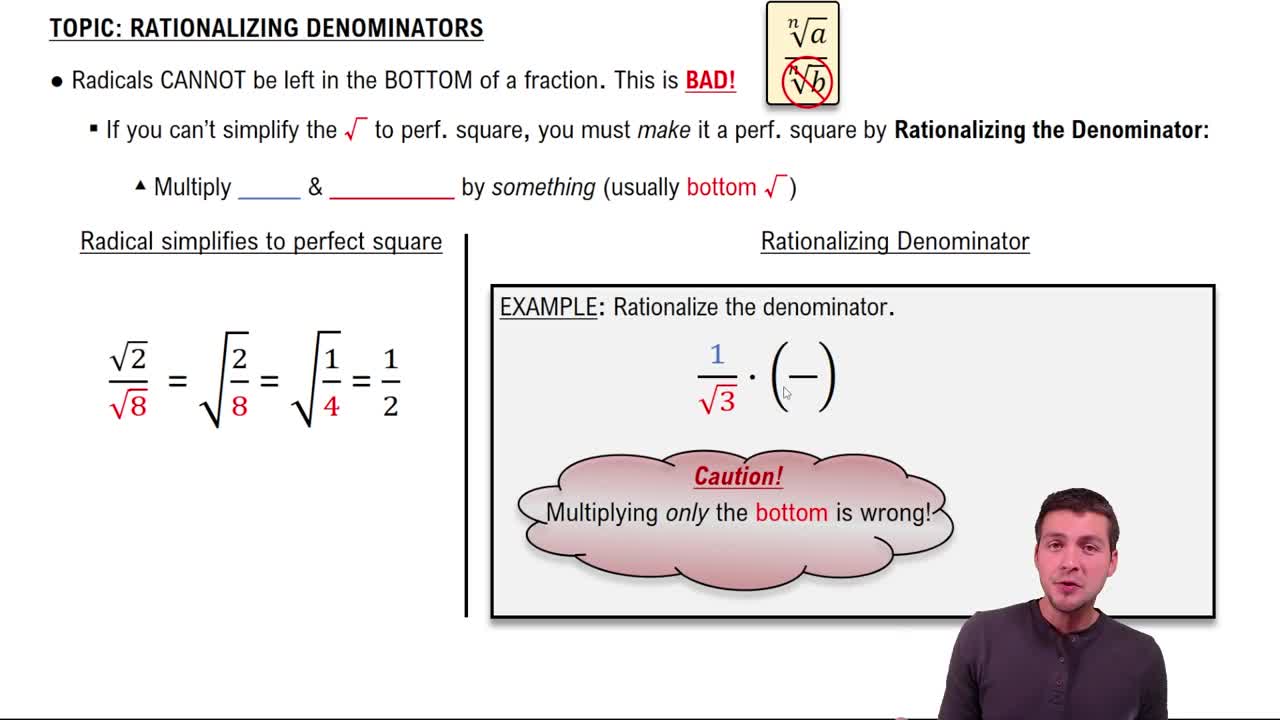
Rationalizing Denominators
Watch next
Master Logarithms Introduction with a bite sized video explanation from Patrick
Start learningRelated Videos
Related Practice
Textbook Question
708
views