Find the indicated sum. Use the formula for the sum of the first n terms of a geometric sequence.
Table of contents
- 0. Review of Algebra4h 18m
- 1. Equations & Inequalities3h 18m
- 2. Graphs of Equations1h 43m
- 3. Functions2h 17m
- 4. Polynomial Functions1h 44m
- 5. Rational Functions1h 23m
- 6. Exponential & Logarithmic Functions2h 28m
- 7. Systems of Equations & Matrices4h 5m
- 8. Conic Sections2h 23m
- 9. Sequences, Series, & Induction1h 22m
- 10. Combinatorics & Probability1h 45m
9. Sequences, Series, & Induction
Geometric Sequences
Problem 37
Textbook Question
Find the sum of each infinite geometric series. 1 + 1/3 + 1/9 + 1/27 + ...
Verified step by step guidance1
Identify the first term \( a \) of the infinite geometric series. In this series, the first term is \( 1 \).
Determine the common ratio \( r \) by dividing the second term by the first term: \( r = \frac{1/3}{1} = \frac{1}{3} \).
Verify that the absolute value of the common ratio is less than 1, i.e., \( |r| < 1 \), which ensures the series converges. Here, \( |\frac{1}{3}| < 1 \), so the series converges.
Use the formula for the sum \( S \) of an infinite geometric series: \[ S = \frac{a}{1 - r} \], where \( a \) is the first term and \( r \) is the common ratio.
Substitute the values of \( a = 1 \) and \( r = \frac{1}{3} \) into the formula to express the sum of the series.
Verified video answer for a similar problem:This video solution was recommended by our tutors as helpful for the problem above
Video duration:
3mPlay a video:
Was this helpful?
Key Concepts
Here are the essential concepts you must grasp in order to answer the question correctly.
Infinite Geometric Series
An infinite geometric series is the sum of infinitely many terms where each term is found by multiplying the previous term by a constant ratio. It has the form a + ar + ar² + ar³ + ..., where |r| < 1 for the series to converge.
Recommended video:
Guided course
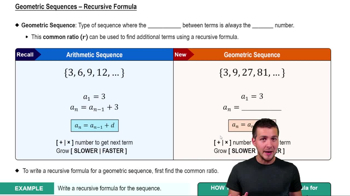
Geometric Sequences - Recursive Formula
Common Ratio
The common ratio (r) is the factor by which each term in a geometric series is multiplied to get the next term. It is found by dividing any term by its preceding term. For convergence in infinite series, the absolute value of r must be less than 1.
Recommended video:
Graphs of Common Functions
Sum Formula for Infinite Geometric Series
The sum S of an infinite geometric series with first term a and common ratio r (|r| < 1) is given by S = a / (1 - r). This formula allows calculation of the total sum without adding infinitely many terms.
Recommended video:
Guided course
Geometric Sequences - Recursive Formula
Watch next
Master Geometric Sequences - Recursive Formula with a bite sized video explanation from Patrick
Start learningRelated Videos
Related Practice
Textbook Question
672
views