Evaluate each expression without using a calculator. 271/3
Table of contents
- 0. Review of Algebra4h 18m
- 1. Equations & Inequalities3h 18m
- 2. Graphs of Equations1h 43m
- 3. Functions2h 17m
- 4. Polynomial Functions1h 44m
- 5. Rational Functions1h 23m
- 6. Exponential & Logarithmic Functions2h 28m
- 7. Systems of Equations & Matrices4h 5m
- 8. Conic Sections2h 23m
- 9. Sequences, Series, & Induction1h 22m
- 10. Combinatorics & Probability1h 45m
0. Review of Algebra
Exponents
Problem 89
Textbook Question
Write each decimal as a fraction. (Do not write in lowest terms.) 0.043
Verified step by step guidance1
Identify the place value of the last digit in the decimal 0.043. Since 0.043 has three decimal places, the last digit is in the thousandths place.
Write the decimal as a fraction with the decimal number as the numerator and 1 followed by as many zeros as decimal places as the denominator. For 0.043, this is \(\frac{43}{1000}\).
Express the decimal as \(\frac{43}{1000}\) without simplifying, as the problem requests not to write the fraction in lowest terms.
Verified video answer for a similar problem:This video solution was recommended by our tutors as helpful for the problem above
Video duration:
54sPlay a video:
Was this helpful?
Key Concepts
Here are the essential concepts you must grasp in order to answer the question correctly.
Converting Decimals to Fractions
To convert a decimal to a fraction, express the decimal number as a ratio of two integers. The decimal digits represent the numerator, and the denominator is a power of 10 based on the number of decimal places. For example, 0.043 has three decimal places, so it can be written as 43/1000.
Recommended video:
Guided course
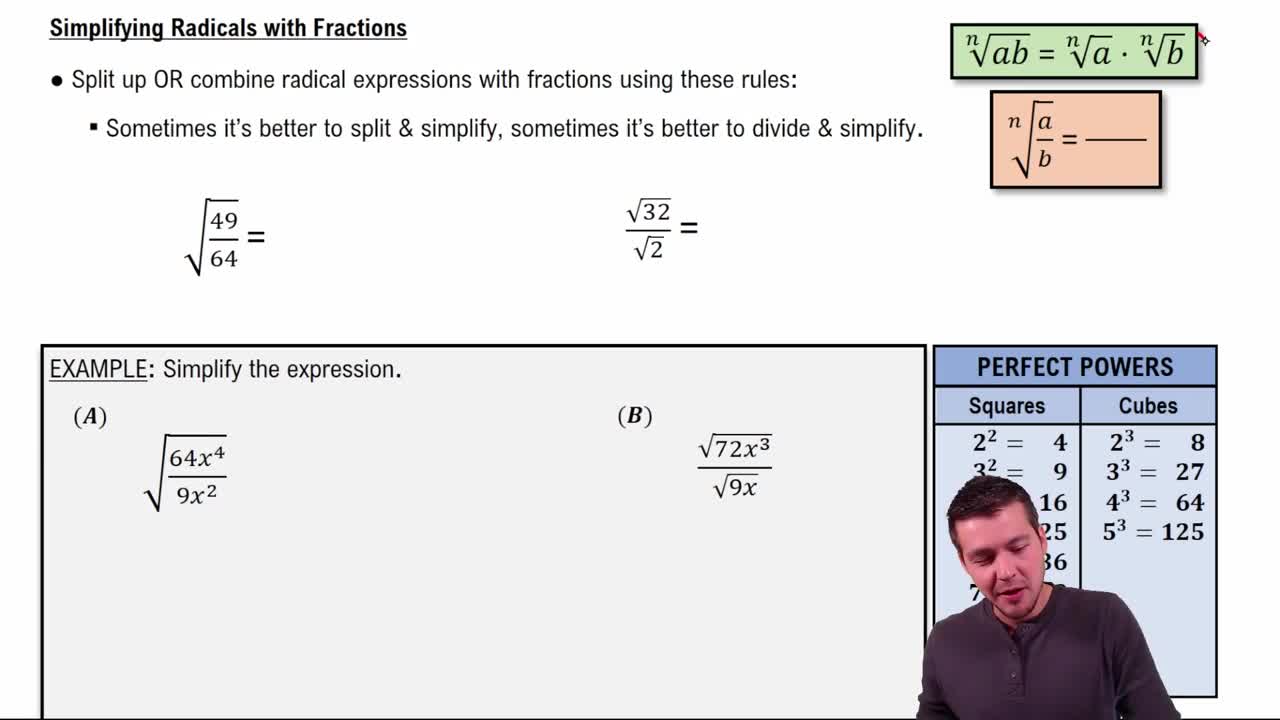
Radical Expressions with Fractions
Place Value in Decimals
Understanding place value is essential when converting decimals to fractions. Each digit after the decimal point represents tenths, hundredths, thousandths, etc. In 0.043, the digit 4 is in the hundredths place and 3 is in the thousandths place, which helps determine the denominator when forming the fraction.
Recommended video:
The Number e
Fraction Simplification (Optional)
Although the question specifies not to simplify, knowing that fractions can be reduced by dividing numerator and denominator by their greatest common divisor is important. Simplification makes fractions easier to interpret but is not required here, so the fraction should be left as initially converted.
Recommended video:
Solving Linear Equations with Fractions
Watch next
Master Introduction to Exponent Rules with a bite sized video explanation from Patrick
Start learningRelated Videos
Related Practice
Textbook Question
901
views