Write the first five terms of each geometric sequence. a1 = 20, r = 1/2
Verified step by step guidance
1
Identify the first term \(a_1\) and the common ratio \(r\) of the geometric sequence. Here, \(a_1 = 20\) and \(r = \frac{1}{2}\).
Recall the formula for the \(n\)-th term of a geometric sequence: \(a_n = a_1 \times r^{n-1}\).
Calculate the second term \(a_2\) by substituting \(n=2\) into the formula: \(a_2 = 20 \times \left(\frac{1}{2}\right)^{2-1}\).
Calculate the third term \(a_3\) by substituting \(n=3\): \(a_3 = 20 \times \left(\frac{1}{2}\right)^{3-1}\).
Continue this process to find the fourth and fifth terms, \(a_4\) and \(a_5\), by substituting \(n=4\) and \(n=5\) respectively into the formula.
Verified video answer for a similar problem:
This video solution was recommended by our tutors as helpful for the problem above
Video duration:
5m
Play a video:
Was this helpful?
Key Concepts
Here are the essential concepts you must grasp in order to answer the question correctly.
Geometric Sequence
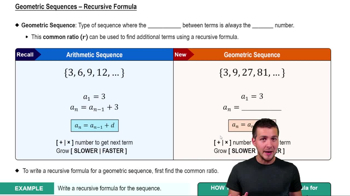
A geometric sequence is a list of numbers where each term after the first is found by multiplying the previous term by a constant called the common ratio. For example, if the first term is 20 and the ratio is 1/2, the sequence progresses by repeatedly multiplying by 1/2.
The common ratio is the fixed factor between consecutive terms in a geometric sequence. It determines how the sequence grows or shrinks. In this problem, the ratio is 1/2, meaning each term is half the previous term.
To find the nth term of a geometric sequence, use the formula a_n = a_1 * r^(n-1), where a_1 is the first term and r is the common ratio. Applying this formula allows you to calculate any term, including the first five terms as requested.