In Exercises 19–30, solve each system by the addition method. 2x + 3y = 6 2x - 3y = 6
Table of contents
- 0. Review of Algebra4h 18m
- 1. Equations & Inequalities3h 18m
- 2. Graphs of Equations1h 43m
- 3. Functions2h 17m
- 4. Polynomial Functions1h 44m
- 5. Rational Functions1h 23m
- 6. Exponential & Logarithmic Functions2h 28m
- 7. Systems of Equations & Matrices4h 5m
- 8. Conic Sections2h 23m
- 9. Sequences, Series, & Induction1h 22m
- 10. Combinatorics & Probability1h 45m
7. Systems of Equations & Matrices
Two Variable Systems of Linear Equations
Problem 25
Textbook Question
Solve each system by elimination. In systems with fractions, first clear denominators.
6x + 7y + 2 = 0
7x - 6y - 26 = 0
Verified step by step guidance1
Rewrite each equation to isolate the constant term on the right side. For the first equation, subtract 2 from both sides to get \$6x + 7y = -2\(. For the second equation, add 26 to both sides to get \)7x - 6y = 26$.
Set up the system of equations for elimination:
\$6x + 7y = -2$
\$7x - 6y = 26$
To eliminate one variable, find a common multiple for the coefficients of either \(x\) or \(y\). For example, multiply the first equation by 6 and the second equation by 7 to align the coefficients of \(y\):
\$6(6x + 7y) = 6(-2) \Rightarrow 36x + 42y = -12$
\$7(7x - 6y) = 7(26) \Rightarrow 49x - 42y = 182$
Add the two new equations to eliminate \(y\):
\((36x + 42y) + (49x - 42y) = -12 + 182\)
This simplifies to \$85x = 170$.
Solve for \(x\) by dividing both sides by 85, then substitute the value of \(x\) back into one of the original equations to solve for \(y\).
Verified video answer for a similar problem:This video solution was recommended by our tutors as helpful for the problem above
Video duration:
5mPlay a video:
Was this helpful?
Key Concepts
Here are the essential concepts you must grasp in order to answer the question correctly.
Systems of Linear Equations
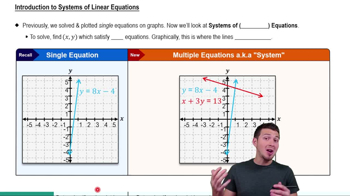
A system of linear equations consists of two or more linear equations with the same variables. The goal is to find values for the variables that satisfy all equations simultaneously. Understanding how to interpret and set up these systems is essential for solving them.
Recommended video:
Guided course
Introduction to Systems of Linear Equations
Elimination Method
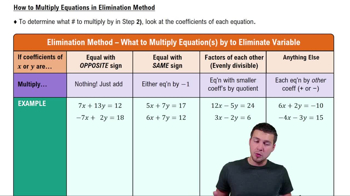
The elimination method involves adding or subtracting equations to eliminate one variable, making it easier to solve for the remaining variable. This technique often requires multiplying equations by constants to align coefficients before elimination.
Recommended video:
Guided course
How to Multiply Equations in Elimination Method
Clearing Fractions
When equations contain fractions, multiplying both sides by the least common denominator removes the fractions, simplifying calculations. Clearing denominators helps avoid errors and makes the elimination process more straightforward.
Recommended video:
Guided course
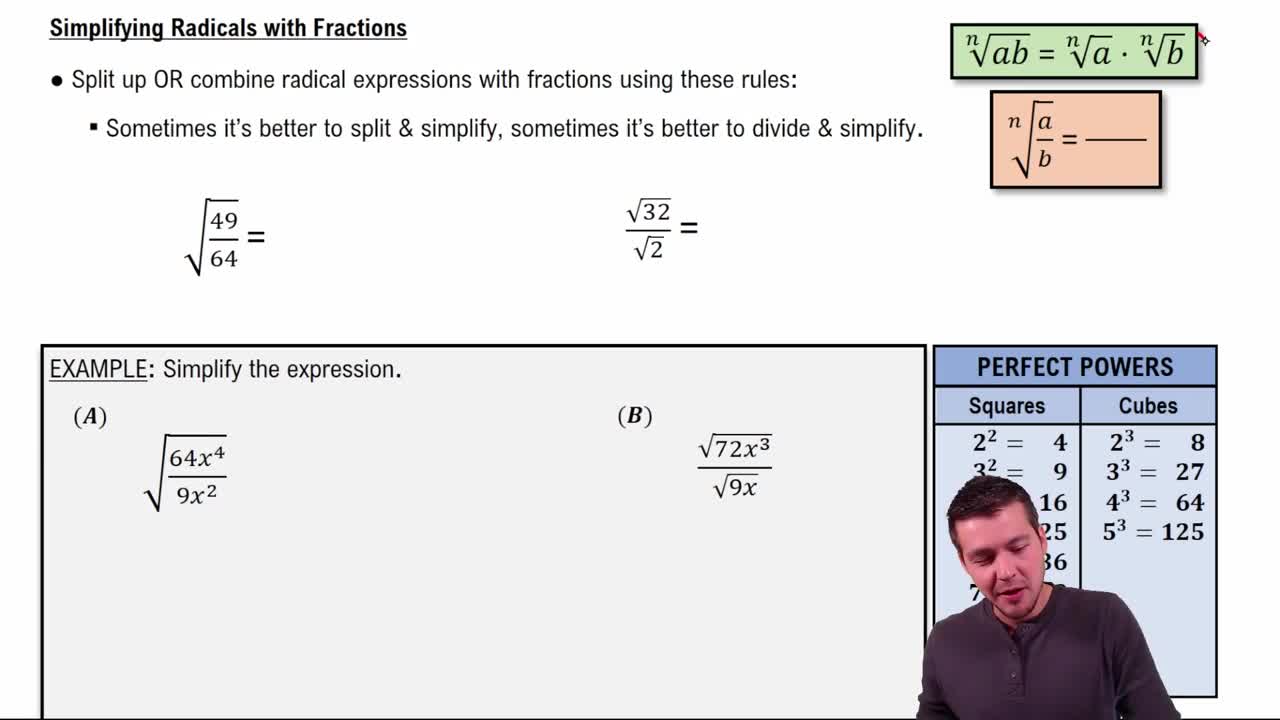
Radical Expressions with Fractions
Watch next
Master Introduction to Systems of Linear Equations with a bite sized video explanation from Patrick
Start learningRelated Videos
Related Practice
Textbook Question
639
views