Perform each division. See Examples 9 and 10. (q^2+4q-32)/(q-4)
Verified step by step guidance
1
Identify the dividend \( q^2 + 4q - 32 \) and the divisor \( q - 4 \).
Set up the division by writing \( q^2 + 4q - 32 \) under the long division symbol and \( q - 4 \) outside.
Divide the first term of the dividend \( q^2 \) by the first term of the divisor \( q \) to get the first term of the quotient, which is \( q \).
Multiply the entire divisor \( q - 4 \) by this first term of the quotient \( q \) and subtract the result from the dividend.
Repeat the process with the new polynomial obtained after subtraction until the degree of the remainder is less than the degree of the divisor.
Verified video answer for a similar problem:
This video solution was recommended by our tutors as helpful for the problem above
Video duration:
1m
Play a video:
Was this helpful?
Key Concepts
Here are the essential concepts you must grasp in order to answer the question correctly.
Polynomial Division
Polynomial division is a method used to divide one polynomial by another, similar to long division with numbers. It involves determining how many times the divisor can fit into the leading term of the dividend, subtracting the result, and repeating the process with the remainder until the degree of the remainder is less than that of the divisor.
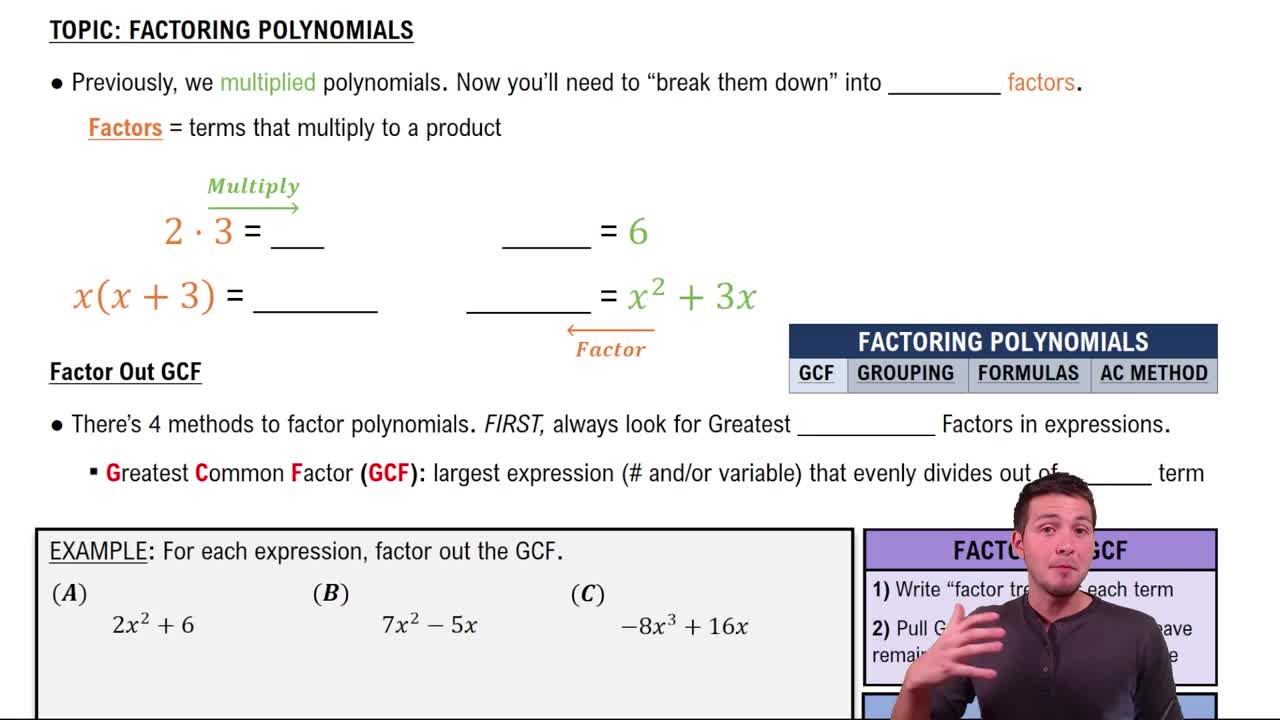
Factoring polynomials involves expressing a polynomial as a product of its simpler components, or factors. This is crucial in simplifying expressions and solving equations, as it can reveal roots or zeros of the polynomial. For example, the polynomial q^2 + 4q - 32 can be factored to facilitate division.
The Remainder Theorem states that when a polynomial f(q) is divided by a linear divisor of the form (q - c), the remainder of this division is equal to f(c). This theorem is useful for quickly finding the remainder without performing full polynomial long division, and it can help in evaluating the division of polynomials.