Use synthetic division to perform each division. x^3 - 1 / x-1
Verified step by step guidance
1
Identify the divisor and the dividend. Here, the divisor is \(x - 1\) and the dividend is \(x^3 - 1\).
Set up the synthetic division. Since the divisor is \(x - 1\), use \(1\) as the number to the left of the synthetic division setup.
Write the coefficients of the dividend \(x^3 - 1\). Note that the polynomial is \(x^3 + 0x^2 + 0x - 1\), so the coefficients are \(1, 0, 0, -1\).
Bring down the leading coefficient (1) to the bottom row.
Multiply the number you brought down (1) by the divisor root (1) and write the result under the next coefficient (0). Add this result to the coefficient above it and write the sum below. Repeat this process for each coefficient.
Verified video answer for a similar problem:
This video solution was recommended by our tutors as helpful for the problem above
Video duration:
5m
Play a video:
Was this helpful?
Key Concepts
Here are the essential concepts you must grasp in order to answer the question correctly.
Synthetic Division
Synthetic division is a simplified method of dividing a polynomial by a linear binomial of the form (x - c). It involves using the coefficients of the polynomial and a specific value (c) to perform the division without writing out the entire polynomial long division process. This technique is particularly useful for quickly finding polynomial quotients and remainders.
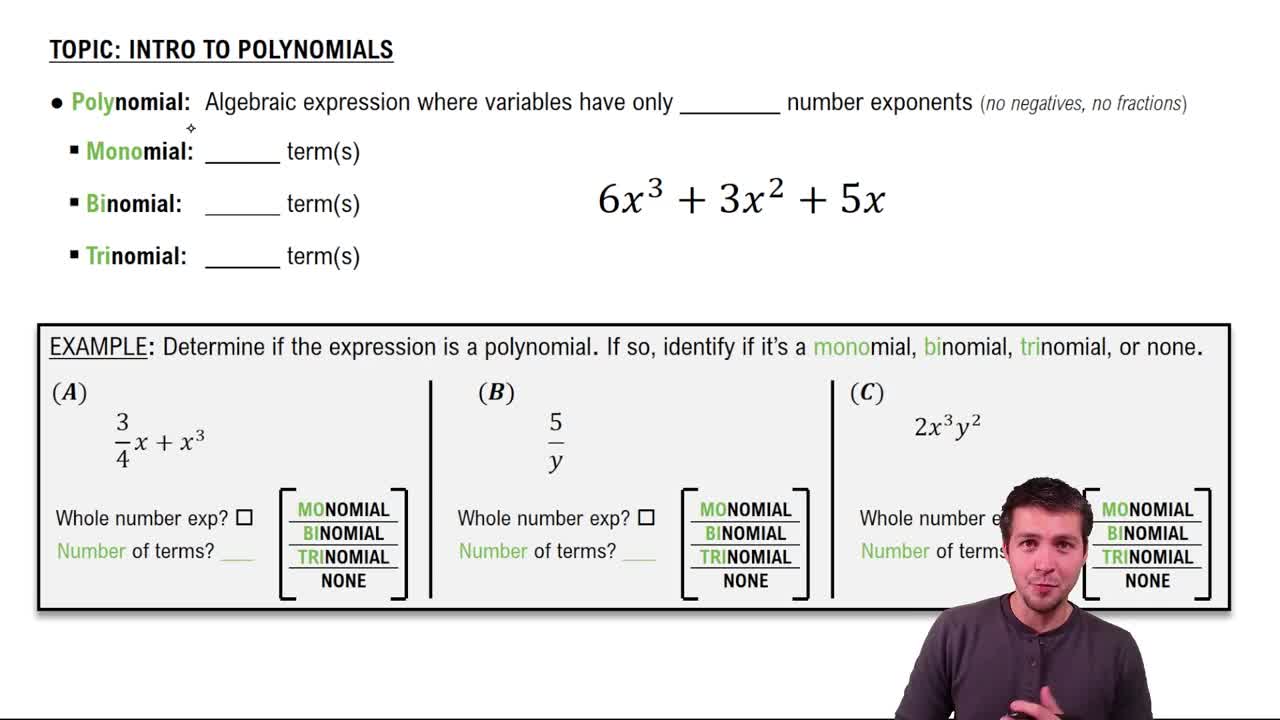
A polynomial is a mathematical expression consisting of variables raised to non-negative integer powers and coefficients. The general form of a polynomial in one variable is a_n*x^n + a_(n-1)*x^(n-1) + ... + a_1*x + a_0, where a_n, a_(n-1), ..., a_0 are constants. Understanding the structure of polynomials is essential for performing operations like division.
The Remainder Theorem states that when a polynomial f(x) is divided by a linear divisor (x - c), the remainder of this division is equal to f(c). This theorem is useful in synthetic division as it allows for quick evaluation of the polynomial at specific points, helping to determine the remainder without fully executing the division.