In Exercises 1–38, multiply as indicated. If possible, simplify any radical expressions that appear in the product.
(4 + √5) (10 - 3√5)
Verified step by step guidance
1
Distribute each term in the first binomial to each term in the second binomial.
Multiply 4 by 10 to get 40.
Multiply 4 by -3\(\sqrt{5}\) to get -12\(\sqrt{5}\).
Multiply \(\sqrt{5}\) by 10 to get 10\(\sqrt{5}\).
Multiply \(\sqrt{5}\) by -3\(\sqrt{5}\) to get -3(\(\sqrt{5}\))^2, which simplifies to -3 \(\times\) 5.
Verified video answer for a similar problem:
This video solution was recommended by our tutors as helpful for the problem above.
Video duration:
4m
Play a video:
0 Comments
Key Concepts
Here are the essential concepts you must grasp in order to answer the question correctly.
Multiplication of Binomials
Multiplying binomials involves applying the distributive property, often referred to as the FOIL method (First, Outside, Inside, Last). This technique helps in systematically multiplying each term in the first binomial by each term in the second binomial, ensuring that all combinations are accounted for in the final expression.
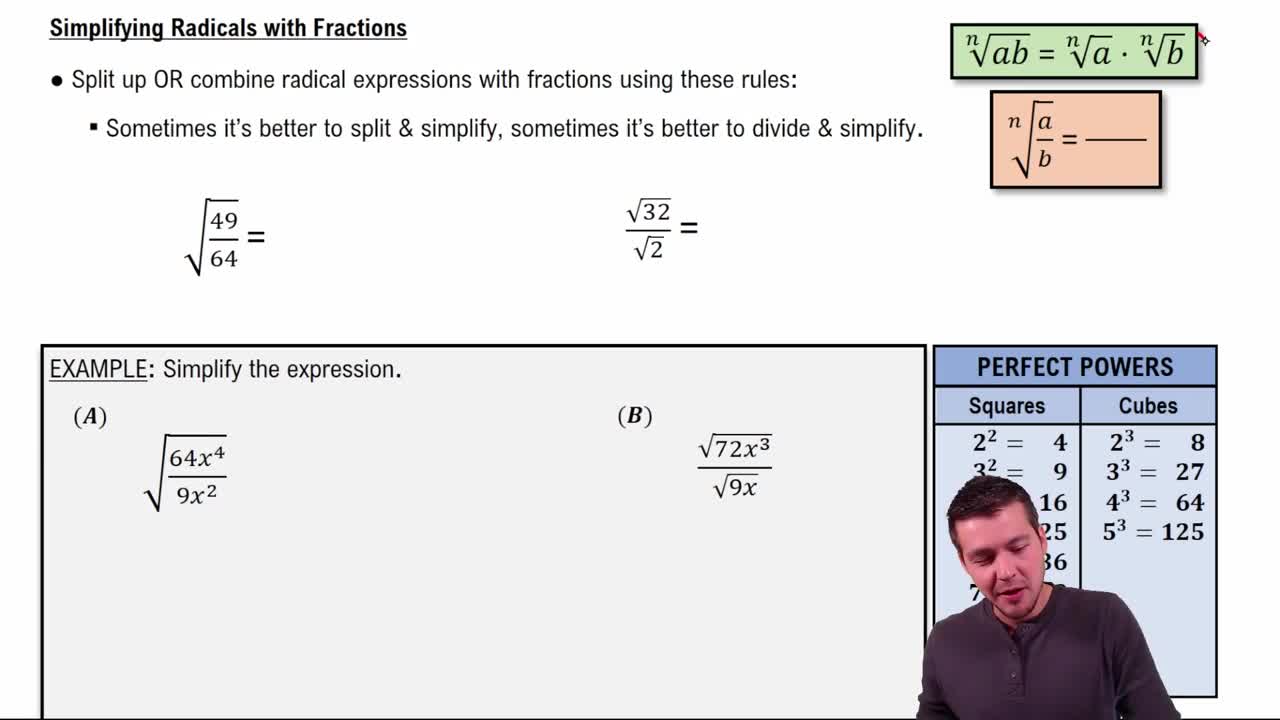
Radical expressions contain roots, such as square roots, cube roots, etc. Simplifying these expressions often involves factoring out perfect squares or cubes, allowing for a more manageable form. Understanding how to manipulate and simplify radicals is crucial when they appear in products or sums.
Simplification involves reducing an expression to its simplest form, which may include combining like terms, reducing fractions, or simplifying radicals. This process is essential in algebra to make expressions easier to work with and to prepare them for further operations or evaluations.

 4:28 minutes
 Verified step by step guidance
 03:42
03:42