
Textbook Question
Solve each problem. See Example 2. In the Apple Hill Fun Run, Mary runs at 7 mph, Janet at 5 mph. If they start at the same time, how long will it be before they are 1.5 mi apart?
707
views

 Verified step by step guidance
 04:10
04:10
 05:02
05:02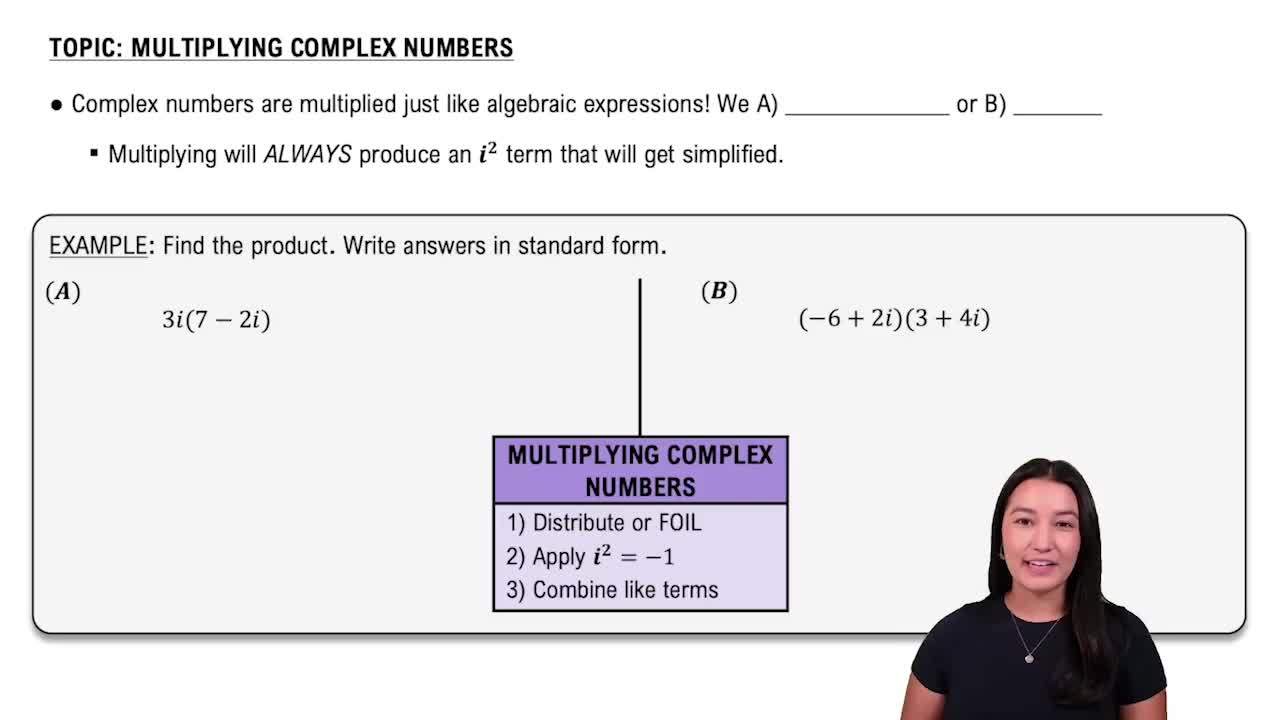 05:02
05:02Solve each problem. See Example 2. In the Apple Hill Fun Run, Mary runs at 7 mph, Janet at 5 mph. If they start at the same time, how long will it be before they are 1.5 mi apart?
Solve each inequality. Give the solution set in interval notation. (1/3)x+(2/5)x-(1/2)(x+3)≤1/10
Perform each operation. Write answers in standard form. (-8+2i)(-1+i)
Solve each equation using the zero-factor property. 36x2 + 60x + 25 = 0
Solve each equation. 0.2x - 0.5 = 0.1x+7
Solve each equation. 3/(x2+x-2) - 1/(x2-1) = 7/(2x2+6x+4)