Solve each inequality. Give the solution set using interval notation. x²-3x ≥ 5
Verified step by step guidance
1
Start by rewriting the inequality to have zero on one side: subtract 5 from both sides to get \(x^{2} - 3x - 5 \geq 0\).
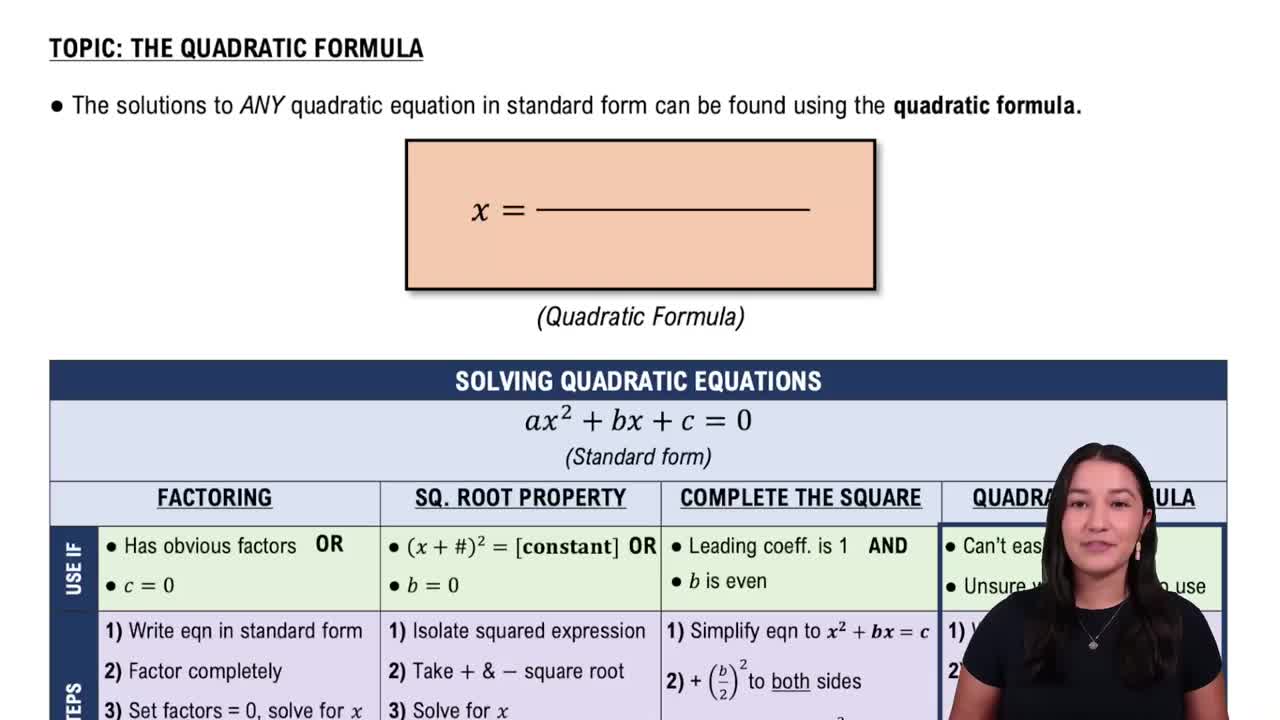
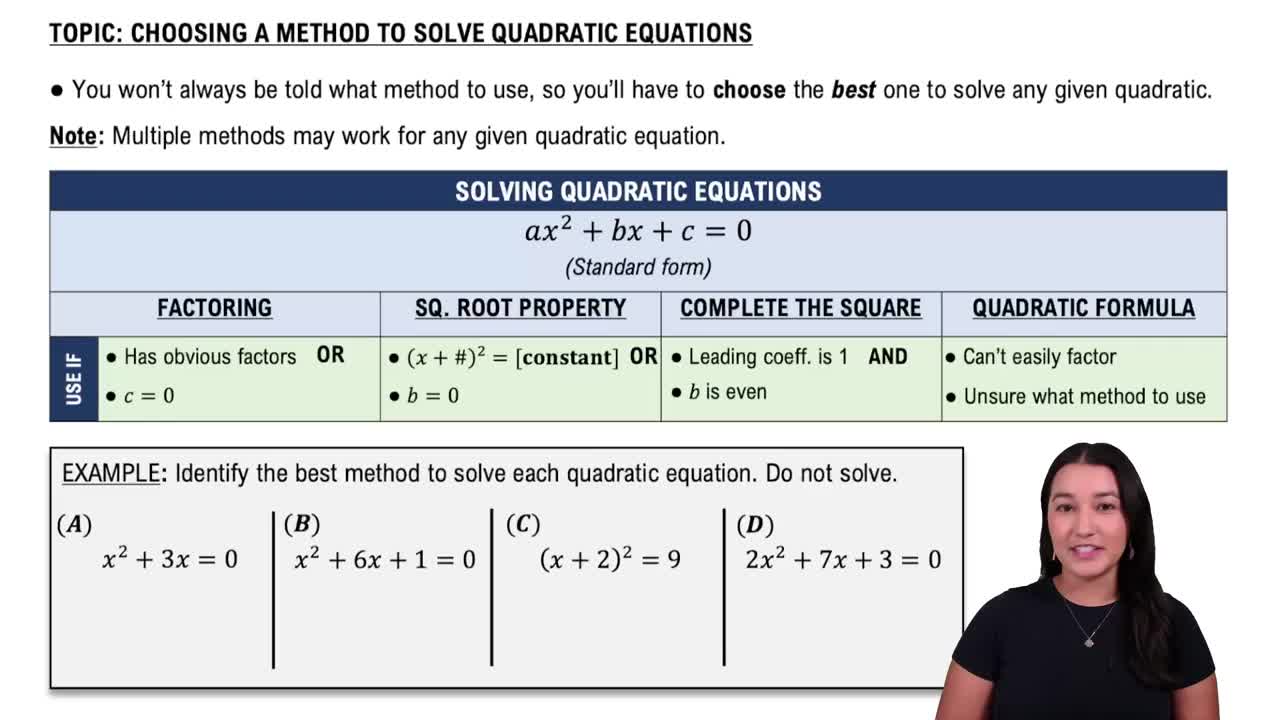
Next, find the roots of the quadratic equation \(x^{2} - 3x - 5 = 0\) by using the quadratic formula: \(x = \frac{-b \pm \sqrt{b^{2} - 4ac}}{2a}\), where \(a=1\), \(b=-3\), and \(c=-5\).
Calculate the discriminant \(\Delta = b^{2} - 4ac = (-3)^{2} - 4(1)(-5)\) to determine the nature of the roots.
Use the roots found to divide the number line into intervals. Test a value from each interval in the inequality \(x^{2} - 3x - 5 \geq 0\) to determine where the inequality holds true.
Express the solution set in interval notation based on the intervals where the inequality is satisfied, including the points where the expression equals zero.
Verified video answer for a similar problem:
This video solution was recommended by our tutors as helpful for the problem above
Video duration:
10m
Play a video:
0 Comments
Key Concepts
Here are the essential concepts you must grasp in order to answer the question correctly.
Solving Quadratic Inequalities
Solving quadratic inequalities involves finding the values of the variable that make the inequality true. This typically requires rewriting the inequality in standard form, factoring or using the quadratic formula to find critical points, and then testing intervals to determine where the inequality holds.
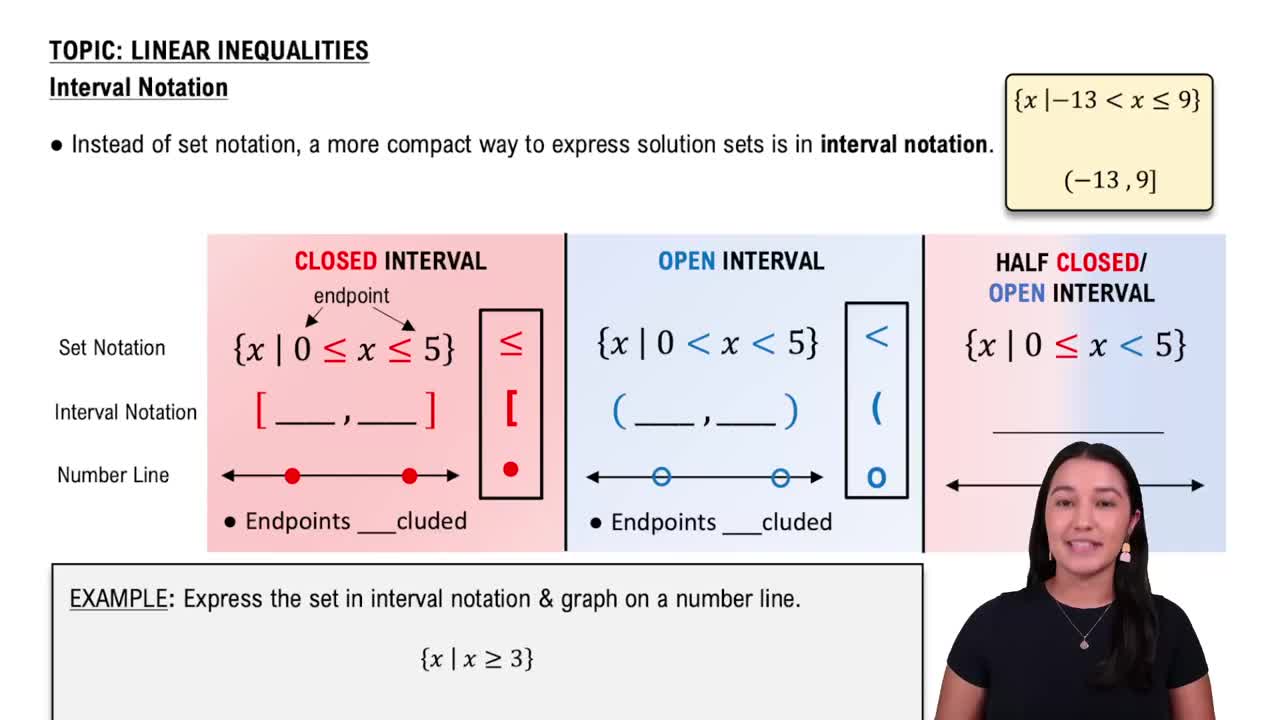
Interval notation is a way to represent sets of numbers on the number line. It uses parentheses () for values not included and brackets [] for values included, describing continuous ranges such as (a, b), [a, b), or (-∞, c]. This notation concisely expresses solution sets of inequalities.
Sign analysis involves determining where a quadratic expression is positive, negative, or zero by examining its roots and the shape of its graph. Since a quadratic opens upward or downward, the sign of the expression changes at its roots, helping identify solution intervals for inequalities.

 10:19 minutes
 Verified step by step guidance
 04:03
04:03