In Exercises 1 - 24, use Gaussian Elimination to find the complete solution to each system of equations, or show that none exists.
Table of contents
- 0. Review of Algebra4h 18m
- 1. Equations & Inequalities3h 18m
- 2. Graphs of Equations1h 43m
- 3. Functions2h 17m
- 4. Polynomial Functions1h 44m
- 5. Rational Functions1h 23m
- 6. Exponential & Logarithmic Functions2h 28m
- 7. Systems of Equations & Matrices4h 5m
- 8. Conic Sections2h 23m
- 9. Sequences, Series, & Induction1h 22m
- 10. Combinatorics & Probability1h 45m
7. Systems of Equations & Matrices
Introduction to Matrices
Problem 9
Textbook Question
In Exercises 8–11, use Gaussian elimination to find the complete solution to each system, or show that none exists.
Verified step by step guidance1
Write the given system of linear equations in augmented matrix form. The augmented matrix combines the coefficients of the variables and the constants from the equations into a single matrix.
Use row operations (row swapping, scaling a row by a nonzero constant, or adding/subtracting multiples of one row to another) to transform the augmented matrix into row-echelon form. The goal is to create zeros below the pivot positions (leading entries in each row).
Continue applying row operations to transform the matrix into reduced row-echelon form (RREF). In RREF, each pivot is 1, and all other entries in the pivot's column are 0.
Interpret the resulting matrix. If the system has a unique solution, the RREF will clearly show the values of the variables. If there are free variables (columns without pivots), express the solution in terms of these free variables. If a row in the matrix corresponds to an inconsistent equation (e.g., 0 = 1), conclude that no solution exists.
Write the complete solution, if it exists, in terms of the variables. If there are free variables, express the solution as a parametric equation. If no solution exists, state that the system is inconsistent.
Verified video answer for a similar problem:This video solution was recommended by our tutors as helpful for the problem above
Video duration:
4mPlay a video:
Was this helpful?
Key Concepts
Here are the essential concepts you must grasp in order to answer the question correctly.
Gaussian Elimination
Gaussian elimination is a systematic method for solving systems of linear equations. It involves transforming the system's augmented matrix into row echelon form using a series of row operations, which include swapping rows, multiplying a row by a non-zero scalar, and adding or subtracting rows. This process simplifies the equations, making it easier to find solutions or determine if no solution exists.
Recommended video:
Guided course
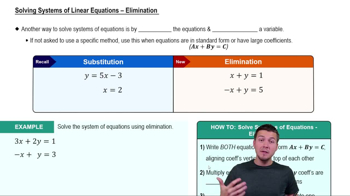
Solving Systems of Equations - Elimination
Row Echelon Form
Row echelon form is a specific arrangement of a matrix where all non-zero rows are above any rows of all zeros, and the leading coefficient of each non-zero row (the first non-zero number from the left) is to the right of the leading coefficient of the previous row. This form is crucial in Gaussian elimination as it allows for back substitution to find the values of the variables in a linear system.
Recommended video:
Guided course
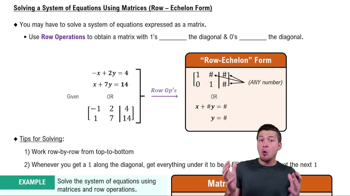
Solving Systems of Equations - Matrices (Row-Echelon Form)
Existence of Solutions
In the context of linear systems, the existence of solutions refers to whether a system has one unique solution, infinitely many solutions, or no solution at all. This can be determined during the Gaussian elimination process by examining the final row echelon form of the augmented matrix. If a row leads to a contradiction (like 0 = 1), the system has no solution; if there are free variables, it indicates infinitely many solutions.
Recommended video:
Probability of Non-Mutually Exclusive Events
Watch next
Master Introduction to Matrices with a bite sized video explanation from Patrick
Start learningRelated Videos
Related Practice
Textbook Question
427
views