Write the first five terms of each geometric sequence. an = - 4a(n-1), a1 = 10
Table of contents
- 0. Review of Algebra4h 18m
- 1. Equations & Inequalities3h 18m
- 2. Graphs of Equations1h 43m
- 3. Functions2h 17m
- 4. Polynomial Functions1h 44m
- 5. Rational Functions1h 23m
- 6. Exponential & Logarithmic Functions2h 28m
- 7. Systems of Equations & Matrices4h 5m
- 8. Conic Sections2h 23m
- 9. Sequences, Series, & Induction1h 22m
- 10. Combinatorics & Probability1h 45m
9. Sequences, Series, & Induction
Geometric Sequences
Problem 13
Textbook Question
Use the formula for the general term (the nth term) of a geometric sequence to find the indicated term of each sequence with the given first term, a1 and common ratio, r. Find a40 when a1 = 1000, r = - 1/2
Verified step by step guidance1
Recall the formula for the nth term of a geometric sequence: \(a_n = a_1 \times r^{n-1}\), where \(a_1\) is the first term, \(r\) is the common ratio, and \(n\) is the term number.
Identify the given values: the first term \(a_1 = 1000\), the common ratio \(r = -\frac{1}{2}\), and the term to find is \(a_{40}\), so \(n = 40\).
Substitute the known values into the formula: \(a_{40} = 1000 \times \left(-\frac{1}{2}\right)^{40-1}\).
Simplify the exponent expression: \(a_{40} = 1000 \times \left(-\frac{1}{2}\right)^{39}\).
Evaluate the power \(\left(-\frac{1}{2}\right)^{39}\) carefully, noting that since 39 is odd, the result will be negative, and then multiply by 1000 to find \(a_{40}\).
Verified video answer for a similar problem:This video solution was recommended by our tutors as helpful for the problem above
Video duration:
3mPlay a video:
Was this helpful?
Key Concepts
Here are the essential concepts you must grasp in order to answer the question correctly.
Geometric Sequence
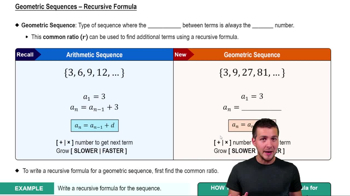
A geometric sequence is a list of numbers where each term after the first is found by multiplying the previous term by a constant called the common ratio. This ratio can be positive, negative, or a fraction, affecting the sequence's behavior. Understanding this helps identify how terms progress.
Recommended video:
Guided course
Geometric Sequences - Recursive Formula
General Term Formula of a Geometric Sequence
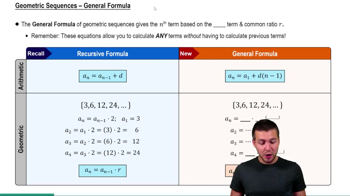
The nth term of a geometric sequence is given by the formula a_n = a_1 * r^(n-1), where a_1 is the first term, r is the common ratio, and n is the term number. This formula allows direct calculation of any term without listing all previous terms.
Recommended video:
Guided course
Geometric Sequences - General Formula
Handling Negative and Fractional Common Ratios
When the common ratio is negative or a fraction, the terms alternate in sign or decrease in magnitude respectively. This affects the sequence's pattern and must be carefully applied in the formula to correctly find terms like a_40.
Recommended video:
Graphs of Common Functions
Watch next
Master Geometric Sequences - Recursive Formula with a bite sized video explanation from Patrick
Start learningRelated Videos
Related Practice
Textbook Question
647
views