Identify the set { 1,1/3, 1/9 ,1/27, ....} as finite or infinite.
Verified step by step guidance
1
Observe the given set: \(\{ 1, \frac{1}{3}, \frac{1}{9}, \frac{1}{27}, \ldots \}\). Notice the pattern in the terms.
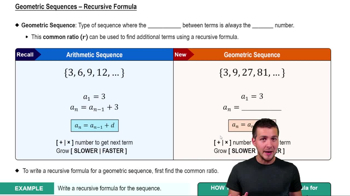
Recognize that each term after the first is obtained by multiplying the previous term by \(\frac{1}{3}\). This means the set is a geometric sequence with the first term \(a = 1\) and common ratio \(r = \frac{1}{3}\).
Understand that the ellipsis (\(\ldots\)) at the end of the set indicates the sequence continues indefinitely, without stopping at a last term.
Recall the definitions: a finite set has a limited number of elements, while an infinite set continues without end.
Conclude that since the sequence continues indefinitely, the set is infinite.
Verified video answer for a similar problem:
This video solution was recommended by our tutors as helpful for the problem above
Video duration:
1m
Play a video:
Was this helpful?
Key Concepts
Here are the essential concepts you must grasp in order to answer the question correctly.
Sequences
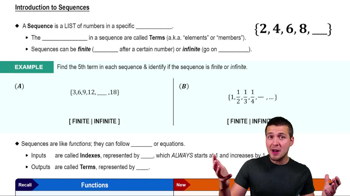
A sequence is an ordered list of numbers following a specific pattern. Each number in the sequence is called a term, and sequences can be finite (having a limited number of terms) or infinite (continuing indefinitely). Understanding the nature of the sequence helps determine its classification.
A geometric sequence is a sequence where each term after the first is found by multiplying the previous term by a constant ratio. For example, in the sequence {1, 1/3, 1/9, 1/27, ...}, each term is multiplied by 1/3. Recognizing this pattern is key to analyzing the sequence.
A finite set contains a limited number of elements, while an infinite set has no end and continues indefinitely. Determining whether a sequence is finite or infinite depends on whether the pattern stops or goes on forever, which is essential for classifying the given set.