Solve each system in Exercises 5–18. ⎩⎨⎧x+y+2z=11x+y+3z=14x+2y−z=5
Verified step by step guidance
1
Write down the system of equations clearly:
\(\begin{cases} x + 0y + 2z = 11 \\ x + 0y + 3z = 14 \\ x + 2y - 0z = 5 \end{cases}\)
Notice that the first two equations both have \(x\) and \(z\) terms but no \(y\). Use these two equations to eliminate \(x\) or \(z\) by subtracting one equation from the other.
Subtract the first equation from the second:
\( (x + 0y + 3z) - (x + 0y + 2z) = 14 - 11 \) which simplifies to an equation involving only \(z\).
Solve the resulting equation for \(z\). Once you have \(z\), substitute this value back into one of the first two equations to solve for \(x\).
With \(x\) and \(z\) known, substitute both into the third equation \(x + 2y = 5\) to solve for \(y\).
Verified video answer for a similar problem:
This video solution was recommended by our tutors as helpful for the problem above
Video duration:
3m
Play a video:
Was this helpful?
Key Concepts
Here are the essential concepts you must grasp in order to answer the question correctly.
Systems of Linear Equations
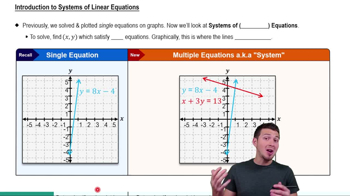
A system of linear equations consists of two or more linear equations with the same variables. The goal is to find values for the variables that satisfy all equations simultaneously. Understanding how to interpret and set up these systems is essential for solving them.
Common methods to solve systems include substitution, elimination, and matrix techniques like Gaussian elimination. Choosing an appropriate method depends on the system's structure. For example, elimination is useful when variables can be easily canceled by adding or subtracting equations.
Coefficients represent the numerical multipliers of variables in equations. Recognizing zero coefficients helps simplify the system by reducing the number of variables in certain equations. This understanding aids in selecting the best approach to isolate variables and solve the system efficiently.