Perform the indicated operations and write the result in standard form. (1 + i)/(1 + 2i) + (1 - i)/(1 - 2i)
Table of contents
- 0. Review of Algebra4h 18m
- 1. Equations & Inequalities3h 18m
- 2. Graphs of Equations1h 43m
- 3. Functions2h 17m
- 4. Polynomial Functions1h 44m
- 5. Rational Functions1h 23m
- 6. Exponential & Logarithmic Functions2h 28m
- 7. Systems of Equations & Matrices4h 5m
- 8. Conic Sections2h 23m
- 9. Sequences, Series, & Induction1h 22m
- 10. Combinatorics & Probability1h 45m
1. Equations & Inequalities
The Imaginary Unit
Problem 3
Textbook Question
In Exercises 1–8, add or subtract as indicated and write the result in standard form. (3 + 2i) - (5 - 7i)
Verified step by step guidance1
Identify the problem as the subtraction of two complex numbers: \((3 + 2i) - (5 - 7i)\).
Rewrite the expression by distributing the subtraction sign to the second complex number: \((3 + 2i) - 5 + 7i\).
Group the real parts together and the imaginary parts together: \((3 - 5) + (2i + 7i)\).
Perform the subtraction and addition separately for the real and imaginary parts: calculate \$3 - 5\( and \)2i + 7i$.
Write the final result in standard form \(a + bi\), where \(a\) is the real part and \(b\) is the coefficient of the imaginary part.
Verified video answer for a similar problem:This video solution was recommended by our tutors as helpful for the problem above
Video duration:
1mPlay a video:
Was this helpful?
Key Concepts
Here are the essential concepts you must grasp in order to answer the question correctly.
Complex Numbers
Complex numbers are numbers in the form a + bi, where a and b are real numbers and i is the imaginary unit with the property i² = -1. They combine real and imaginary parts and are used to represent quantities that cannot be expressed on the real number line alone.
Recommended video:
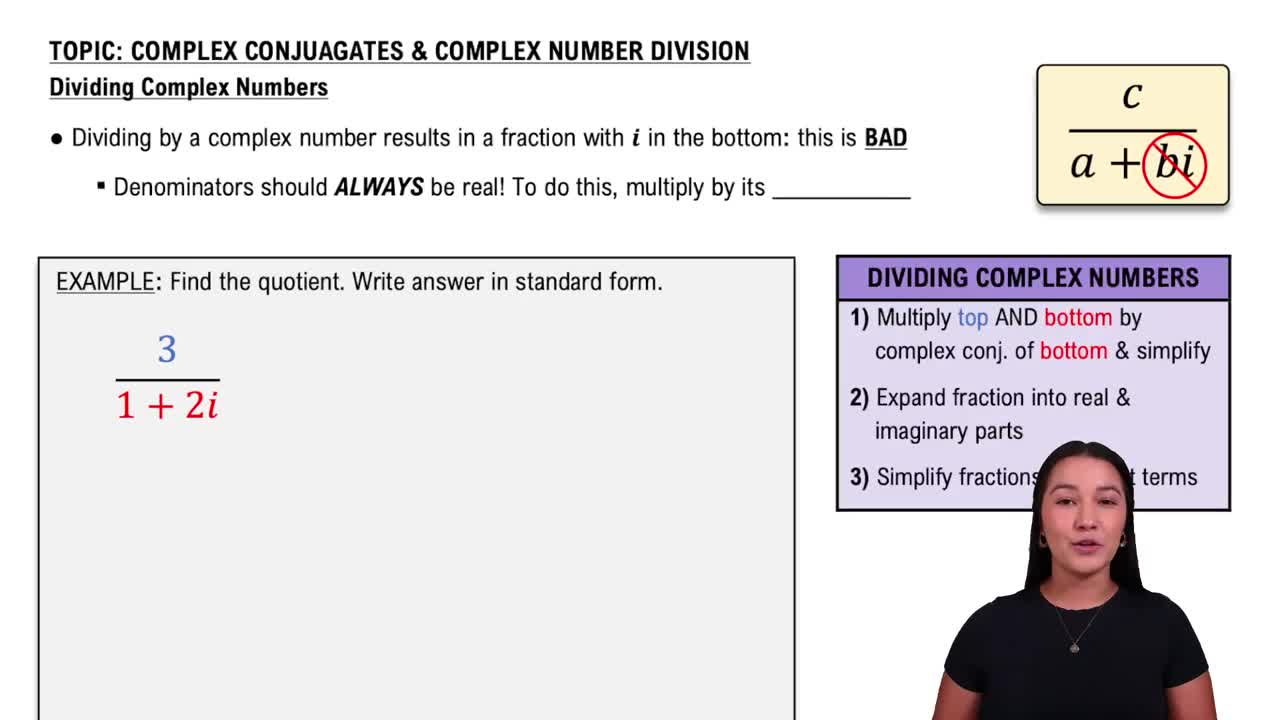
Dividing Complex Numbers
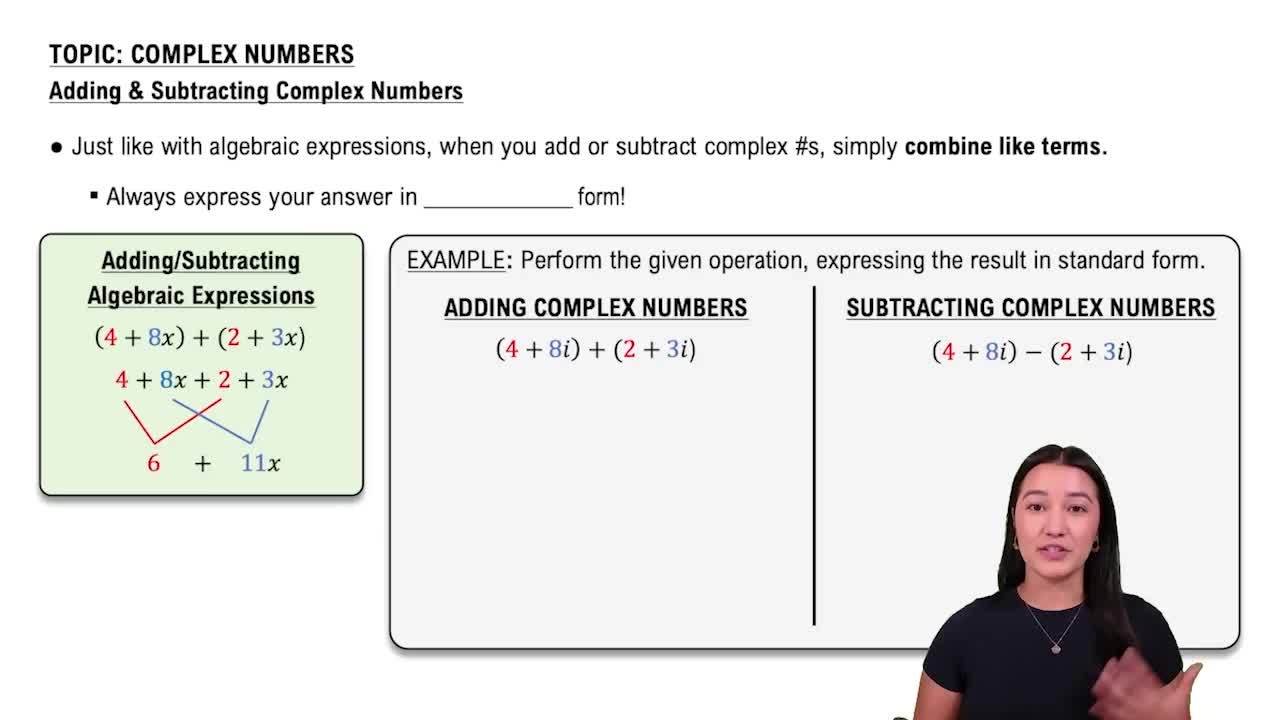
Addition and Subtraction of Complex Numbers
To add or subtract complex numbers, combine their real parts and their imaginary parts separately. For example, (a + bi) - (c + di) = (a - c) + (b - d)i. This operation follows the same rules as combining like terms in algebra.
Recommended video:
Adding and Subtracting Complex Numbers
Standard Form of a Complex Number
The standard form of a complex number is written as a + bi, where a is the real part and b is the coefficient of the imaginary part. Writing the result in standard form means expressing the answer clearly with the real and imaginary parts separated.
Recommended video:
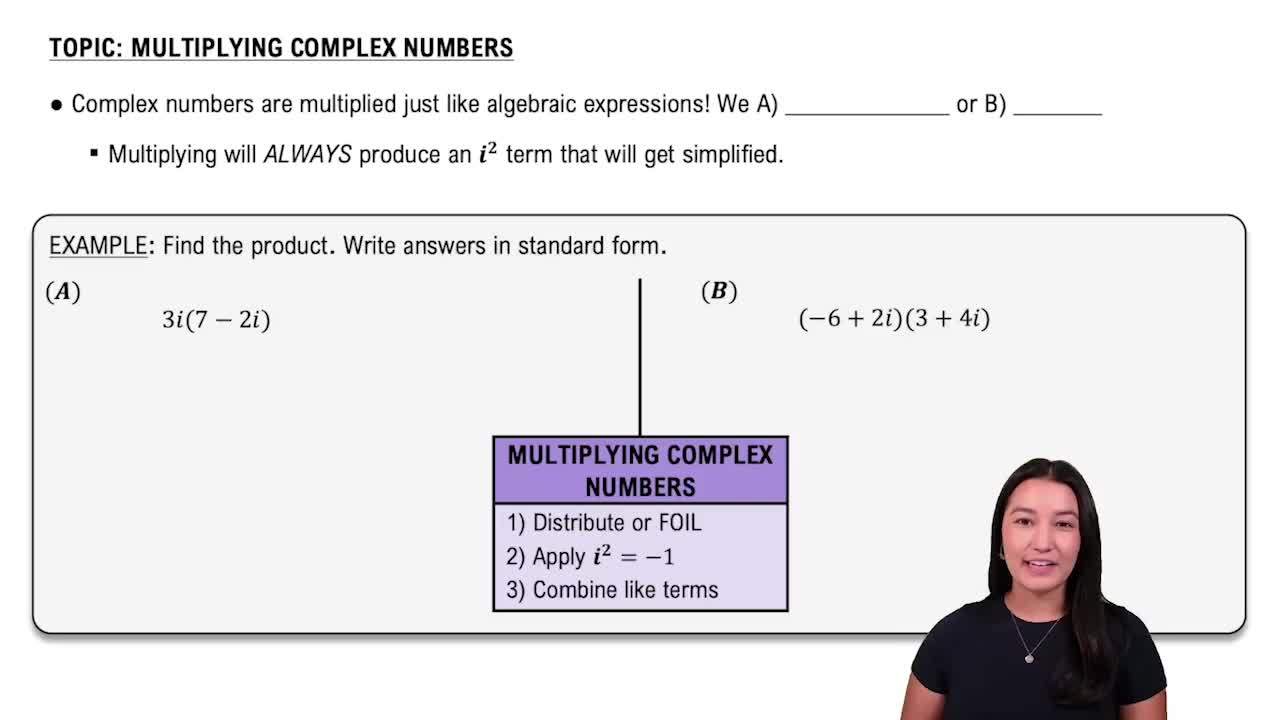
Multiplying Complex Numbers
Watch next
Master Square Roots of Negative Numbers with a bite sized video explanation from Patrick
Start learningRelated Videos
Related Practice
Textbook Question
706
views