Ch. 5 - Systems and Matrices
Lial - College Algebra 13th Edition
Lial13th EditionCollege AlgebraISBN: 9780136881063Not the one you use?Change textbook
Chapter 6, Problem 8

Use the substitution or elimination method to solve each system of equations. Identify any inconsistent systems or systems with infinitely many solutions. If a system has infinitely many solutions, write the solution set with y arbitrary.
6x + 10y = -11
9x + 6y = -3

Verified step by step guidance
1
First, write down the system of equations clearly: \[6x + 10y = -11\] \[9x + 6y = -3\]
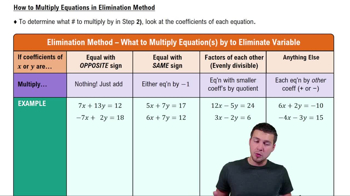
Choose a method to solve the system. Here, we will use the elimination method. The goal is to eliminate one variable by making the coefficients of either \(x\) or \(y\) the same (or opposites) in both equations.
To eliminate \(x\), find the least common multiple (LCM) of the coefficients of \(x\) in both equations, which are 6 and 9. The LCM is 18. Multiply the first equation by 3 and the second equation by -2 to get: \[3(6x + 10y) = 3(-11) \Rightarrow 18x + 30y = -33\] \[-2(9x + 6y) = -2(-3) \Rightarrow -18x - 12y = 6\]
Add the two new equations to eliminate \(x\): \[(18x + 30y) + (-18x - 12y) = -33 + 6\] This simplifies to: \[18x - 18x + 30y - 12y = -27\] \[0x + 18y = -27\] So, you get: \[18y = -27\]
Solve for \(y\) by dividing both sides by 18: \[y = \frac{-27}{18}\] Once you have \(y\), substitute this value back into one of the original equations to solve for \(x\). This will give you the solution to the system. If you find a contradiction or a true statement for all values, you can identify if the system is inconsistent or has infinitely many solutions.

Verified video answer for a similar problem:

This video solution was recommended by our tutors as helpful for the problem above.
Video duration:
6m
Was this helpful?

Key Concepts

Here are the essential concepts you must grasp in order to answer the question correctly.

Substitution and Elimination Methods

These are algebraic techniques used to solve systems of linear equations. Substitution involves solving one equation for a variable and substituting it into the other, while elimination involves adding or subtracting equations to eliminate a variable, simplifying the system to one equation with one variable.
Recommended video:
Guided course
6:04
How to Multiply Equations in Elimination Method

Types of Solutions for Systems of Equations

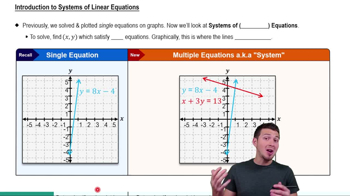
A system can have a unique solution (one point), infinitely many solutions (all points on a line), or no solution (parallel lines). Identifying the type depends on the relationships between the equations, such as whether they are multiples of each other or contradictory.
Recommended video:
Guided course
4:27
Introduction to Systems of Linear Equations

Expressing Solutions with Parameters

When a system has infinitely many solutions, the solution set is expressed using a parameter (like y arbitrary) to represent all possible solutions. This involves rewriting one variable in terms of the other, showing the dependency between variables.
Recommended video:
Guided course
05:09
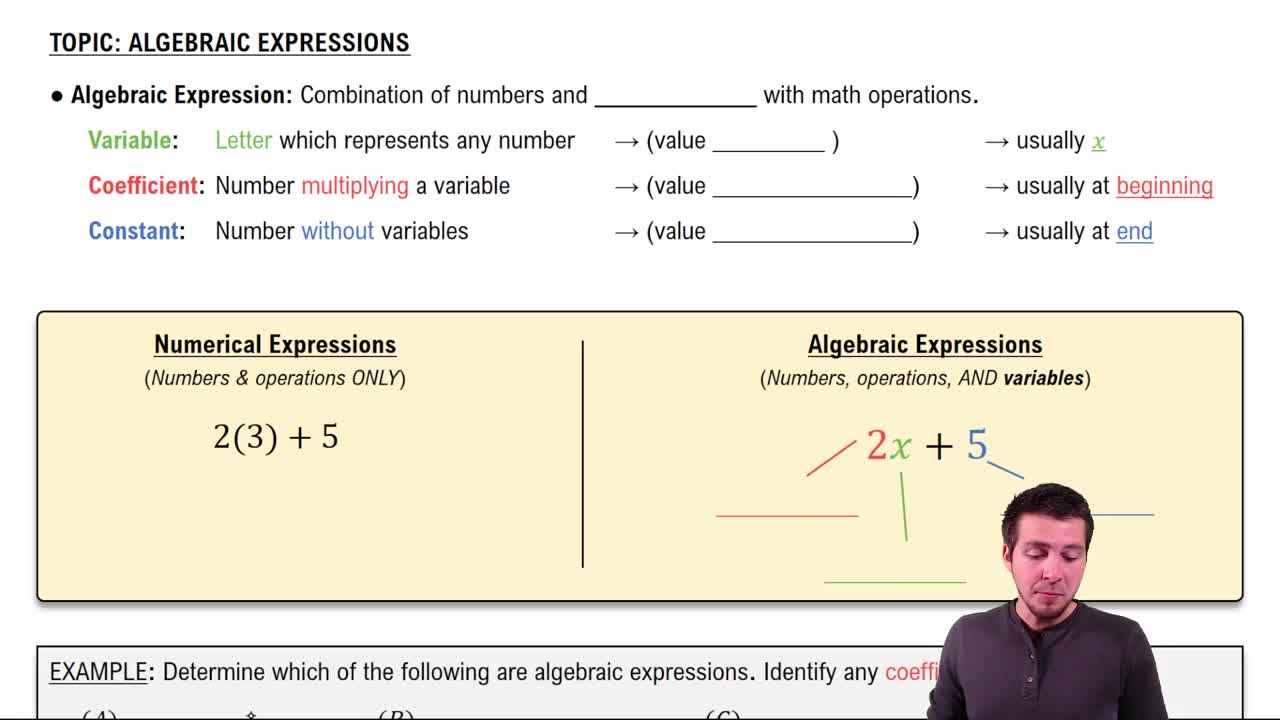
Introduction to Algebraic Expressions