Ch. 6 - Matrices and Determinants
Blitzer - College Algebra 8th Edition
Blitzer8th EditionCollege AlgebraISBN: 9780136970514Not the one you use?Change textbook
Chapter 7, Problem 46

In Exercises 46–51, evaluate each determinant.

Verified step by step guidance
1
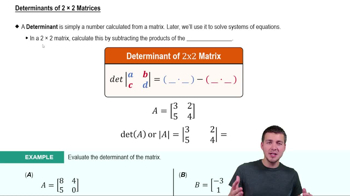
Step 1: Understand the structure of the determinant. A determinant is a scalar value that can be computed from the elements of a square matrix. For a 2x2 matrix, the determinant is calculated using the formula: det(A) = a*d - b*c, where the matrix is [[a, b], [c, d]]. For larger matrices, such as 3x3, the determinant is calculated using cofactor expansion.
Step 2: Identify the size of the matrix provided in the problem. If it is a 2x2 matrix, use the formula det(A) = a*d - b*c. If it is a 3x3 matrix, use cofactor expansion along a row or column. For example, for a 3x3 matrix [[a, b, c], [d, e, f], [g, h, i]], the determinant is calculated as: det(A) = a(ei - fh) - b(di - fg) + c(dh - eg).
Step 3: Substitute the values from the matrix into the appropriate determinant formula. For a 2x2 matrix, substitute the values of a, b, c, and d. For a 3x3 matrix, substitute the values of a, b, c, d, e, f, g, h, and i into the cofactor expansion formula.
Step 4: Simplify the expressions by performing the necessary multiplications and subtractions. For a 2x2 matrix, calculate the product of a*d and b*c, then subtract the second product from the first. For a 3x3 matrix, calculate each minor determinant (e.g., ei - fh, di - fg, dh - eg) and combine them with the appropriate signs.
Step 5: Verify your work by double-checking the calculations for accuracy. Ensure that all substitutions and arithmetic operations are correct. If the determinant is zero, it indicates that the matrix is singular (non-invertible).

Verified video answer for a similar problem:

This video solution was recommended by our tutors as helpful for the problem above.
Video duration:
1m
Was this helpful?

Key Concepts

Here are the essential concepts you must grasp in order to answer the question correctly.

Determinants

A determinant is a scalar value that can be computed from the elements of a square matrix. It provides important information about the matrix, such as whether it is invertible and the volume scaling factor of the linear transformation represented by the matrix. The determinant can be calculated using various methods, including row reduction, cofactor expansion, or specific formulas for small matrices.
Recommended video:
Guided course
4:36
Determinants of 2×2 Matrices

Square Matrices

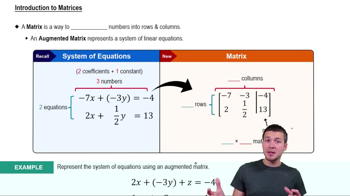
A square matrix is a matrix with the same number of rows and columns, denoted as n x n. Determinants are only defined for square matrices, as they represent linear transformations in n-dimensional space. Understanding the properties of square matrices, such as their rank and eigenvalues, is essential for evaluating determinants and interpreting their significance.
Recommended video:
Guided course
4:35
Introduction to Matrices

Cofactor Expansion

Cofactor expansion is a method used to calculate the determinant of a matrix by breaking it down into smaller matrices. This technique involves selecting a row or column, multiplying each element by its corresponding cofactor (which is the determinant of the submatrix formed by removing the row and column of that element), and summing these products. This method is particularly useful for larger matrices and helps in understanding the recursive nature of determinants.