In Exercises 59–94, solve each absolute value inequality. |x| > 3
Verified step by step guidance
1
Recall the definition of absolute value inequalities: For an inequality of the form \(|x| > a\), where \(a\) is a positive number, the solution consists of values of \(x\) whose distance from zero is greater than \(a\).
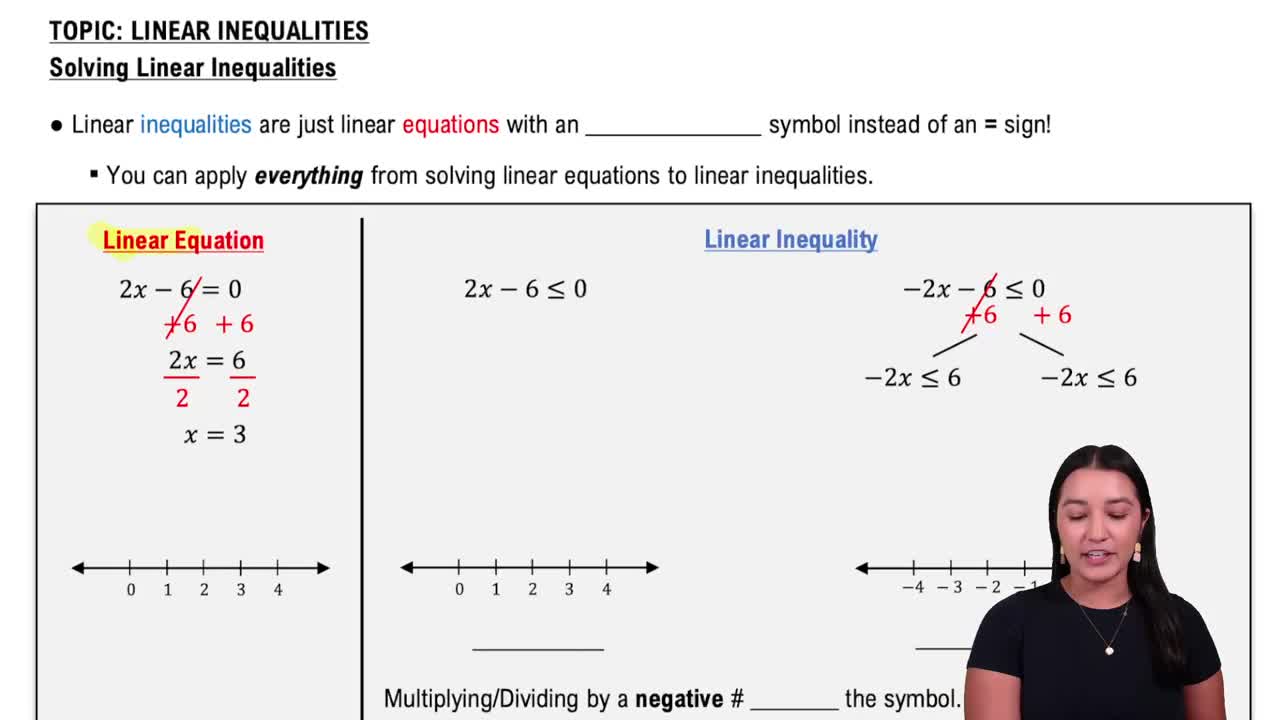
Rewrite the inequality \(|x| > 3\) as two separate inequalities: \(x > 3\) or \(x < -3\). This is because the absolute value being greater than 3 means \(x\) is either greater than 3 or less than -3.
Express the solution set as the union of the two intervals: \(x \in (-\infty, -3)\) or \(x \in (3, \infty)\).
If needed, represent the solution on a number line by shading the regions to the left of -3 and to the right of 3, excluding the points -3 and 3 themselves since the inequality is strict (greater than, not greater than or equal to).
Summarize the solution in interval notation as \((-\infty, -3) \cup (3, \infty)\).
Verified video answer for a similar problem:
This video solution was recommended by our tutors as helpful for the problem above
Video duration:
2m
Play a video:
Was this helpful?
Key Concepts
Here are the essential concepts you must grasp in order to answer the question correctly.
Absolute Value Definition
The absolute value of a number represents its distance from zero on the number line, always expressed as a non-negative value. For any real number x, |x| equals x if x is positive or zero, and -x if x is negative. Understanding this helps interpret inequalities involving absolute values.
Inequalities involving absolute values can be split into two cases based on the definition of absolute value. For |x| > a (where a > 0), the solution is x < -a or x > a, representing values whose distance from zero exceeds a. Recognizing this split is essential for solving such inequalities.
Visualizing absolute value inequalities on a number line aids in understanding solution sets. For |x| > 3, the solution includes all points more than 3 units away from zero, which corresponds to two intervals: less than -3 and greater than 3. This graphical approach clarifies the inequality's meaning.