In Exercises 1–18, solve each system by the substitution method.
Table of contents
- 0. Review of Algebra4h 18m
- 1. Equations & Inequalities3h 18m
- 2. Graphs of Equations1h 43m
- 3. Functions2h 17m
- 4. Polynomial Functions1h 44m
- 5. Rational Functions1h 23m
- 6. Exponential & Logarithmic Functions2h 28m
- 7. Systems of Equations & Matrices4h 5m
- 8. Conic Sections2h 23m
- 9. Sequences, Series, & Induction1h 22m
- 10. Combinatorics & Probability1h 45m
7. Systems of Equations & Matrices
Two Variable Systems of Linear Equations
Problem 27
Textbook Question
In Exercises 25–35, solve each system by the method of your choice. This is a piecewise function, refer to textbook problem.
Verified step by step guidance1
This problem refers to solving a system of equations involving a piecewise function. A piecewise function is defined by different expressions depending on the value of the input variable. Begin by carefully analyzing the piecewise function provided in the textbook to understand its structure and the intervals for which each expression applies.
Identify the system of equations that needs to be solved. If the system involves the piecewise function, determine which piece of the function applies to the given conditions or intervals. This will help you decide which equation to use for solving the system.
Choose a method to solve the system of equations. Common methods include substitution, elimination, or graphing. If substitution is chosen, solve one equation for one variable and substitute it into the other equation. If elimination is chosen, manipulate the equations to eliminate one variable by adding or subtracting them.
Solve for the first variable using the chosen method. Once you have the value of the first variable, substitute it back into one of the original equations to solve for the second variable. Be mindful of the intervals defined by the piecewise function to ensure the solution is valid.
Verify your solution by substituting the values of the variables back into the original system of equations, including the piecewise function. Ensure that the solution satisfies all equations and adheres to the conditions of the piecewise function.
Verified video answer for a similar problem:This video solution was recommended by our tutors as helpful for the problem above
Video duration:
5mPlay a video:
Was this helpful?
Key Concepts
Here are the essential concepts you must grasp in order to answer the question correctly.
Piecewise Functions
A piecewise function is defined by multiple sub-functions, each applying to a specific interval of the domain. Understanding how to interpret and evaluate these functions is crucial, as the output depends on the input's range. For example, a function might be defined as f(x) = x^2 for x < 0 and f(x) = 2x + 1 for x ≥ 0, requiring careful consideration of the input value.
Recommended video:
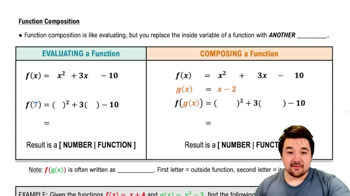
Function Composition
Systems of Equations
A system of equations consists of two or more equations that share common variables. Solving these systems involves finding the values of the variables that satisfy all equations simultaneously. Methods such as substitution, elimination, or graphical representation can be employed, and understanding these techniques is essential for finding solutions in various contexts, including piecewise functions.
Recommended video:
Guided course
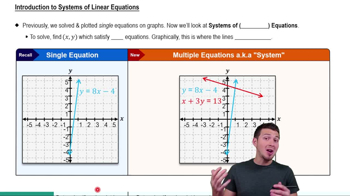
Introduction to Systems of Linear Equations
Methods of Solving
There are several methods for solving systems of equations, including graphing, substitution, and elimination. Each method has its advantages depending on the complexity of the equations and the context. For instance, graphing provides a visual representation, while substitution allows for direct calculation of variable values. Familiarity with these methods is vital for effectively tackling problems involving piecewise functions.
Recommended video:
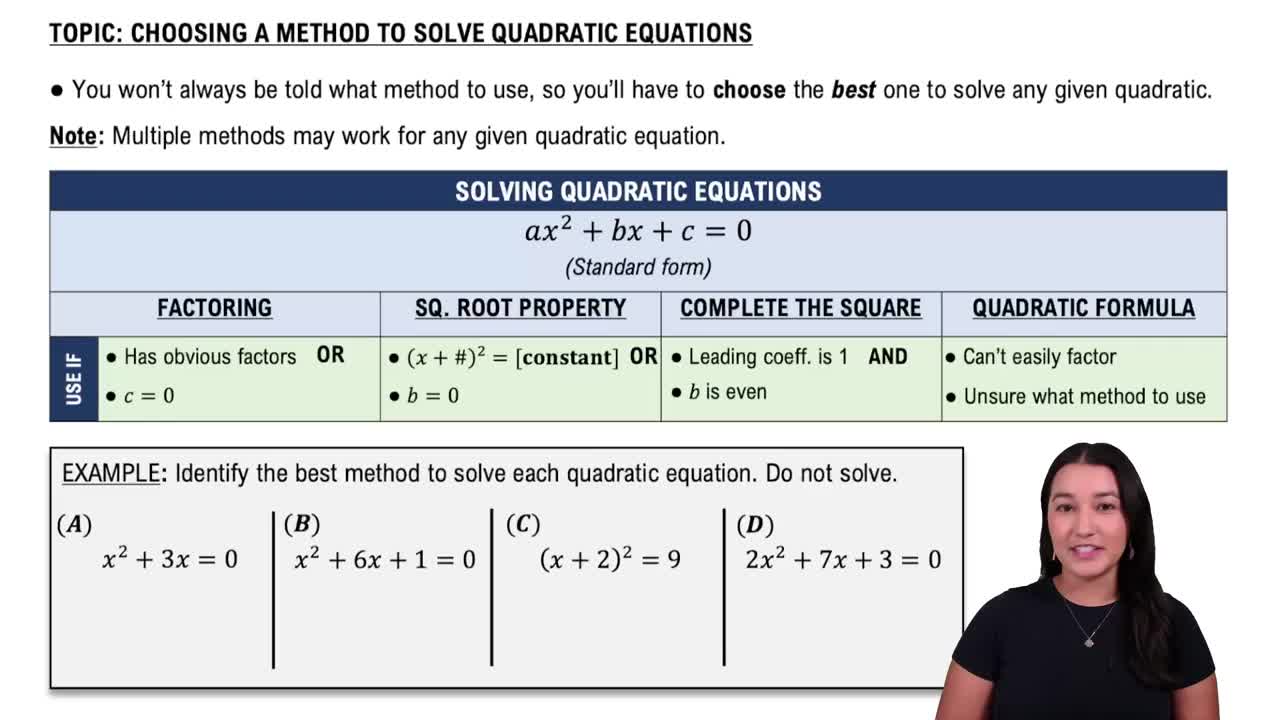
Choosing a Method to Solve Quadratics
Watch next
Master Introduction to Systems of Linear Equations with a bite sized video explanation from Patrick
Start learningRelated Videos
Related Practice
Textbook Question
462
views