Recognize that the expression \( \sqrt[7]{y^7} \) is asking for the seventh root of \( y^7 \).
Recall the property of radicals and exponents: \( \sqrt[n]{a^n} = a \) when \( n \) is a positive integer.
Apply this property to the expression: \( \sqrt[7]{y^7} = y \).
Understand that this simplification works because raising a number to a power and then taking the root of the same degree cancels each other out.
Conclude that the root of \( y^7 \) is simply \( y \).
Verified video answer for a similar problem:
This video solution was recommended by our tutors as helpful for the problem above
Video duration:
1m
Play a video:
Was this helpful?
Key Concepts
Here are the essential concepts you must grasp in order to answer the question correctly.
Radical Expressions
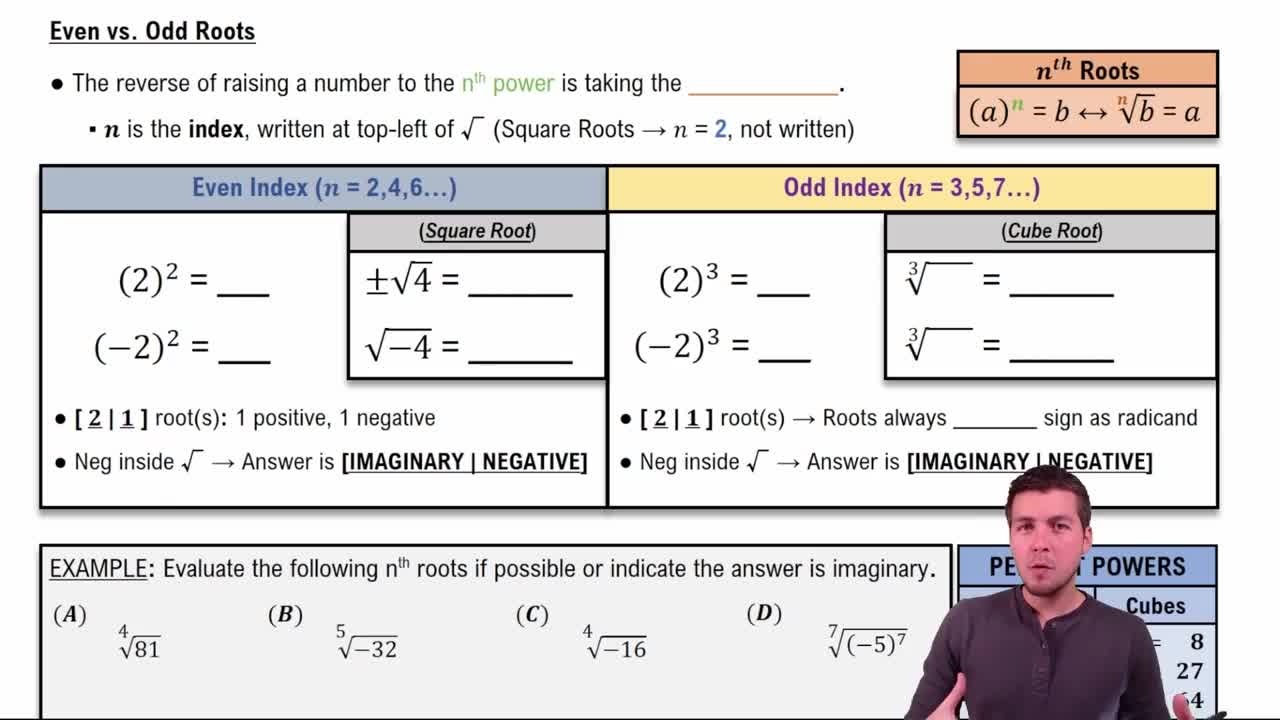
Radical expressions involve roots, such as square roots or cube roots, represented by the radical symbol (√). The expression ⁷√y⁷ indicates the seventh root of y raised to the seventh power. Understanding how to manipulate and simplify radical expressions is essential for solving problems involving roots.
The properties of exponents govern how to simplify expressions involving powers. One key property states that when taking the nth root of a number raised to the nth power, the result is the base itself (e.g., ⁷√y⁷ = y). Familiarity with these properties allows for efficient simplification of expressions involving roots and powers.
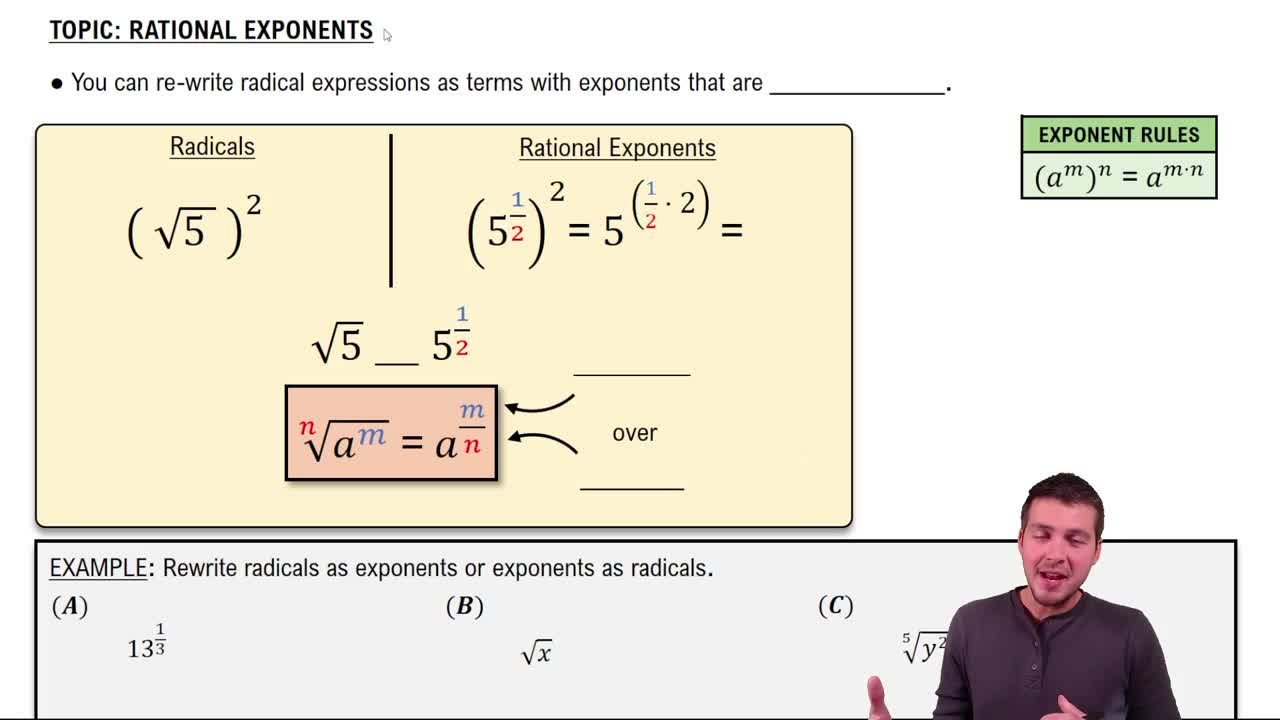
The relationship between roots and powers is fundamental in algebra. Specifically, the nth root of a number can be expressed as raising that number to the power of 1/n. This concept is crucial for understanding how to convert between radical and exponential forms, facilitating easier manipulation of algebraic expressions.