In Exercises 33–44, add or subtract terms whenever possible. √50x−√8x
Verified step by step guidance
1
Step 1: Identify the terms under the square roots: \( \sqrt{50x} \) and \( \sqrt{8x} \).
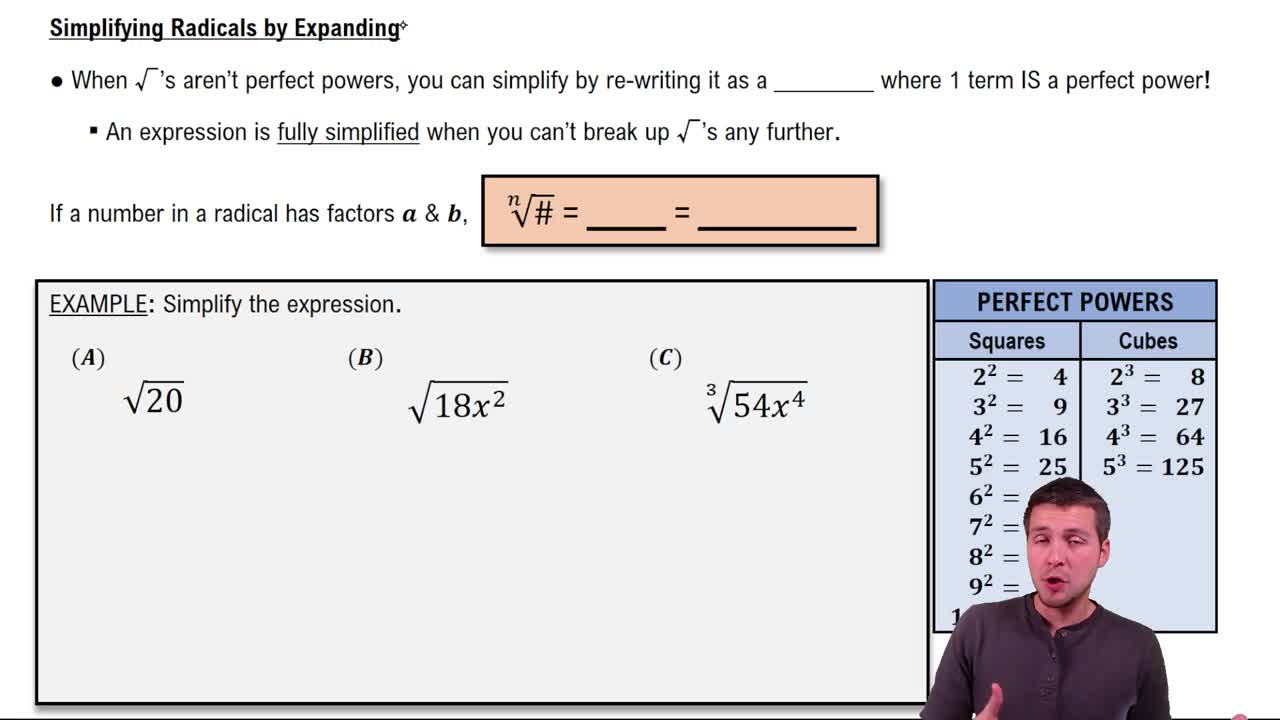
Step 2: Simplify each square root by factoring out perfect squares. For \( \sqrt{50x} \), notice that 50 can be factored as 25 * 2, so \( \sqrt{50x} = \sqrt{25 \cdot 2x} = \sqrt{25} \cdot \sqrt{2x} = 5\sqrt{2x} \).
Step 3: Similarly, simplify \( \sqrt{8x} \). Notice that 8 can be factored as 4 * 2, so \( \sqrt{8x} = \sqrt{4 \cdot 2x} = \sqrt{4} \cdot \sqrt{2x} = 2\sqrt{2x} \).
Step 4: Now that both terms are simplified, you have \( 5\sqrt{2x} - 2\sqrt{2x} \).
Step 5: Combine like terms by subtracting the coefficients of \( \sqrt{2x} \): \( (5 - 2)\sqrt{2x} = 3\sqrt{2x} \).
Verified video answer for a similar problem:
This video solution was recommended by our tutors as helpful for the problem above
Video duration:
3m
Play a video:
Was this helpful?
Key Concepts
Here are the essential concepts you must grasp in order to answer the question correctly.
Radical Simplification
Radical simplification involves reducing square roots to their simplest form. For example, √50 can be simplified to √(25*2) = 5√2. This process is essential for combining like terms in expressions involving square roots.
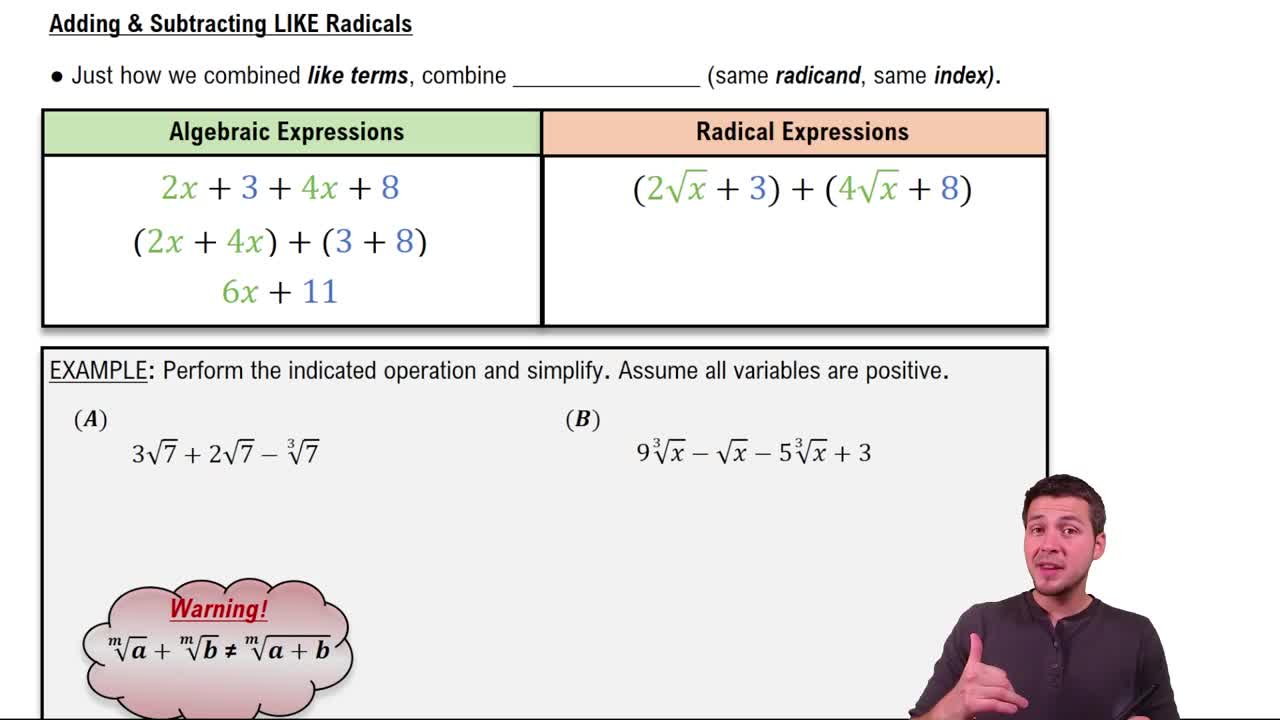
Like terms are terms that have the same variable raised to the same power. In the expression √50x and √8x, both terms contain the variable x under a square root, allowing them to be combined after simplification. Recognizing like terms is crucial for performing addition or subtraction.
Combining radicals involves adding or subtracting simplified radical expressions that are like terms. After simplifying √50x to 5√2x and √8x to 2√2x, you can combine them to get (5√2x - 2√2x) = 3√2x. This step is key to solving the problem correctly.