Given that log10 2 ≈ 0.3010 and log10 3 ≈ 0.4771, find each logarithm without using a calculator. log10 √30
Table of contents
- 0. Review of Algebra4h 18m
- 1. Equations & Inequalities3h 18m
- 2. Graphs of Equations1h 43m
- 3. Functions2h 17m
- 4. Polynomial Functions1h 44m
- 5. Rational Functions1h 23m
- 6. Exponential & Logarithmic Functions2h 28m
- 7. Systems of Equations & Matrices4h 5m
- 8. Conic Sections2h 23m
- 9. Sequences, Series, & Induction1h 22m
- 10. Combinatorics & Probability1h 45m
6. Exponential & Logarithmic Functions
Introduction to Logarithms
Problem 103
Textbook Question
In Exercises 101–104, write each equation in its equivalent exponential form. Then solve for x. log4x=-3
Verified step by step guidance1
Recall the definition of logarithm: if \( \log_b a = c \), then the equivalent exponential form is \( b^c = a \).
Apply this definition to the given equation \( \log_4 x = -3 \). Rewrite it as \( 4^{-3} = x \).
Express \( 4^{-3} \) as a fraction with a positive exponent: \( 4^{-3} = \frac{1}{4^3} \).
Calculate \( 4^3 \) by multiplying 4 by itself three times: \( 4 \times 4 \times 4 \).
Write the final expression for \( x \) as \( x = \frac{1}{4^3} \), which is the solution in exponential form.
Verified video answer for a similar problem:This video solution was recommended by our tutors as helpful for the problem above
Video duration:
1mPlay a video:
Was this helpful?
Key Concepts
Here are the essential concepts you must grasp in order to answer the question correctly.
Definition of Logarithms
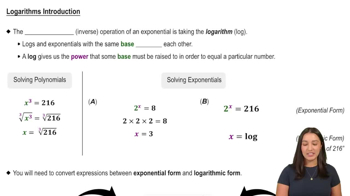
A logarithm answers the question: to what exponent must the base be raised to produce a given number? For example, log_b(a) = c means b^c = a. Understanding this definition is essential to convert between logarithmic and exponential forms.
Recommended video:
Logarithms Introduction
Converting Logarithmic Equations to Exponential Form
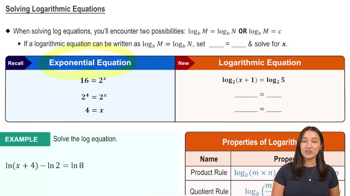
To rewrite a logarithmic equation like log_b(x) = y in exponential form, express it as b^y = x. This conversion simplifies solving for the variable by changing the equation into a more straightforward exponential expression.
Recommended video:
Solving Logarithmic Equations
Solving Exponential Equations
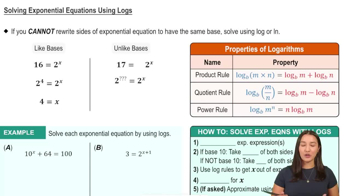
Once the equation is in exponential form, solving for the variable involves evaluating powers or roots. For example, if 4^{-3} = x, calculate 4^{-3} by using the negative exponent rule, which means 1 divided by 4^3.
Recommended video:
Solving Exponential Equations Using Logs
Watch next
Master Logarithms Introduction with a bite sized video explanation from Patrick
Start learningRelated Videos
Related Practice
Textbook Question
817
views